Operation Amistad: India Deploys Emergency Relief to Earthquake-Ravaged Venezuela
By International Desk
Updated: June 27, 2026
In a massive humanitarian response to the catastrophic seismic events that have devastated the Bolivarian Republic of Venezuela, the Indian government has launched "Operation Amistad." This mission, characterized by rapid deployment and technical precision, aims to provide critical medical and structural support to a nation reeling from the most powerful tremors to hit the region in over a century.
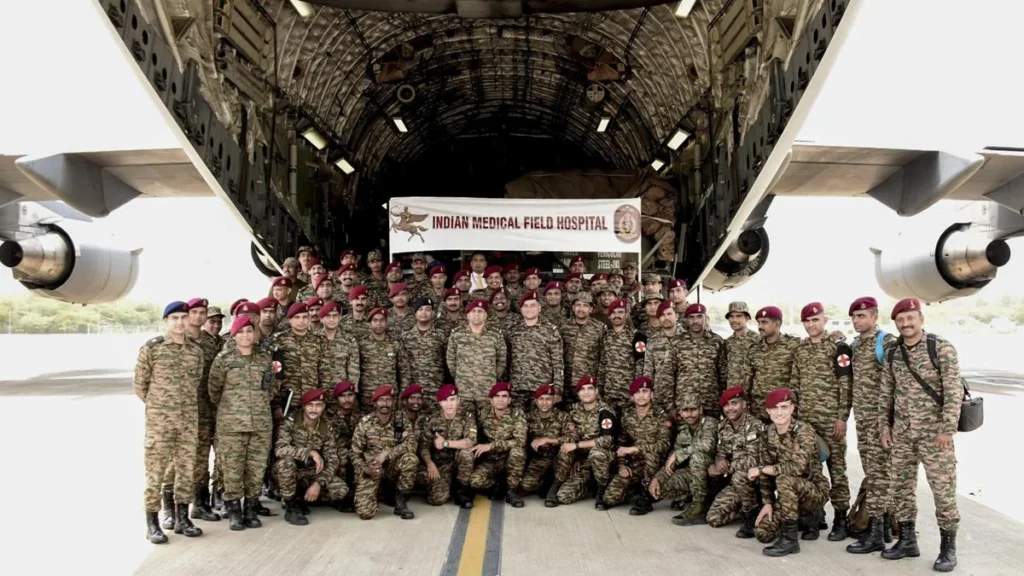
As of the morning of June 26, 2026, two Indian Air Force (IAF) C-17 Globemaster transport aircraft took flight, laden with essential medical infrastructure and a specialized response team, marking the beginning of a robust relief effort designed to stabilize the healthcare landscape in the affected Venezuelan provinces.
The Scope of the Crisis: A Nation in Shock
The crisis began on Wednesday evening, June 24, 2026, when a pair of massive earthquakes—measuring 7.2 and 7.5 on the Richter scale—struck the South American nation. The seismic activity, which sent shockwaves across the region, resulted in structural collapse on a massive scale, trapping thousands under debris and overwhelming local healthcare facilities.
According to the latest figures provided by acting President Delcy Rodríguez, the death toll has climbed to 920, with at least 3,360 individuals sustaining injuries. These numbers are widely expected to rise as search and rescue teams navigate the rubble of what was once thriving infrastructure. The scale of the destruction has prompted a global outcry, with India emerging as a key first responder in the international effort.
Operation Amistad: Strategic Deployment
The Indian government’s intervention, dubbed "Operation Amistad" (Spanish for "friendship"), is a testament to the country’s growing capability as a "first responder" in global disaster scenarios. The mission involves a multifaceted approach to disaster relief:
- The 60 Para Field Hospital: Central to the operation is a 41-member specialized team drawn from the Indian Army’s 60 Para Field Hospital. This elite unit, which includes nine senior medical officers, is renowned for its experience in high-pressure medical environments.
- Logistical Payload: The two C-17 Globemasters are transporting over 35 tons of relief materials. This includes six tons of life-saving medicines and specialized medical equipment.
- BHISHM Cubes: A highlight of the aid package is the inclusion of two "BHISHM" (Bharat Health Initiative for Sahyog Hita and Maitri) portable hospitals. These modular, rapid-deployment units can be set up in minutes, providing surgical and diagnostic capabilities that are currently missing in the disaster-struck zones of Venezuela.
External Affairs Minister S. Jaishankar, in a statement released via social media, reaffirmed India’s commitment, noting that the country stands "shoulder to shoulder" with the government and the people of Venezuela during this unprecedented period of grief and destruction.

Chronology of the Disaster and Response
The timeline of the tragedy highlights the urgency with which both local and international authorities have acted:
Wednesday, June 24, 2026:
- The Initial Strikes: At approximately dusk, back-to-back earthquakes of magnitude 7.2 and 7.5 strike.
- Immediate Impact: Widespread power outages and communication blackouts occur. Local emergency services are immediately overwhelmed by the volume of trauma cases.
Thursday, June 25, 2026:
- Assessment Phase: Venezuelan authorities struggle to assess the extent of the damage. Reports begin to surface of entire residential blocks reduced to rubble.
- International Outreach: The Venezuelan government formally requests international humanitarian aid, prompting an immediate response from India’s Ministry of External Affairs (MEA).
Friday, June 26, 2026:
- Departure of Relief: The IAF C-17 aircraft depart from India, carrying the 41-member medical task force and the first shipment of 35 tons of aid.
- Official Update: Acting President Delcy Rodríguez confirms the death toll has hit 920, warning that the number of missing persons remains in the thousands.
Saturday, June 27, 2026:
- Operational Integration: The Indian medical task force arrives in the theater of operations, coordinating with local officials to establish the Field Hospital and commence triage operations for the injured.
Official Responses and Diplomatic Solidarity
The Indian Ministry of External Affairs (MEA) emphasized that the aid is not merely a material contribution but a statement of solidarity. In its formal release, the MEA noted: "The government of India extends its heartfelt condolences to the families who have lost their loved ones and wishes a speedy recovery to those injured. India will remain in close coordination with the government of Venezuela and stands ready to provide further assistance as may be required."
The "Operation Amistad" mission is designed to be self-reliant. The medical task force is equipped to operate independently, ensuring that they do not place an additional burden on the already strained Venezuelan logistics network. By deploying the BHISHM cubes, India is effectively providing a "hospital in a box" that can manage everything from routine trauma care to complex orthopedic surgeries required for crush injuries sustained during building collapses.

Implications for International Disaster Management
The speed of the Indian response underscores a strategic shift in New Delhi’s foreign policy. India has increasingly positioned itself as a "Net Security Provider" and a reliable partner in the Global South. By deploying the 60 Para Field Hospital—a unit that has seen service in various international crises—India is signaling that it possesses the logistical reach to project its soft power across oceans to assist nations in need.
The Role of Technology in Relief
The use of BHISHM cubes is particularly significant. These units, which were specifically designed to bridge the gap between initial rescue and permanent medical infrastructure, have become a cornerstone of India’s HADR (Humanitarian Assistance and Disaster Relief) policy. Their deployment in Venezuela marks a major international test for this indigenous technology.
Regional Stability and Humanitarian Logistics
Venezuela, already grappling with internal economic and political volatility, now faces the challenge of managing a humanitarian crisis that threatens to destabilize the region further. The influx of international aid, led by countries like India, is seen as critical to preventing a secondary health crisis—such as the outbreak of waterborne diseases or the collapse of sanitation systems—that often follows such massive earthquakes.
The Road Ahead: Challenges in Reconstruction
While the immediate focus remains on life-saving operations, the path to recovery for Venezuela will be long. Experts suggest that the destruction of critical infrastructure will hinder the distribution of food, water, and electricity for weeks, if not months.
The 41-member Indian team, working in coordination with local Venezuelan authorities, is currently identifying "hot zones" where the need for surgical intervention is most acute. The success of this mission will depend on the ability of international teams to integrate with local emergency responders, who are currently suffering from their own losses while attempting to perform search and rescue duties.
As "Operation Amistad" gains momentum, the world watches to see how this international coalition will handle the rescue and stabilization efforts. For the people of Venezuela, the arrival of the Indian Air Force aircraft represents a vital lifeline in their darkest hour—a symbol of international cooperation in the face of nature’s most destructive forces.
India’s proactive stance in this crisis serves as a reminder that in an interconnected world, the tragedy of one nation is the responsibility of all. As the relief operations continue, the focus will remain on saving the missing, treating the injured, and eventually beginning the daunting task of rebuilding the shattered landscape of the South American nation.