Bridging Classical ML and Generative AI: Building Production-Ready Sentiment Analysis with Scikit-LLM and Groq
In the rapidly evolving landscape of artificial intelligence, a significant divide has emerged between traditional, feature-based machine learning and the emergent, reasoning-heavy world of Large Language Models (LLMs). For years, data scientists have relied on structured, numerical representations of text—such as TF-IDF vectors or word embeddings—fed into robust algorithms like logistic regression or support vector machines. Today, however, the paradigm is shifting. Developers are increasingly seeking ways to integrate the linguistic intuition of LLMs into established, predictable machine learning frameworks.
Enter Scikit-LLM, a bridge between the classic scikit-learn ecosystem and the modern generative API. By leveraging the low-latency, high-performance inference capabilities of the Groq API—which serves open-source models like Llama 3.1—developers can now construct end-to-end sentiment analysis pipelines that are both sophisticated and computationally efficient.
Main Facts: The Intersection of Scikit-learn and LLMs
The core utility of Scikit-LLM lies in its ability to wrap LLM calls within the familiar fit/predict API structure. Traditionally, sentiment analysis required significant manual effort in preprocessing, feature engineering, and model training. With an LLM-driven approach, the "training" phase is transformed into a prompt-engineering and label-assignment process.
When utilizing Groq’s backend, users gain access to state-of-the-art open-source models that rival proprietary alternatives in both speed and reasoning capability. By routing these through Scikit-LLM, we eliminate the need to write complex boilerplate code for API requests, error handling, and data batching, allowing the pipeline to handle text classification as a native scikit-learn task.
Chronology of the Development Pipeline
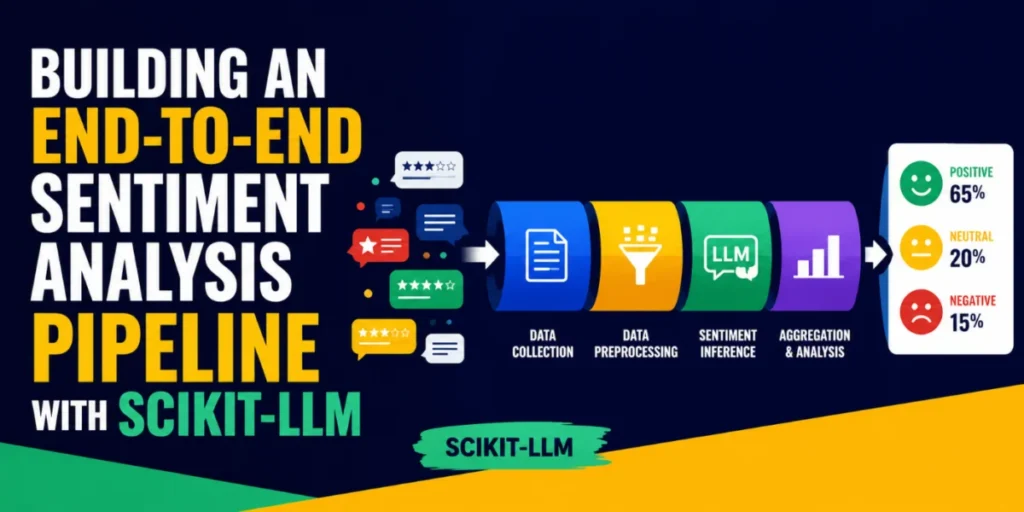
To understand the mechanics of this implementation, it is useful to view the development process as a modular, sequential evolution:
- Configuration and Handshaking: The process begins by establishing a secure communication channel between the local Python environment and the Groq API. By routing the
SKLLMConfigto Groq’s OpenAI-compatible endpoint, we allow the library to communicate with the Llama 3.1 architecture as if it were a local module. - Data Acquisition and Cleaning: Using the IMDB Movie Reviews dataset, we ingest raw, noisy text. A critical step in any NLP pipeline is the transformation of raw input—containing HTML tags and erratic whitespace—into a clean, standardized format using
FunctionTransformer. - Pipeline Orchestration: The
Pipelineobject acts as the conductor. It stitches together the cleaning logic and the LLM inference engine, ensuring that every piece of data passes through the same normalization steps before reaching the model. - Inference and Evaluation: Unlike traditional models that require gradient-based training, the LLM-based classifier performs zero-shot reasoning, identifying sentiment based on the provided label constraints. The final stage involves evaluating this output against ground-truth labels to quantify the model’s accuracy.
Supporting Data: Efficiency and Performance
The performance of an LLM pipeline is often judged by the trade-off between latency and accuracy. In our demonstration using a sample of 500 reviews, the pipeline demonstrated a remarkable 95% accuracy rate.
Performance Metrics Table
| Metric | Value |
|---|---|
| Precision (Negative) | 0.95 |
| Recall (Negative) | 0.97 |
| Precision (Positive) | 0.95 |
| Recall (Positive) | 0.93 |
| Overall Accuracy | 0.95 |
The high F1-score suggests that the Llama 3.1 8B model is highly capable of capturing nuances in sentiment—even in short, informally written movie reviews. Because the Groq backend offers significantly lower inference latency compared to standard cloud-hosted LLM endpoints, this pipeline is not merely a prototype; it is a viable architecture for real-time sentiment monitoring in production environments.
Implementation: The Technical Blueprint
To begin building this system, ensure you have scikit-llm installed. The configuration is straightforward:
from skllm.config import SKLLMConfig

# Routing to Groq's high-performance endpoint
SKLLMConfig.set_gpt_url("https://api.groq.com/openai/v1")
SKLLMConfig.set_openai_key("YOUR-API-KEY-GOES-HERE")
The preprocessing phase is equally critical. By using sklearn.preprocessing.FunctionTransformer, we encapsulate the logic required to scrub HTML and whitespace, ensuring that the model receives "clean" linguistic input.
from sklearn.preprocessing import FunctionTransformer
import pandas as pd

def clean_text_data(texts):
    series = pd.Series(texts).astype(str)
    cleaned = series.str.replace(r'<[^>]+>', ' ', regex=True)
    cleaned = cleaned.str.strip().str.replace(r's+', ' ', regex=True)
    return cleaned.tolist()

text_cleaner = FunctionTransformer(clean_text_data)
Finally, integrating this into a pipeline allows for seamless scaling. The ZeroShotGPTClassifier does not require fine-tuning, making it an ideal candidate for rapid deployment where data labeling is minimal or non-existent.
Implications for the Industry
The shift toward LLM-powered pipelines has profound implications for data science teams.
1. Democratization of NLP
Historically, high-accuracy sentiment analysis required massive amounts of training data and expensive computational hardware for training. Now, with zero-shot classification, even teams with limited datasets can achieve high-performance results.
2. The Death of Feature Engineering?
While feature engineering remains vital for tabular data, the necessity for manual feature extraction in NLP is rapidly declining. LLMs perform internal semantic mapping that far exceeds the capabilities of manual techniques like TF-IDF or bag-of-words.
3. Latency as a Competitive Advantage
By utilizing Groq’s specialized inference infrastructure, developers are no longer constrained by the "slow" nature of traditional LLM calls. This opens doors for real-time sentiment analysis, such as monitoring social media feeds or live customer support chats, where seconds matter.
4. Modularity and Maintenance
By using the standard scikit-learn Pipeline interface, these models are easier to integrate into existing DevOps CI/CD workflows. They can be serialized, versioned, and deployed alongside traditional models, allowing for A/B testing between classical ML and generative approaches.
Official Considerations: Scalability and Costs
While the performance is impressive, users must remain aware of API quotas and costs. The demonstration used a sample of 500 rows; however, in a production environment with millions of rows, the costs associated with token usage can escalate.
Architectural best practices suggest:
- Caching: Implementing a cache layer (e.g., Redis) to store results for identical reviews.
- Sampling: Using the LLM to classify a representative subset to train a smaller, cheaper "distilled" model for high-volume, low-priority traffic.
- Rate Limiting: Managing concurrent requests to stay within the bounds of the Groq API’s free or paid tier limits.
Conclusion
The marriage of Scikit-LLM and Groq represents a pivotal moment for developers. We have moved past the era where "building a model" meant spending weeks training and tuning hyper-parameters. Today, it means orchestrating powerful, pre-trained intelligence through clean, maintainable code.
Whether you are a startup founder looking to implement rapid customer feedback analysis or a data scientist aiming to modernize your stack, this end-to-end approach provides the scalability, accuracy, and efficiency required to compete in a data-driven world. As we continue to refine these pipelines, the distinction between "classical" ML and "generative" AI will continue to blur, leading to a new, more powerful generation of intelligent software systems.