Bridging the AI Skills Gap: How the First "AI Leaders" Cohort is Reshaping Open Source Workforce Readiness
CHICAGO — On June 23, the landscape of technical education underwent a quiet but profound transformation. In a ceremony held in the heart of Chicago, approximately 40 students from the University of Illinois Chicago (UIC), Louisiana Tech University, and the University of Louisiana at Lafayette were recognized as the inaugural graduates of the AI Leaders Micro-Credential.
This was not merely a graduation; it was the culmination of a high-stakes experiment designed to answer a singular, urgent question: Can open-source learning bridge the widening chasm between theoretical AI literacy and the pragmatic, job-ready skills required by the modern digital economy?
The AI Leaders program, touted as the nation’s first workforce-focused AI literacy course tied to a recognized, verifiable credential, represents a departure from traditional academic models. Rather than relying on simulated environments or abstract coding exercises, these students spent the duration of the program contributing to the very architecture of the open web.
The Genesis of the AI Leaders Program: A Chronology
The journey to this June celebration began long before the first lines of code were written. The program was born out of a realization that the rapid acceleration of generative AI was leaving both academia and the workforce struggling to keep pace.
February 2026: The Formal Announcement
The initiative was officially unveiled in February 2026, setting a bold ambition: to leverage the WordPress ecosystem—which powers over 40% of the web—as a living laboratory for AI development. By rooting the curriculum in open-source software, the program organizers aimed to ensure that students were not just learning about AI, but actively participating in the collaborative, decentralized environment that defines modern enterprise software development.
Spring 2026: The Pilot Phase
Throughout the spring, the inaugural cohort engaged in a rigorous curriculum. Unlike traditional MOOCs (Massive Open Online Courses), which often focus on passive consumption of content, the AI Leaders program required students to produce tangible outcomes. Each participant was tasked with building real-world project portfolios, applying generative AI tools to authentic business problems, and contributing directly to the WordPress open-source software project.
June 23, 2026: The Celebration of Competency
The Chicago gathering marked the official conclusion of the pilot. The event served as a bridge between the classroom and the career, bringing students into direct contact with industry employers and agencies. The recognition of these students was bolstered by a $1,000 stipend for each participant, a financial incentive made possible through a strategic partnership between Automattic and the University of Illinois Chicago.
The Architecture of the Program: Why Open Source?
At the core of the AI Leaders initiative is a foundational philosophy: that AI and open-source expertise should be democratic, accessible, and transparent. The program’s curriculum is built on the belief that the most effective way to learn is to build on the shoulders of giants.
Learning Through Contribution
The program differentiates itself by moving beyond the concept of a "certificate of completion." Instead, it issues a credential based on demonstrable contribution. By requiring students to contribute to the WordPress ecosystem, the program ensures that graduates leave with:
- Verifiable Experience: Their code and project contributions are public and reviewable by potential employers.
- Ecosystem Fluency: Students learn how to navigate the complex, collaborative, and fast-paced environment of open-source development.
- AI Integration Skills: They learn to use generative AI not as a replacement for human work, but as a force multiplier for productivity, specifically within the context of the WordPress development stack.
The Institutional Collaboration
The program is the result of a multi-stakeholder partnership that addresses different needs in the workforce pipeline:
- The University of Illinois Chicago (UIC): Provided the academic rigor and the framework for the Tech Solutions Open Source Fund.
- Automattic: Provided the industry expertise and the funding necessary to bridge the gap between academic theory and commercial application.
- WordPress Foundation: Contributed to the pedagogical development, ensuring the curriculum reflects the current standards and future directions of the web’s most dominant CMS.
Supporting Data and Portfolio Impact
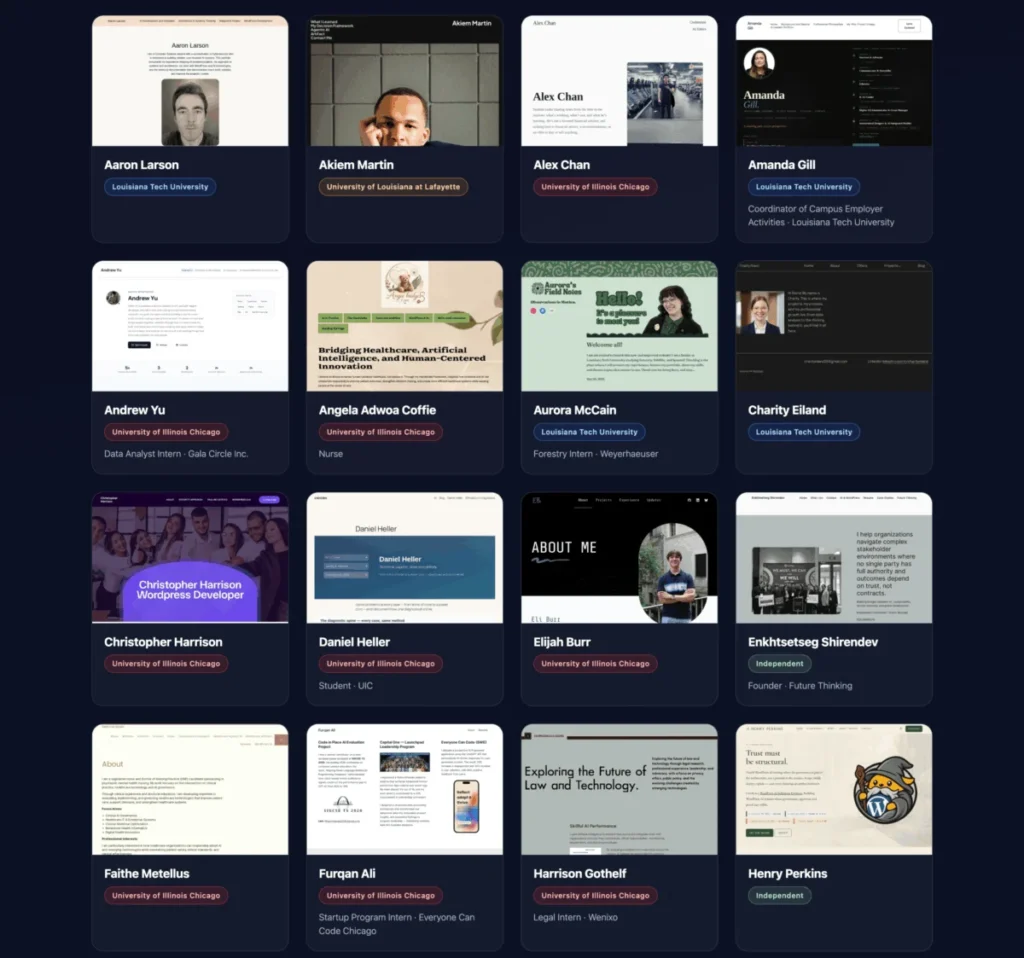
The efficacy of the AI Leaders program is best observed through the lens of the student projects. The portfolios produced by this cohort are not theoretical; they are functional, iterative, and reflect the kind of problem-solving that companies look for in junior developers and product managers.
The portfolios, accessible via the official AI Leaders blog, showcase a range of applications. Some students focused on automating content workflows, while others worked on enhancing plugin accessibility or optimizing site performance through AI-driven analytics. By utilizing generative AI to solve specific pain points within the WordPress community, these students demonstrated a level of technical maturity that is rarely captured in a standard transcript.
Official Responses and Perspectives
The significance of this program extends beyond the students themselves; it is being watched closely by tech policy experts and university administrators alike.
In discussions surrounding the program, stakeholders have emphasized that the goal is not to "fix" the labor market overnight, but to provide a blueprint for how institutions can partner with the open-source community.
"WordPress was built to expand access to publishing and participation on the open web," a spokesperson for the initiative noted during the launch. This sentiment is central to the project’s mission: the belief that the barriers to entry for AI mastery should be lowered to allow anyone—regardless of geography or socioeconomic status—to participate in the future of the digital economy.
Industry partners who attended the Chicago celebration highlighted the "hireability" of the cohort. Employers noted that the primary challenge in hiring for AI roles is the "black box" nature of most training programs. Because AI Leaders graduates have a public record of their contributions, the risk factor for employers is significantly reduced. They are not hiring someone who passed a test; they are hiring someone who has already been an active participant in the software supply chain.
Implications for the Future of Work
The AI Leaders program serves as a pilot for a broader shift in higher education. As AI continues to automate routine cognitive tasks, the value of a degree is increasingly being judged by the ability of the graduate to adapt, collaborate, and build within complex ecosystems.
The Move Toward "Micro-Credentialing"
The success of this pilot suggests that the future of technical education may lie in these smaller, highly specialized, and industry-validated credentials. By partnering with organizations like the WordPress Foundation, universities can ensure that their curricula do not stagnate, but rather evolve in real-time with the technology it teaches.
Closing the "Job Pathway" Gap
The most critical takeaway from the June 23 event is that education must be tethered to job pathways. The organizers have already confirmed that further job placements are in motion for the first cohort, proving that the bridge between the academy and the industry is not just a concept, but a functioning pipeline.
What Comes Next
The inaugural cohort is viewed by the organizers as the "Version 1.0" of a much larger, more scalable project. Plans for the next round of AI Leaders are already in the early stages of development. For those interested in the evolution of this model, the program encourages students and professionals to subscribe for updates, as the next cohort is expected to broaden the scope of participants and, potentially, the range of open-source projects involved.
A Call to Continued Education
While the AI Leaders program offers a distinct pathway for those ready to dive into the deep end of open-source development, it is part of a larger ecosystem of resources. For those at the beginning of their journey or those looking to sharpen their skills in specific areas, the broader WordPress community offers a vast array of workshops, lesson plans, and community-created resources.
The democratization of AI skills, when combined with the collaborative power of the open web, offers a promising counter-narrative to the fear that AI will displace human talent. Instead, as the AI Leaders program has demonstrated, it provides a tool for human talent to reach new heights of creativity and professional efficacy.
As we look toward the second half of 2026, the question is no longer whether AI will change the workforce, but whether our educational institutions will be agile enough to keep up. With the AI Leaders program, the University of Illinois Chicago, Automattic, and the WordPress Foundation have provided a compelling answer: the future is open, collaborative, and, above all, ready to be built.
For those seeking to follow the progress of the program or to prepare for the next application cycle, resources can be found at WordPress.org/education/.