Bridging the Divide: Mastering Context and Memory Engineering in Agentic AI
As AI agents evolve from simple chat interfaces into complex, autonomous entities capable of managing multi-session workflows and executing sophisticated task chains, developers are encountering a recurring architectural wall. It is a phenomenon where agents lose the thread of long-running tasks, hallucinate stale data, or allow irrelevant information to overwhelm their reasoning.
While these failures often appear as a singular "intelligence" issue, they are frequently the byproduct of a structural misalignment between two distinct but deeply codependent disciplines: Context Engineering and Memory Engineering. Mastering these two pillars is no longer optional for those building reliable, production-grade agentic systems.
The Core Problem: Ephemeral vs. Persistent Intelligence
To understand why agents fail, one must first distinguish between the what and the when of information management.
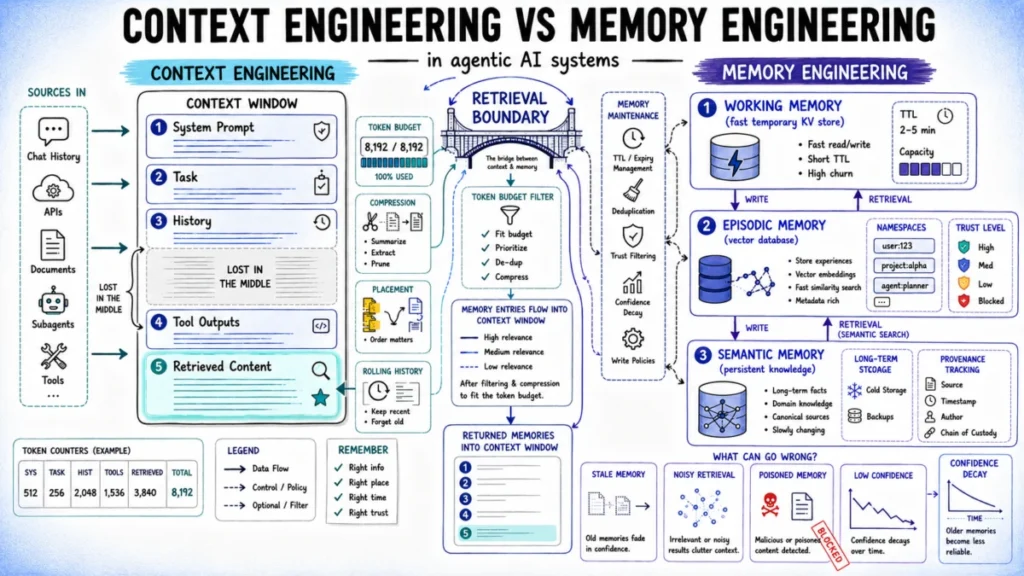
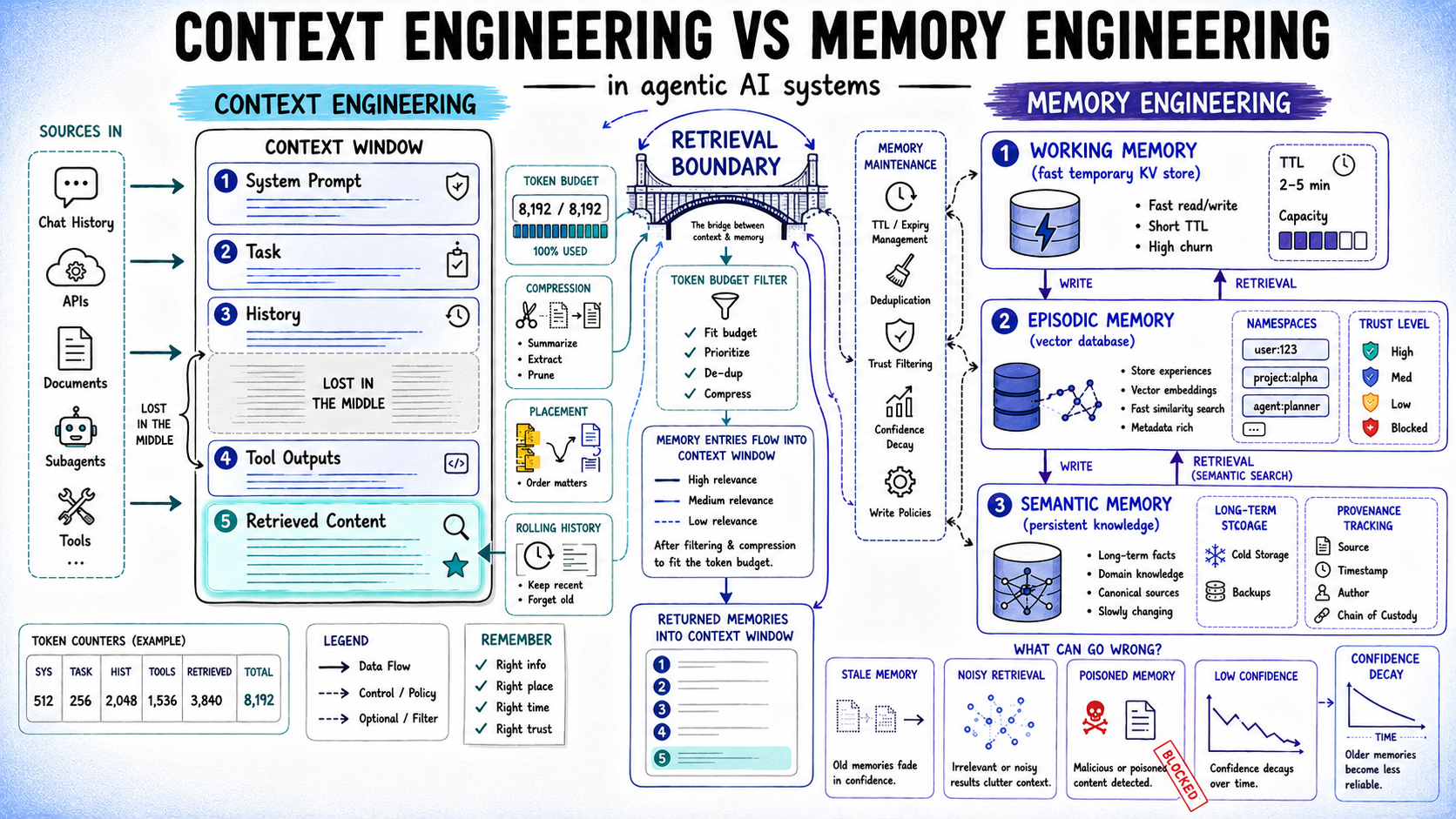
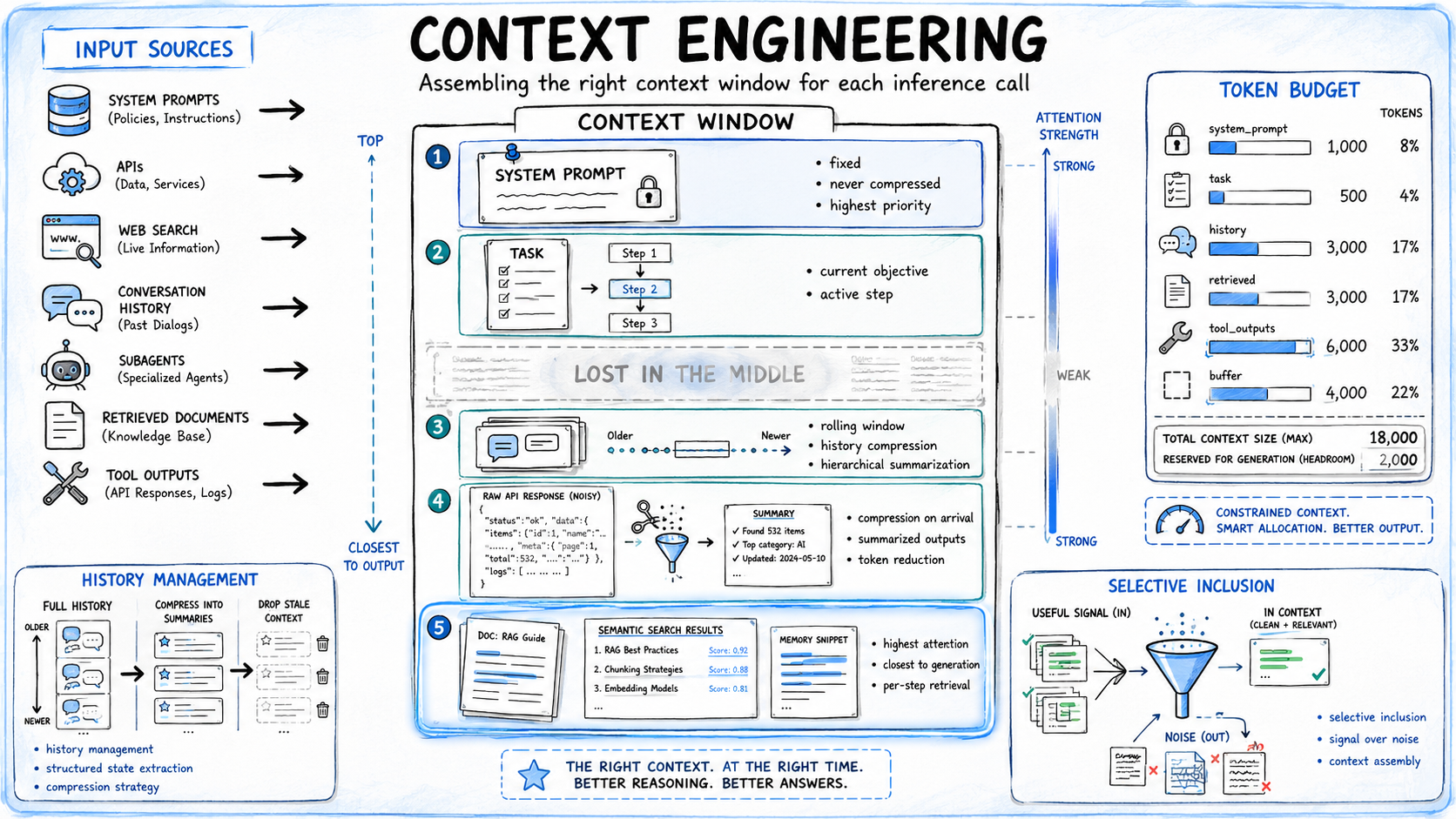
Context Engineering is the art of the immediate. It concerns the design of a single inference call—what to include, how to structure it, and how to compress it to maximize the model’s reasoning capabilities within the finite limits of the context window. It is inherently ephemeral; once the LLM finishes its generation, the context window is wiped clean.
Memory Engineering, by contrast, is the science of persistence. It focuses on the systems that survive beyond a single interaction. It encompasses the policies for writing, storing, retrieving, updating, and governing information. If an agent recalls a user’s preference from three weeks ago or coordinates a sub-task with a specialized agent, it is leveraging a memory system.
The failure to bridge these two leads to "agentic amnesia" or, conversely, "context pollution," where the agent is either unable to recall necessary facts or is buried under a mountain of context noise.
Context Engineering: Architecting the Inference Window
For an agent running a complex workflow, the context window is a limited, high-value real estate. Every piece of data—system prompts, tool outputs, previous dialogue—competes for space.
The Science of Selective Inclusion
Not every piece of information retrieved by an agent belongs in the prompt. A common pitfall is "data dumping," where developers pass raw database queries or verbose logs directly to the model. This bloats the token count and forces the LLM to spend its attention budget on parsing noise rather than reasoning. Effective context engineering mandates that data be summarized or extracted before it reaches the inference layer.
Structural Placement and the "Lost in the Middle" Effect
Research has consistently shown that LLMs exhibit a "lost in the middle" phenomenon: they attend strongly to the beginning and the end of a context window but often lose the signal of information buried in the middle. Consequently, developers must design their prompts to place critical instructions at the top and the most relevant, retrieved "just-in-time" data at the very end, closest to the model’s generation point.
Proactive Compression
The most robust agents do not wait for a token limit error to truncate their history. Instead, they employ proactive compression. This involves transforming raw conversation history into structured state objects or summaries at fixed intervals. By treating the context window as a managed resource rather than a passive container, engineers can maintain consistency over long-running sessions.
Memory Engineering: The Infrastructure of Recall
If context is the "now," memory is the "history." A robust memory system requires a rigorous approach to data lifecycle management.
The Write Policy: Beyond Raw Storage
The most common mistake in memory engineering is the "store everything" approach. Without a defined write policy, memory stores quickly become corrupted with low-value data and conflicting facts. A high-fidelity system should evaluate data based on:
- Importance: Is this fact central to the user’s long-term goals?
- Confidence: Was this piece of information verified by a tool, or is it a user’s opinion?
- Trust: Is the data coming from a reliable, internal system or an external, untrusted source?
Storage Tiers
Effective systems use a tiered architecture to match data utility with performance:
- Working Memory: High-speed, in-memory caches (e.g., Redis) for active task states.
- Episodic Memory: Vector databases for semantic search across past interactions.
- Semantic/Procedural Memory: Structured K/V stores for persistent facts and "learned" workflows that dictate how an agent should behave.
Maintenance and Decay
Memory is not static. A "forgetting" strategy—or at least a "pruning" strategy—is vital. Implementing Time-To-Live (TTL) on volatile data and periodic deduplication prevents the system from becoming bogged down by stale information. Using a MemoryEntry schema that includes metadata like confidence and expires_at allows the system to programmatically purge information that no longer serves the agent’s current objective.
The Retrieval Boundary: Where Context Meets Memory
The most critical point in agentic architecture is the "Retrieval Boundary." This is where the memory system outputs a candidate set of information, and the context assembler must decide how to package it.
Failure Mode: Retrieval Without Budgeting
The classic failure occurs when a retrieval system pulls a massive amount of "relevant" data without checking the available token budget. This often results in the agent receiving a prompt that exceeds its capacity or, worse, triggers a truncated response.
The Solution: Retrieval-aware context assembly. The context assembler should set a max_tokens constraint for the retrieval module. The retrieval system then sorts candidates by relevance and fills that budget until the limit is reached, ensuring that only the highest-signal content enters the model’s view.
Failure Mode: Contextual Misplacement
Even if the retrieval is perfect, the information is useless if it is misplaced. If a piece of retrieved information is critical for a current decision, it must be positioned at the "end" of the prompt. If the system treats retrieval as an arbitrary injection, it ignores the model’s natural bias toward the end of the context window, leading to "retrieval blindness."
Implications for Future Agentic Systems
As we look toward the future of agentic AI, the distinction between these two disciplines will likely blur into a unified "Cognitive Architecture."
Official Perspectives and Emerging Standards
Leading research from groups like Anthropic and providers like MongoDB suggests that the next generation of agents will feature "Self-Reflective Memory." These agents will be capable of identifying when their own memory is stale and triggering a "garbage collection" routine to update or delete records.
Furthermore, the industry is moving toward standardized memory schemas. By adopting structured formats for MemoryEntry, developers can ensure that memory components are interoperable, allowing an agent to swap out a vector database for a more specialized storage backend without rewriting the entire context assembly logic.
Conclusion: Aligning the Layers
To build agents that don’t just "chat" but truly "perform," we must treat them as systems with distinct layers of consciousness.
- Context Engineering provides the immediate reasoning surface.
- Memory Engineering provides the foundational knowledge base.
When these layers are decoupled, we get fragile agents. When they are integrated—through retrieval-aware budgeting, intelligent placement, and rigorous write policies—we unlock agents capable of sustained, reliable, and highly intelligent operation across days, weeks, and complex multi-step tasks. The future of agentic AI belongs to those who master the delicate balance between what an agent knows and what it can see at any given moment.