Bridging the Operational-Analytical Divide: AWS Integrates DuckDB into Amazon Aurora PostgreSQL for Direct Data Lake Querying
In a major architectural leap for enterprise data management, Amazon Web Services (AWS) has announced a powerful new capability for Amazon Aurora PostgreSQL: the ability to directly query operational data alongside data lakes formatted in Apache Iceberg and Apache Parquet. By embedding the high-performance analytical engine DuckDB directly into the database architecture, AWS has effectively eliminated the need for complex, resource-heavy Extract, Transform, and Load (ETL) and reverse-ETL pipelines.
This development marks a significant milestone in database engineering. For decades, organizations have struggled with the structural separation between transactional databases (optimized for low-latency writes and real-time operational workloads) and data lakes (built for massive, cost-effective analytical processing). Bridging this divide traditionally required building, monitoring, and maintaining data pipelines that duplicate storage, inflate infrastructure costs, and introduce latency.
With this new release, engineers and data architects can leverage standard PostgreSQL syntax, tools, and applications to query live operational data—including uncommitted writes—simultaneously with archived records stored in Amazon S3, S3 Tables, and Iceberg-compatible catalogs.
Main Facts: What the New Aurora PostgreSQL Capability Delivers
The core of this new feature lies in its underlying technology and execution model. By integrating DuckDB directly within Aurora PostgreSQL, AWS has enabled in-database analytics that execute without network hops or intermediate data staging areas.
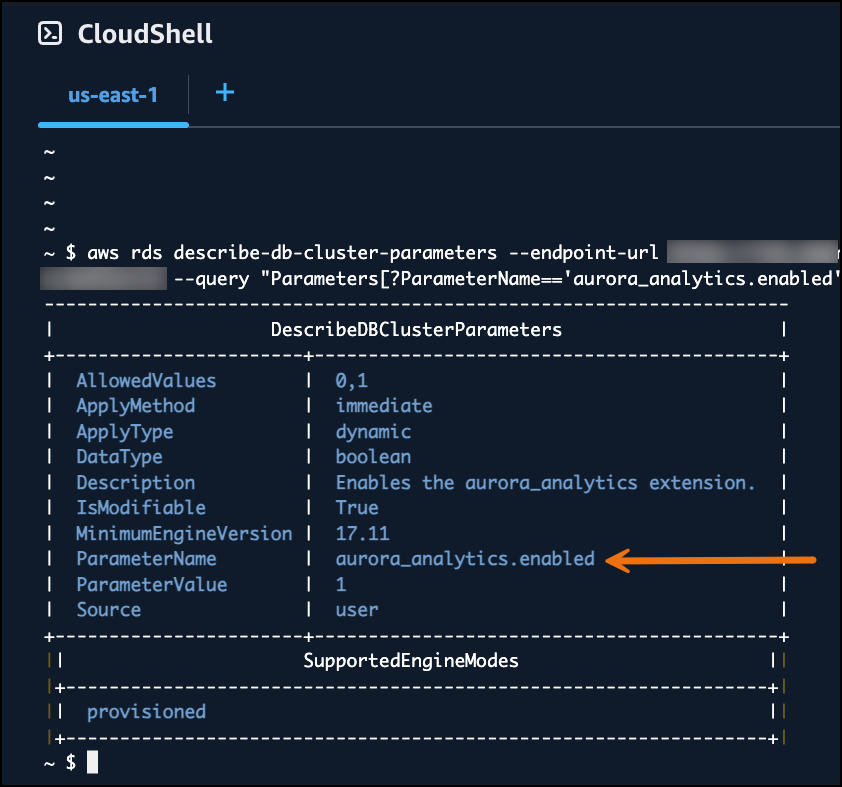
- Supported Versions: The capability is available on Aurora PostgreSQL major version 17 (starting with version 17.11) and version 18 (starting with version 18.6).
- Data Format Compatibility: Users can query data stored natively in Apache Iceberg and Apache Parquet formats across Amazon S3 and S3 Tables.
- Catalog Integration: Through AWS Glue Data Catalog federation, queries can seamlessly span external Iceberg REST Catalog (IRC)-compatible catalogs.
- Advanced Query Optimizations: Aurora applies intelligent cost-based optimizations, including predicate pushdown and column pruning, ensuring that only relevant data blocks are scanned and read from storage.
- Caching and Performance Monitoring: Frequently accessed data lake files are cached locally within the Aurora instance to accelerate subsequent queries. Administrators can inspect deep execution metrics using the newly introduced
aurora_analytics_stat_statements()function. - Pricing Model: The capability carries no additional software licensing surcharge. Customers pay only for the incremental Aurora compute resources consumed by the analytical queries and standard Amazon S3 request and storage fees.
Chronology: The Path to Unified Operational and Analytical Workloads
The journey toward seamless transactional and analytical convergence (often referred to in the industry as HTAP, or Hybrid Transactional/Analytical Processing) has evolved over many years. However, this specific architectural milestone traces several distinct developmental phases:
- The Era of Data Silos and Traditional ETL: Historically, operational databases and data lakes lived in isolation. Organizations running high-throughput transactional applications on PostgreSQL relied on third-party ETL tools to batch-transfer data nightly into a data warehouse or data lake for historical reporting and business intelligence.
- The Rise of Reverse ETL and Data Lakehouses: As cloud storage matured around open table formats like Apache Iceberg and Delta Lake, organizations began pushing analytics directly to object storage. This created the opposite problem: applications needing real-time operational context alongside historical archives had to build reverse-ETL pipelines, synchronizing data back into operational stores. This approach drastically increased infrastructure complexity and cost.
- The DuckLabs Integration: A pivotal turning point occurred when DuckLabs—the core engineering team behind the high-performance analytical database project DuckDB—joined Amazon. Their mandate: bring the vectorized query execution efficiency of DuckDB into the AWS ecosystem.
- General Availability Release: AWS successfully embedded the DuckDB engine directly into the Aurora PostgreSQL runtime. Released across all commercial AWS regions and AWS GovCloud (US), the feature empowers PostgreSQL instances to act as a unified gateway for live and archived data alike.
Supporting Data: Architecture and Implementation Workflow
Implementing this capability requires minimal friction for engineering teams already familiar with PostgreSQL and Amazon RDS.
Step-by-Step Configuration
To configure direct data lake querying, database administrators follow a streamlined workflow:
- Cluster Provisioning: Provision an Aurora PostgreSQL cluster running version 17.11+ or 18.6+.
- IAM Configuration: Attach an IAM role granting Aurora permissions to access designated Amazon S3 buckets and the AWS Glue Data Catalog.
- Extension Activation: Connect to the database via any PostgreSQL client (such as
psqlor the Amazon RDS console) and enable the extension:CREATE EXTENSION aurora_analytics; - Foreign Table Definition: Define foreign tables pointing directly to the object storage location, or utilize automated schema discovery:
CREATE FOREIGN TABLE transaction_history ()
SERVER aurora_analytics_server
OPTIONS (
   location 's3://<my-bucket>/finance/transaction_history.parquet',
   format 'parquet'
);
Note: By leaving the column definitions empty in the
CREATE FOREIGN TABLEstatement, Aurora automatically infers the schema from the underlying Parquet metadata. For large-scale data environments, a singleIMPORT FOREIGN SCHEMAcommand can bulk-create tables from an entire AWS Glue Data Catalog database.
Query Execution Example
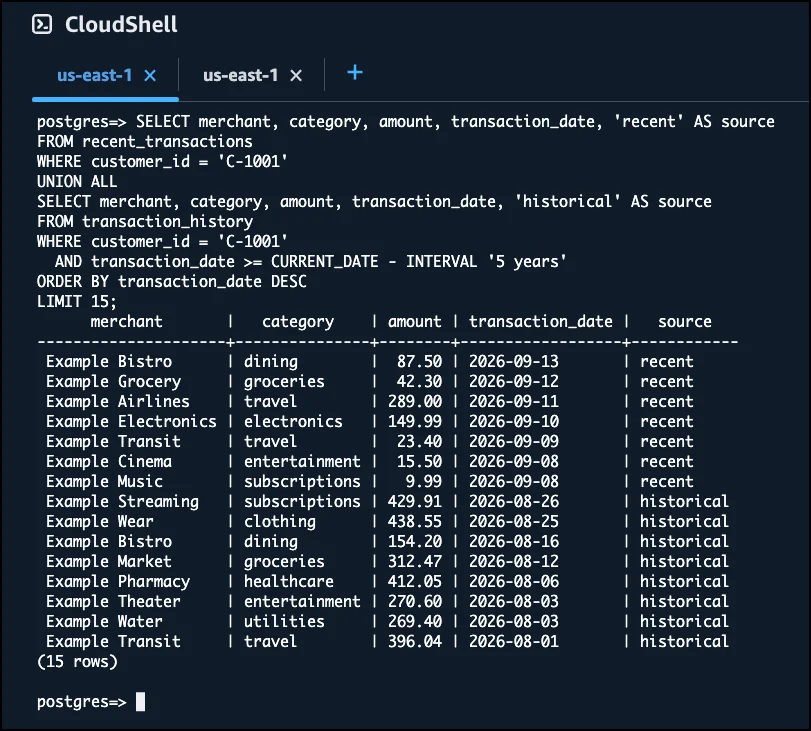
Once configured, developers can execute complex joins and unions across live operational tables and deep historical archives in a single query:
SELECT merchant, category, amount, transaction_date, 'recent' AS source
FROM recent_transactions
WHERE customer_id = 'C-1001'
UNION ALL
SELECT merchant, category, amount, transaction_date, 'historical' AS source
FROM transaction_history
WHERE customer_id = 'C-1001'
  AND transaction_date >= CURRENT_DATE - INTERVAL '5 years'
ORDER BY transaction_date DESC
LIMIT 15;
In this execution plan, DuckDB manages the high-throughput analytical scan of the historical Parquet files residing in Amazon S3, while Aurora handles the live, uncommitted transactional writes. The database engine merges these distinct datasets into a single, cohesive result set without moving the underlying data.

Official Responses and Industry Context
According to AWS engineering leadership, the integration addresses a profound operational burden felt by modern software teams. As organizations increasingly deploy generative AI applications and autonomous AI agents, the predictability of data access patterns has evaporated.
"Whether you’re powering real-time dashboards, enriching transactions with historical context, or building AI agents that reason over both live and archived data, you can now do it all through a single, familiar interface," noted AWS representatives during the launch announcement.
In modern AI agent architectures, it is practically impossible to pre-replicate every conceivable dataset an agent might query during runtime. By enabling Aurora PostgreSQL to query live operational states alongside multi-year data lake archives dynamically, AI agents can reason over complete organizational knowledge without suffering from stale context or waiting on asynchronous data pipelines.
Furthermore, AWS confirmed that the integration is built modularly around the open-source DuckDB core. This design ensures that future upstream performance enhancements and feature additions to the open-source DuckDB engine will flow directly into Amazon Aurora and other connected AWS services, compounding the architectural benefits over time.
Implications: Reshaping Application Development and Infrastructure Economics
The introduction of direct data lake querying within Amazon Aurora PostgreSQL carries profound implications for software architects, data engineers, and enterprise financial planners:
1. Radical Simplification of Application Architecture
Engineering teams no longer need to architect, monitor, and debug fragile multi-tier data synchronization jobs just to provide historical context to transactional applications. By treating Amazon S3 and Apache Iceberg tables as native extensions of the relational database, codebases become cleaner, maintenance overhead plummets, and time-to-market for new features accelerates.
2. Cost Reduction Through Data De-duplication
Data duplication has long been a hidden tax of enterprise cloud architectures. Storing identical records across operational databases, staging tables, data warehouses, and object stores consumes vast storage resources. By querying data in place within Amazon S3 and Apache Iceberg, organizations eliminate redundant storage costs while retaining full analytical capability.
3. Scaling Workloads Without Operational Bottlenecks
For workloads requiring ultra-low, single-digit-millisecond latency on analytical subsets, developers retain the flexibility to materialize data lake segments into native Aurora tables using standard commands like CREATE TABLE AS SELECT or MERGE INTO. Moreover, because read queries can be routed to any read replica within an Aurora cluster, heavy analytical scans can be completely isolated from primary writer instances, protecting core transactional performance.
4. A Natural Foundation for Enterprise AI
As businesses race to deploy context-aware AI agents and large language model (LLM) workflows, data freshness and accessibility are paramount. This capability equips AI infrastructure with immediate, secure, and unified access to both hot operational transactions and cold historical archives—unlocking new tiers of automated reasoning and enterprise intelligence.