Decoding the Antitrust Fall-Out: What Landmark Rulings on Google Search and Display Monopolies Mean for Digital Advertisers
Sponsored Insights by Silver Arbitration Law, PLLC
For years, digital marketers managing Google Search campaigns have had to become experts at rationalizing the inexplicable. When cost-per-click (CPC) rates climbed month after month, professionals leaned on a standard playbook of explanations. They pointed to increased market competition, broader keyword match types, declining Quality Scores, or the pressing need for a full account restructuring. Each of these explanations felt plausible, grounded in the day-to-day realities of running paid search campaigns in an increasingly crowded digital ecosystem.
However, recent federal court rulings have pulled back the curtain on the mechanics of the digital advertising marketplace, revealing that rising costs were not always driven by organic market forces alone.
Legal experts and arbitration professionals who have studied the exhaustive court records point to a startling reality: many advertisers have been quietly shouldering supracompetitive prices—costs driven well above what a healthy, competitive market would naturally produce. For digital marketers, business owners, and corporate legal teams, understanding the scope of these antitrust rulings is no longer just an academic exercise in tech policy. It has become a crucial financial review process, potentially opening the door to substantial arbitration claims.
Main Facts: Uncovering Monopolistic Power and "Pricing Knobs"
The foundation for these revelations rests on two major federal antitrust actions brought against Google. The most immediate impact for search advertisers stems from a landmark August 2024 decision. Following a rigorous ten-week trial, a federal court ruled definitively that Google "has exercised its monopoly power by charging supracompetitive prices for general search text ads."
To understand the gravity of this finding, one must look at how the court defined the term. "Supracompetitive" refers directly to pricing that exceeds the fair market value established by open and unhindered market competition.
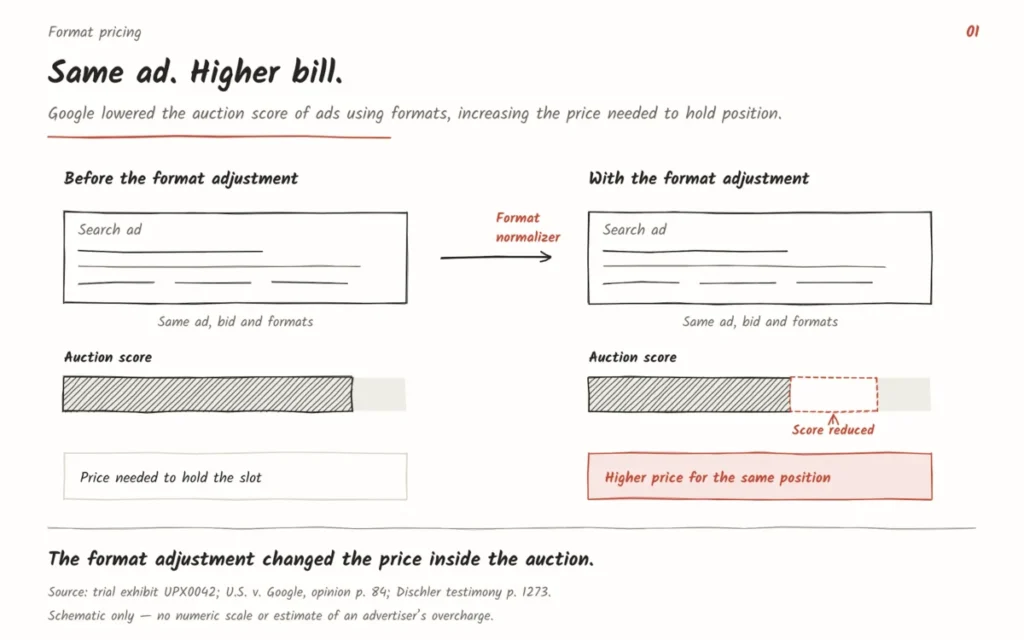
The trial record laid bare the inner workings of Google’s ad auction systems, exposing internal mechanisms that industry insiders had long suspected but could never prove. Testimony and evidence introduced during the proceedings revealed that Google’s dedicated ads team utilized internal "pricing knobs." These tools allowed the platform to systematically raise the actual price paid by a winning advertiser without requiring any corresponding changes in bid amounts, ad quality, or actual market competition.

How did these pricing knobs achieve this? Primarily by artificially inflating the score of the runner-up bidder—the baseline metric that dictates the winning advertiser’s final CPC.
Crucially, these aggressive pricing modifications were implemented without transparency. Advertisers were kept entirely in the dark. During the trial, Google’s Vice President of Ads offered candid testimony, stating plainly: "We tend not to tell advertisers about pricing changes." Echoing this corporate culture of non-disclosure, the court’s memorandum opinion noted that "[m]any advertisers do not even realize that Google is responsible for the changes in price."
Chronology: The Timeline of Auction Changes and Judicial Milestones
To determine whether an individual ad account was impacted by these practices, marketers and financial auditors must look closely at a specific chronology of events, court decisions, and systemic changes.
The Search Antitrust Timeline
- August 2024: Following a grueling ten-week trial, the U.S. District Court issues its landmark ruling finding Google guilty of maintaining an illegal monopoly in general search text ads through supracompetitive pricing.
- April 17, 2025: In a separate yet related legal blow, Judge Leonie Brinkema of the U.S. District Court for the Eastern District of Virginia rules that Google has monopolized two distinct segments of the digital display advertising chain. This ruling focuses heavily on ad tech tools used across the publisher ecosystem, raising separate considerations for brands that invested heavily in display inventory.
- September 2025: The court issues a comprehensive remedies decision. Among its provisions, the ruling mandates that Google publicly disclose material changes to its ad auction mechanisms moving forward, providing advertisers with unprecedented visibility into future pricing adjustments.
- Present Day: Google continues to appeal the core antitrust rulings. Meanwhile, thousands of U.S. businesses are actively evaluating their historical ad spend to determine their eligibility for individual arbitration claims.
Supporting Data: Assessing Spend, Damages, and Eligibility
For businesses looking to transition from passive observers to active participants in recovering potential overcharges, a rigorous data audit is required. Reviewing an account involves separating eligible spend from non-eligible inventory and understanding the scale of potential recovery.
Isolating Search Text Ads from Shopping and Performance Max
The initial search ruling applies strictly to general search text ads. It is critical to note that the court did not find a monopoly in the broader, aggregate market for all search advertising—a category that includes native shopping ads and retail-driven platforms sold by competitors like Amazon and Walmart.
If a significant portion of an organization’s historical ad budget was channeled into Google Shopping, YouTube ads, or Performance Max campaigns, those budgets must be meticulously separated from general text ad spend before any legal or financial conclusions can be drawn. Utilizing structured research prompts and AI-assisted legal briefs can help marketing teams quickly categorize ad types and relevant historical years.
Calculating Potential Claims
What is a potential arbitration claim actually worth? Antitrust economists and legal experts estimate that Google’s internal overcharges effectively inflated search prices by roughly 5% to 10%. Under established antitrust laws, proven damages are traditionally trebled (tripled).

When these multipliers are applied, legal professionals estimate that a successful claim could yield anywhere from 15% to 30% of an account’s eligible historical search spend.
To put this in perspective:
- If a mid-sized enterprise spent $10 million on eligible search text ads during the relevant audited periods, the baseline overcharge calculations point to a potential claim valued between $1.5 million and $3 million, before accounting for legal fees or case-specific adjustments.
Of course, these figures represent the theoretical size of a claim; the final recovery amount is ultimately determined through the binding arbitration process or formal legal settlements.
Official Responses and the Corporate Defense
Google has strongly disagreed with the court’s findings from the outset and is actively pursuing appeals through the federal appellate courts to overturn the decisions. The company maintains that its auction models are designed to maximize efficiency, relevance, and value for both users and advertisers.
Despite the ongoing legal battles, the regulatory landscape has forced a shift toward greater accountability. The court-ordered remedies requiring public disclosures of auction modifications mean that Google can no longer make unannounced structural adjustments to pricing knobs without leaving a clear, trackable public record.
Furthermore, a common concern among brand managers and marketing directors is whether filing an individual claim will trigger retaliatory actions from Google—such as account suspension, algorithm penalties, or suppressed ad delivery. Legal experts who represent claimants emphasize that the practical risk of retaliation is remarkably low. Thousands of U.S. advertisers are currently pursuing individual arbitration claims, and there are no reported instances of platform retaliation. Retaliating against a massive cohort of active claimants would introduce severe new legal liabilities and reputational hazards for a company already operating under intense federal judicial oversight.
Implications: Practical Steps for Advertisers and Agencies
Navigating the aftermath of these antitrust rulings requires a methodical, step-by-step approach. Businesses should not rush blindly into legal proceedings, but neither should they leave millions of dollars in potential overcharges unexamined.

1. Identify the Correct Legal Entities
Before initiating any formal review, accounts must clarify the precise business entities involved. Marketers need to identify which legal entity formally accepted Google’s advertising terms and paid the associated invoices, as well as which digital agencies or manager accounts operated the campaigns over the years. These foundational details dictate who legally holds the claim and who must formally authorize counsel.
2. Review the Arbitration Clause
Google’s standard advertising terms of service contain a mandatory arbitration clause. This means that advertisers bound by these terms must pursue any covered disputes through individual arbitration rather than traditional class-action lawsuits. Claims are brought forward through the American Arbitration Association (AAA).
3. Evaluate the Administrative Burden
Many executives worry that exploring a claim will drain internal resources. In practice, the administrative lift is remarkably light. For a standard claim, gathering and submitting historical account records typically requires no more than an hour of total staff time—usually split between a digital marketer with direct account access and an authorized corporate signatory. Once documentation is handed over to specialized arbitration counsel, the legal team handles the assessment, filing, and coordination, engaging corporate stakeholders only when critical decisions are required.
4. Understand Agency vs. Client Rights
For brands that rely heavily on third-party marketing agencies to manage their paid search operations, ownership of the claim is clear-cut: the entity that funded the ad spend holds the right to the claim and any subsequent financial recovery. Agencies play a vital role in this process by helping pull comprehensive spend history, identifying active campaign years, and bridging the gap between brand leadership and specialized arbitration lawyers.
Conclusion: Moving Forward Informed
The federal antitrust rulings against Google have permanently altered the landscape of digital advertising. For decades, rising CPCs were accepted as an immutable cost of doing business in a monopolized digital storefront. Today, court records have proven that hidden pricing mechanisms inflated those costs artificially.
For enterprise advertisers and growing businesses alike, the path forward involves prudent due diligence. Whether by consulting with specialized arbitration counsel to review historical spend or utilizing research tools to assess corporate eligibility, taking an informed, measured approach is the most responsible course of action. The evidence is part of the public record; determining whether your business was affected is the next logical step.
Disclaimer: Attorney Advertising. Mark Beckett is an attorney admitted in New York. This article is sponsored by Silver Arbitration Law, PLLC, and is provided for general informational purposes only. It does not constitute legal advice or establish an attorney-client relationship. Prior results do not guarantee similar outcomes. Claims against Google are pursued through individual arbitration under Google’s Terms of Service, not via traditional court litigation. Quotations from court opinions are reproduced verbatim from published decisions in United States v. Google LLC (D.D.C. Aug. 5, 2024, and E.D. Va. Apr. 17, 2025). Silver Arbitration Law, PLLC is not affiliated with or endorsed by Google LLC.