Deepening Probe: Ayodhya Police Raid Residences of Eight Accused in Ram Temple Donation Embezzlement Case
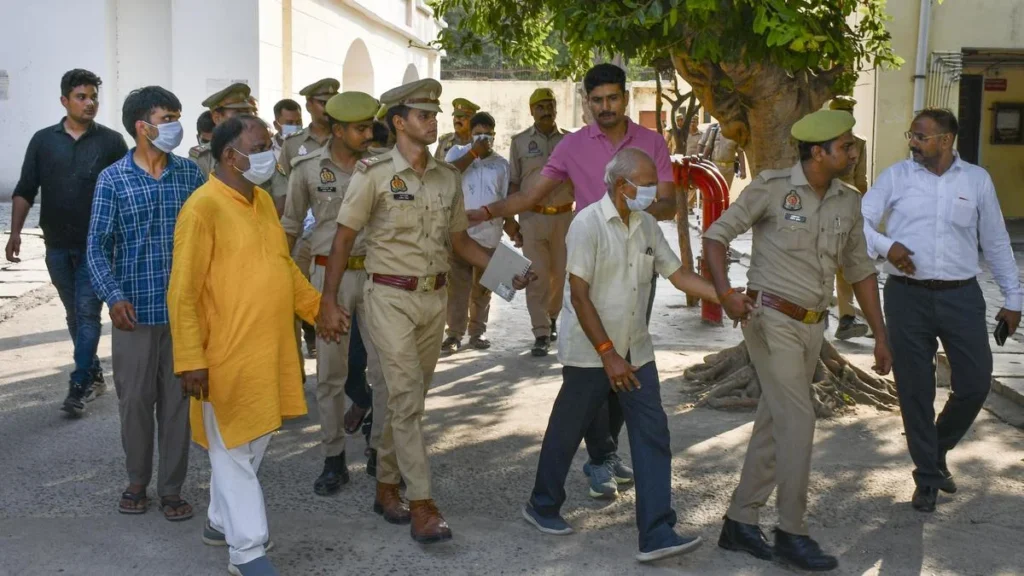
AYODHYA — The investigation into the massive financial irregularities involving donations made to the Ram Temple in Ayodhya intensified on Sunday, June 28, 2026, as local law enforcement authorities conducted simultaneous, high-stakes raids on the residences of all eight individuals currently in custody.
The operation, which involved multiple police teams accompanied by local magistrates, marks a critical turning point in a scandal that has sent shockwaves through the temple trust and the millions of devotees who have contributed to the site’s development. The accused, who were directly involved in the counting and management of cash and precious offerings, are now facing a widening net of evidence as investigators work to recover misappropriated funds.
The Core Allegations: A Breach of Sacred Trust
The controversy centers on the alleged siphoning of cash and valuables offered by pilgrims at the Ram Temple. The eight suspects—identified as Avinash Shukla, Anukalp Mishra, Lav Kush Mishra, Manish Kumar Yadav, Karunesh Pandey, Ram Shankar Mishra, Subhash Srivastava, and Ramashankar (alias Tinnu) Yadav—were part of the authorized team tasked with the sensitive duty of counting and auditing the daily donations.
According to prosecution documents, the accused leveraged their proximity to the donation process to systematically divert funds. Investigators allege that the group operated with a degree of internal coordination, enabling them to bypass security protocols designed to account for every rupee and precious item donated.
To date, the investigation has successfully recovered approximately ₹79.85 lakh in cash. However, sources close to the investigation suggest that this figure may be merely the "tip of the iceberg," as forensic auditors continue to cross-reference donation registers with the actual deposits made into the temple’s official accounts.
Chronology of the Scandal
The unfolding of this case has been rapid, moving from initial whispers of irregularity to a full-scale criminal investigation in a matter of weeks.
- Early June 2026: Reports of financial discrepancies begin to circulate, alleging that the amounts recorded in the donation registers do not align with the physical currency reaching the bank vaults.
- Mid-June 2026: The Uttar Pradesh government, recognizing the gravity of the allegations and the potential for a public outcry, constitutes a three-member Special Investigation Team (SIT) to verify the claims.
- Late June 2026: The SIT submits a preliminary report confirming significant misappropriation. Based on these findings, the Ayodhya Police register a formal First Information Report (FIR).
- June 26, 2026: Following the registration of the FIR, the eight suspects are apprehended and produced before an Ayodhya court, which remands them to judicial custody until June 29.
- June 28, 2026: In a bid to secure further evidence, the Ayodhya Police execute search warrants at the private residences of all eight accused, seeking documents, electronic devices, and additional hidden assets.
- June 29, 2026: The accused are slated to be produced in court, where the police are expected to move for a request for custodial remand to interrogate the suspects further.
Legal Framework and Charges
The prosecution has invoked a stringent set of charges under the Bharatiya Nyaya Sanhita (BNS), reflecting the gravity of a crime involving public donations to a religious institution. The charges include:

- Theft by Servant: A charge applied due to the accused’s formal employment or contractual status within the donation counting mechanism.
- Criminal Breach of Trust: Given that the accused were entrusted with the management of funds by the temple trust.
- Receiving Stolen Property: Alleging that the accused knowingly possessed or hid funds that were unlawfully acquired.
- Criminal Conspiracy: Based on the evidence of organized, multi-person involvement in the embezzlement scheme.
- Prevention of Corruption Act: Provisions from this act have been added, emphasizing the public interest involved in the management of the temple’s financial assets.
Legal experts note that if convicted, the accused face significant prison sentences. The inclusion of the Prevention of Corruption Act suggests that the state views this not merely as simple theft, but as an institutional failure that requires a rigorous legal response.
The Role of the Special Investigation Team (SIT)
The formation of the SIT by the Uttar Pradesh government was a decisive move to ensure transparency. By bypassing local-level interference, the SIT was able to conduct an independent audit of the donation receipts. Their preliminary report served as the foundation for the FIR.
The SIT is now focusing on the “custody chain” of the donations. This involves mapping the movement of money from the donation boxes to the counting room, and finally to the banking institution. By identifying exactly where the “leakage” occurred, the team aims to determine if the corruption was limited to this group of eight or if there is a broader network of collusion within the temple’s administrative hierarchy.
Official Responses and Public Sentiment
The temple administration has maintained a stance of “zero tolerance” regarding the incident. Officials have stated that the trust is cooperating fully with the police and the SIT, providing all necessary logs, CCTV footage, and internal audit reports.
However, the incident has sparked significant public debate. Devotees from across India, who have contributed thousands of crores to the construction and maintenance of the Ram Temple, have expressed a mixture of anger and betrayal. Social media platforms and local community forums in Ayodhya have been flooded with demands for increased security and more robust digital accounting systems for future donations.
“The donations are not just currency; they are a manifestation of the faith of millions,” said a spokesperson for a local civil society group. “Any attempt to misappropriate these funds is a direct insult to the sanctity of the temple.”
Implications: The Future of Temple Governance
This case serves as a massive wake-up call for the management of high-traffic religious sites across India. The Ayodhya Ram Temple, being one of the most significant sites in the country, manages massive daily inflows of cash and gold.

Modernizing Oversight
The embezzlement scandal is likely to force the temple trust to accelerate its transition to fully automated and digitized donation collection. Experts suggest that the future of temple governance in India may lie in:
- Biometric Access: Restricting access to donation counting areas to authorized personnel with biometric verification.
- Real-time Digital Auditing: Implementing systems where every donation is logged electronically at the point of receipt.
- Third-Party Oversight: Periodic, unannounced audits by independent financial firms to ensure that internal controls are functioning as intended.
The Broader Political Landscape
Given the political significance of the Ram Temple, the investigation is being watched closely by political parties and observers alike. The government’s willingness to prosecute the individuals involved—despite the potential for negative headlines—is being interpreted as an attempt to uphold the integrity of the institution. Conversely, the opposition has signaled its intent to keep the pressure on, demanding a white paper on the temple’s finances and a total overhaul of the administrative team.
Looking Ahead: The July 29 Court Appearance
As the clock ticks toward Monday, June 29, the anticipation surrounding the court proceedings is palpable. The police’s request for custodial remand is expected to be contested by the defense, but investigators are confident that the evidence seized during Sunday’s raids will provide the necessary justification for further interrogation.
The recovery of the ₹79.85 lakh is only the beginning. The police are now looking for trails of "laundered" money—investments in property, vehicles, or bank accounts that may have been purchased using the siphoned funds.
For the people of Ayodhya and the millions who look to the city as a spiritual beacon, the resolution of this case is not just a matter of law—it is a matter of restoring the integrity of a site that represents the culmination of a decades-long national journey. As the legal process grinds forward, the focus remains on justice, transparency, and ensuring that the sanctity of the Ram Temple is never again compromised by greed.