Digital Lockdown in the Capital: How a 20-Hour Internet Blackout Paralyzed New Delhi’s Administrative Heart
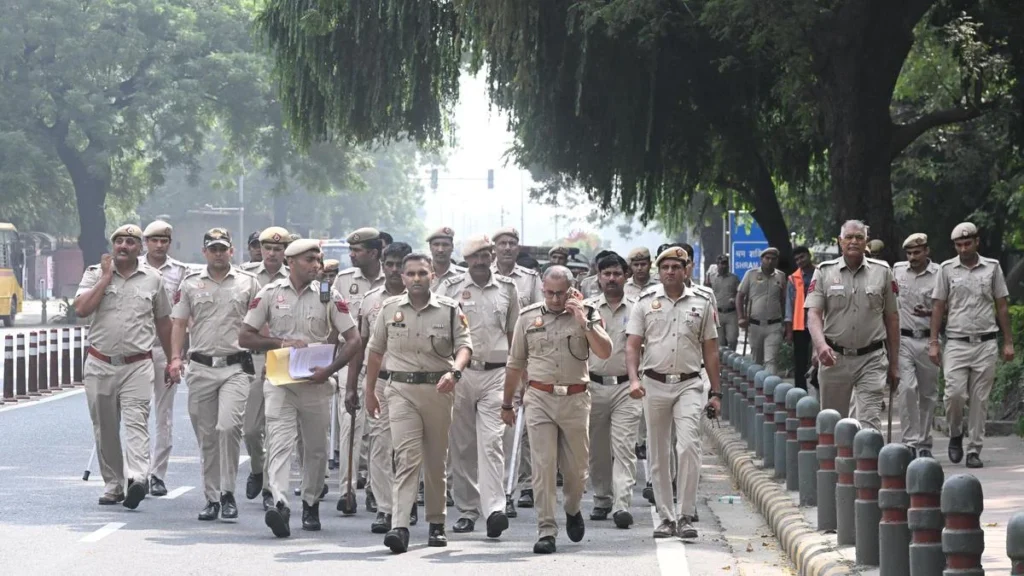
NEW DELHI — In an unprecedented administrative maneuver aimed at stifling large-scale demonstrations in the nation’s capital, authorities enforced a sweeping mobile internet shutdown across the administrative heart of New Delhi. Spanning from 10:00 p.m. on Friday, October 9, through Saturday evening, October 10, 2026, the digital blackout compounded the chaos caused by a heavy-handed police crackdown on protestors near Janpath and Kartavya Path.
Geographically, the shutdown covered a four-kilometer radius centered around the high-profile intersection of Janpath and Kartavya Path—two of the city’s busiest and most politically sensitive thoroughfares. Marking the largest localized communications curb in Delhi since the nationwide anti-Citizenship (Amendment) Act (CAA) protests over half a decade ago, the blackout crippled digital commerce, paralyzed the gig economy, disrupted urban transit, and ignited fierce debates over digital rights, government transparency, and freedom of expression.
1. Main Facts of the Digital Blackout
The disruption was absolute for tens of thousands of residents, commuters, workers, and tourists trapped within the designated exclusion zone.
- The Timeline: The blackout commenced abruptly at 10:00 p.m. on Friday, October 9, 2026, and remained in effect for nearly twenty hours, with partial data restorations reported only by Saturday evening.
- Geographic Scope: A tightly monitored four-kilometer radius encircling the Janpath and Kartavya Path junction in Lutyens’ Delhi, encompassing key government enclaves, commercial hubs, and historic monuments.
- Impact on Commerce: Digital payments—the lifeblood of modern urban Indian commerce—ground to an absolute halt. Small vendors, street-side stalls, and commuters dependent on Unified Payments Interface (UPI) transactions found themselves locked out of financial networks. Only establishments equipped with wired broadband or dedicated Wi-Fi facilities managed to process electronic sales.
- Communication Breakdown: Voice calls and standard Short Message Service (SMS) channels remained marginally functional, but citizens were entirely cut off from mobile data. Protesters, families, and bystanders scrambled to make traditional voice calls to coordinate movements, utterly unable to transmit photographic or video evidence of the ongoing security crackdown.
2. Chronology of Events
The unfolding crisis was characterized by a rapid escalation of security measures followed by cascading infrastructural failures across central New Delhi.
Friday, October 9, 2026
- 9:00 p.m. – 10:00 p.m.: Heavy security deployments begin staging around prominent intersections in central Delhi, notably near Jantar Mantar and the Kartavya Path corridors, anticipating large-scale demonstrations against administrative policies.
- 10:00 p.m.: Mobile internet services abruptly drop across the four-kilometer radius centered on Janpath and Kartavya Path. Telecom operators silently implement the shutdown orders, plunging the zone into a digital vacuum.
Saturday, October 10, 2026
- Morning (8:00 a.m. – 12:00 p.m.): As the capital wakes up, the fallout from the shutdown becomes starkly apparent. Gig workers attempting to log into delivery and rideshare applications find themselves locked out. Commuters discover that navigation algorithms cannot process real-time traffic data.
- Afternoon (12:00 p.m. – 4:00 p.m.): Digital censorship claims surface. The Indian National Congress party’s youth wing, the Seva Dal, discovers its official account on X (formerly Twitter) has been withheld in India. Concurrently, B.V. Srinivas, the chief organizer of the Seva Dal, finds his Instagram handle blocked nationwide by Meta. Srinivas announces immediate legal recourse via the Delhi High Court.
- Late Afternoon (4:00 p.m. – 6:00 p.m.): Civil society organizations, notably the Internet Freedom Foundation (IFF), issue blistering statements condemning the government’s failure to publish the mandatory statutory order, pointing out that leaked memos carry a "Top Secret" classification.
- Evening (6:00 p.m. onward): Authorities begin a phased rollback of the restrictions. Mobile data access is restored in incremental patches across central Delhi, allowing a gradual return to digital normalcy.
3. Supporting Data and Socio-Economic Impact
The collateral damage of the connectivity blackout extended far beyond the immediate political protests, exposing the deep vulnerabilities of a hyper-digitized metropolitan economy.
Paralysis of the Gig Economy
New Delhi’s vast army of gig workers—food couriers, e-commerce delivery personnel, and app-based cab drivers—bore the brunt of the infrastructural blackout. Because modern delivery and transport applications rely entirely on continuous cellular data packets to assign tasks, track routes, and verify customer drop-offs, thousands of workers found themselves economically stranded. Many drivers who completed trips inside the affected zone were unable to log back in to accept subsequent orders or process digital receipts, resulting in significant, unrecoverable wage losses for the day.
Urban Navigation Failure
Real-time urban navigation, long taken for granted by millions of daily commuters, collapsed entirely within the capital. Google Maps and competing navigation applications failed to update dynamically. Because real-time congestion and road closure data rely on crowdsourced telemetry from active user devices, the sudden absence of mobile data turned the software blind.
Throughout Saturday afternoon, turn-by-turn routing algorithms offered wildly inaccurate advice, directing motorists into massive, snaking detours around Lutyens’ Delhi. Drivers found themselves trapped in secondary traffic jams because the applications could not reflect newly cleared police barricades or sudden route adjustments executed by law enforcement on the ground.
Inconsistent Enforcement and Telecom Discrepancies
Adding to the confusion, the implementation of the shutdown appeared plagued by technical inconsistencies. Numerous subscribers of specific telecom operators reported retaining 4G and 5G data access well into Saturday afternoon, while users on competing networks had been entirely cut off since the previous night. This uneven enforcement not only compromised the tactical objectives of the security apparatus but also created widespread confusion regarding the legal and geographical boundaries of the blackout zone.
4. Official Responses and Legal Controversies
The deployment of the internet shutdown immediately drew sharp criticism from political opposition figures and digital rights advocates, sparking a fierce debate over executive overreach, civil liberties, and judicial accountability.

Political Censorship and Legal Challenges
The communications blackout was compounded by targeted digital censorship. The Indian National Congress’s Seva Dal organization revealed that its official account on X had been abruptly withheld within India, silencing its institutional voice during a politically volatile weekend.
More aggressively, B.V. Srinivas, the chief organizer of the Seva Dal, discovered that his personal Instagram account had been blocked nationwide via directives issued to Meta. Denouncing the move as an authoritarian attempt to muzzle political dissent and suppress real-time documentation of police actions, Srinivas confirmed that his legal team was actively preparing a writ petition to challenge the Meta block and the underlying government orders in the Delhi High Court.
The Internet Freedom Foundation’s Condemnation
The Internet Freedom Foundation (IFF), India’s premier digital liberties watchdog, issued a scathing critique of the shutdown, focusing heavily on the opaque manner in which the executive order was promulgated.
The IFF noted that despite strict legal mandates requiring transparency and public dissemination of internet suspension orders—established under the Temporary Suspension of Telecom Services (Public Emergency or Public Safety) Rules—the government failed to publish the directive.
"The communication shared by [newswire agency] ANI invokes Rule 3 of these Rules, the same Rule that requires the order to be published," the IFF stated in an official release. "It is nevertheless marked ‘Top Secret’, the highest security classification used by the Government of India."
The Foundation further challenged the empirical justification offered by state authorities for deploying communication blackouts during public demonstrations. Highlighting the absence of public safety data, the IFF cited academic research to debunk the notion that cutting off communications reduces public violence.
"The government has placed no evidence before the public that a shutdown makes a protest safer," the IFF asserted. "The available research is to the contrary, as a 2019 study of shutdowns and protest in India by Jan Rydzak, then at Stanford’s Global Digital Policy Incubator, found shutdowns ‘much more strongly associated with increases in violent collective action than with non-violent mobilization’."
5. Broader Implications for Democracy and Digital Rights
The 20-hour digital blackout in New Delhi serves as a sobering reminder of the fragile balance between state security imperatives and fundamental democratic rights in the digital age. As India continues to cement its status as one of the world’s largest digital economies—boasting billions of dollars in daily UPI transactions and a rapidly expanding gig workforce—the weaponization of internet shutdowns as a primary crowd-control mechanism carries profound long-term consequences.
- Erosion of Economic Productivity: Arbitrary communication blocks impose immediate, quantifiable financial losses on ordinary citizens, small businesses, and informal sector workers who rely on digital infrastructure for survival.
- Weakening of Democratic Accountability: Restricting mobile data streams concurrently hampers journalists, citizen documentarians, and political opposition figures from recording, verifying, and broadcasting the actions of law enforcement agencies during civil unrest.
- Challenging the Rule of Law: The reliance on "Top Secret" classifications to bypass statutory obligations of transparency sets a dangerous precedent, undermining judicial oversight and public trust in administrative governance.
As legal challenges loom on the horizon—particularly regarding the blocking of prominent political handles and the non-publication of statutory suspension rules—the events of October 9–10, 2026, will likely be scrutinized by the Indian judiciary as a defining test case for digital rights and executive power in the years ahead.