Diplomatic Balancing Act: Modi and Trump Navigate Strained Ties at G7 Summit
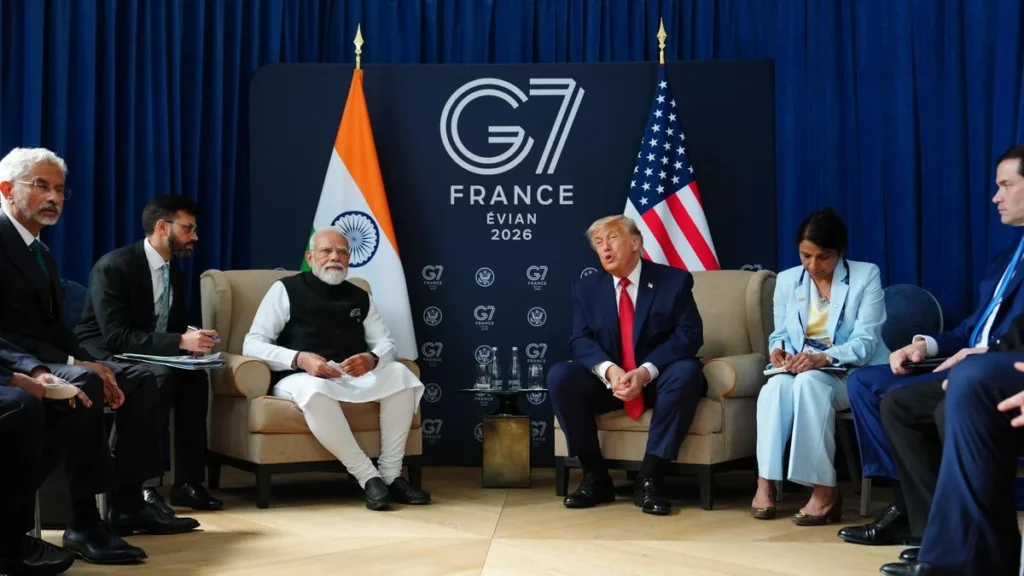
EVIAN-LES-BAINS, France — Against the picturesque backdrop of the French Alps, the G7 Summit became the stage for a high-stakes diplomatic encounter between Indian Prime Minister Narendra Modi and U.S. President Donald Trump on June 17, 2026. The meeting, held amid a backdrop of geopolitical volatility in West Asia and persistent friction in bilateral trade negotiations, served as a crucial stress test for the India-U.S. Comprehensive Global Strategic Partnership.
While the public optics remained focused on the personal rapport between the two leaders, the substance of the discussion was underscored by the recent tragic deaths of Indian seafarers in the Strait of Hormuz—a flashpoint that has tested the resolve of New Delhi’s policy of strategic autonomy.
The Core Issues: Safety, Trade, and Geopolitics
The bilateral meeting, held on the sidelines of the G7 summit, was dominated by three critical pillars: the protection of Indian citizens in global maritime trade, the finalization of a stalled bilateral trade deal, and the broader security architecture of the Indo-Pacific and West Asian regions.
The Strait of Hormuz and the Seafarers’ Crisis
The most poignant moment of the meeting occurred when Prime Minister Modi raised the issue of the safety of Indian seafarers. Following the deaths of three Indian nationals in a U.S. military strike off the coast of Oman last week, the incident has sparked widespread public outcry in India.
"Mr. President, you are aware that across the world, Indian seafarers in the hundreds of thousands are working and performing their duties across global maritime trade routes, including the Strait of Hormuz, and their safety is of utmost importance to us," Mr. Modi stated.
The Prime Minister’s emphasis on the incident signaled a departure from the usual diplomatic platitudes, signaling that the safety of India’s workforce is non-negotiable. Mr. Modi further linked the regional security of the Strait of Hormuz to the global economy, stressing that keeping these lanes open is vital for international stability.
The Trade Deadlock
Despite the rhetoric of friendship, the economic relationship remains caught in a web of protectionist policies and technical disagreements. While both nations announced the finalization of a trade deal in February, the agreement remains unsigned. The stumbling blocks—primarily U.S. tariff adjustments and specific regulatory discrepancies—have created a lingering sense of uncertainty.
President Trump, acknowledging the delay, described Mr. Modi as a "very tough" negotiator, noting that the two sides were "very close" to concluding the deal. To break the impasse, U.S. Trade Representative Jamieson Greer is scheduled to visit New Delhi next week to conduct high-level talks aimed at ironing out the final details.
Chronology: A Relationship in Flux
The current state of U.S.-India relations is the culmination of a complex timeline of cooperation and friction that has evolved rapidly since 2025.
- February 2025: Prime Minister Modi and President Trump meet to launch the COMPACT (Catalyzing Opportunities for Military Partnership, Accelerated Commerce and Technology) framework, aimed at deepening institutional alignment.
- February 2026: Both nations publicly announce the "finalization" of a comprehensive trade deal, projecting a major diplomatic win.
- June 2026 (Early): Three Indian seafarers are killed in a U.S. strike near Oman, escalating regional tensions and causing political friction in New Delhi.
- June 17, 2026: The G7 Summit in Evian-les-Bains provides the venue for the first direct discussion between the leaders following the Oman incident.
Official Responses and Public Statements
President Trump’s reaction to the deaths of the Indian sailors drew significant attention. When asked by reporters if he had condolences for the families, Trump’s response was characteristically blunt: "I heard about that. It’s a rough profession. There’s no question about it. This has been happening throughout time, but we work together. We love all of those people."
The President’s attempt to characterize the event as a byproduct of a "rough profession" contrasted sharply with the gravity conveyed by the Indian delegation. However, Trump was quick to pivot back to the warmth of the bilateral relationship, dismissing rumors of a fraying partnership.

"He’s the most beautiful looking man. He looks so nice. He’s like an angel, but actually he’s a killer," Trump remarked, using his unique brand of hyperbolic praise. "He’s as tough as they come, but he looks so good. So he gets you by surprise."
For his part, Prime Minister Modi remained focused on the institutional trajectory of the partnership. In a social media statement following the meeting, he highlighted the review of cooperation across energy, technology, and military spheres, emphasizing that the India-U.S. COMPACT framework remains the bedrock of their interaction.
Implications: The Strategic Landscape
The meeting at Evian-les-Bains highlighted several critical implications for the future of the Indo-U.S. relationship.
1. The Burden of Strategic Autonomy
India’s foreign policy is currently navigating a delicate balance. While it shares the U.S. desire to contain Iranian influence in the region, it cannot afford to ignore the domestic political pressure caused by the loss of Indian lives due to U.S. military action. By raising the issue directly, Modi has signaled to Washington that India’s strategic partnership does not equate to blind support for U.S. military operations that jeopardize Indian interests.
2. The Defence "Gentleman’s Agreement"
One of the most revealing moments of the summit was President Trump’s assertion regarding the defense relationship. When asked about a potential mutual defense treaty, Trump noted that while there was no formal contract, "if India were to be attacked, we would be there to help." This verbal assurance, while not legally binding, provides a level of comfort to New Delhi as it faces its own regional security challenges.
3. Economic Hurdles
The delay in the trade deal suggests that both administrations are facing significant domestic pressure. For the Trump administration, "America First" policies continue to create friction with international partners. For the Modi government, balancing domestic agricultural and manufacturing protections against U.S. demands for market access remains a difficult tightrope walk. The upcoming visit of the U.S. Trade Representative will be a litmus test for whether the political will to sign the deal is matched by the bureaucratic ability to execute it.
Analysis: A Partnership of Necessity
Despite the mounting challenges—ranging from restrictions on skilled migration to the growing U.S. proximity to Pakistan—the underlying logic of the India-U.S. relationship remains robust. Both nations view each other as essential counters to the rise of regional rivals.
The G7 meeting confirmed that the "Comprehensive Global Strategic Partnership" is far from dead, but it is entering a more mature and demanding phase. The days of simple diplomatic photo-ops are being replaced by transactional, high-stakes negotiations where domestic grievances and international ambitions collide.
As Prime Minister Modi and President Trump look toward the future, the success of their relationship will likely be defined by their ability to resolve the trade impasse and demonstrate that the partnership can provide tangible security benefits for both nations. With the U.S. Trade Representative arriving in India next week, the next chapter of this complex relationship is already being written.
The "angel" and the "killer," as Trump affectionately described the dynamic, must now move past the rhetoric and ensure that their strategic partnership delivers on the promises made in the halls of power, far from the scenic vistas of the French Alps.