SEATTLE — As organizations increasingly transition artificial intelligence agents from simple experimental prototypes into mission-critical production environments, the underlying infrastructure requirements have grown exponentially. Moving beyond single-turn chat interfaces, modern AI implementations demand long-running workflows that persist for hours or days, seamless multi-agent coordination, shared contextual awareness, and, in many specialized scenarios, direct access to high-performance computing resources like graphical processing units (GPUs).
To address these architectural bottlenecks, Amazon Web Services (AWS) has announced the official launch of runtime instances for Amazon Bedrock AgentCore Runtime. This major expansion introduces a fully managed, persistent compute option explicitly engineered to support complex, heavy-duty agentic workloads without forcing engineering teams to manually provision, patch, and orchestrate raw cloud infrastructure.
Main Facts: What Are Amazon Bedrock AgentCore Runtime Instances?
The newly introduced runtime instances represent a powerful complementary compute tier within the Amazon Bedrock AgentCore ecosystem. While existing runtime microVMs offer fast-scaling, lightweight environments for tasks running up to 8 hours, runtime instances deliver dedicated, AWS-managed Amazon Elastic Compute Cloud (EC2) infrastructure tailored for continuous, multi-day operations.
Key technical attributes and capabilities of the new runtime instances include:
Persistent Multi-Agent Hosting: Developers can deploy multiple independent agents within a single runtime environment, with each agent maintaining its own unique code dependencies and package artifacts.
Extended Session Lifespans: Agents can collaborate on the same host within shared operational sessions that remain active and persistent for up to 14 days.
GPU Acceleration: Built-in hardware acceleration support for compute-heavy operations, including complex machine learning tasks, large-scale data ingestion, and intensive code execution.
Cost Optimization via Hibernation: Teams can seamlessly stop and restart sessions during idle periods, significantly reducing cloud spend without losing active context.
Deep Storage Integration: Runtime instances natively integrate with Amazon Elastic Block Store (Amazon EBS) and AgentCore Memory, granting agents robust, long-term recall capabilities across separate sessions and workflows.
Framework Agnosticism: Developers retain total flexibility to build using popular open-source agent frameworks—such as CrewAI, LangGraph, LlamaIndex, and Strands—alongside any foundational model of their choice.
Chronology: The Evolution of Agentic Infrastructure
To fully appreciate the significance of this release, it is helpful to trace the rapid evolution of generative AI application development over recent years:
The Prototype Phase: Initially, developers focused primarily on model selection and prompt engineering, relying on local testing environments or simple serverless functions to handle basic user inputs.
The Orchestration Era: As applications matured, frameworks like LangChain and CrewAI emerged to connect LLMs with external tools and databases. However, scaling these multi-step pipelines exposed critical infrastructure limitations, particularly regarding state persistence and timeout management.
The Rise of Managed MicroVMs: AWS introduced Amazon Bedrock AgentCore Runtime microVMs to provide isolated, managed execution spaces capable of handling short-to-medium duration tasks with secure state management.
The Production Scale Challenge: Enterprises attempting to run autonomous agents continuously—such as software engineering agents, automated security auditors, and complex data-scraping pipelines—encountered roadblocks regarding multi-day execution, direct operating system access, and multi-agent resource sharing.
Today’s Milestone: With the debut of runtime instances, AWS bridges the gap between serverless execution and heavy-duty infrastructure management, giving developers enterprise-grade control over long-lived agent operations.
Supporting Data and Architecture: How Dual Compute Tiers Cooperate
One of the most innovative design patterns enabled by this release is the hybrid use of both runtime microVMs and runtime instances simultaneously through unified AgentCore APIs.
Rather than treating these infrastructure options as mutually exclusive, AWS has designed them to operate in a symbiotic hierarchy:
In this architecture, a lightweight orchestrator agent deployed on a rapid-scaling runtime microVM handles incoming API calls, manages user interaction, and dynamically dispatches tasks. Meanwhile, heavy-duty worker agents running on dedicated runtime instances tackle compute-intensive jobs—such as heavy code compilation, automated vulnerability scanning, or browser-based GUI automation—that require sustained local state and direct operating system access.
A Practical Demonstration: Autonomous Code Collaboration
To illustrate the power of this setup, developers can configure two independent agents—a Code Writer and a Code Reviewer—running on the same underlying EC2 capacity provider (such as an ARM-based c7g.2xlarge instance equipped with 8 vCPUs and 16 GiB of memory).
The Writer Agent: Powered by an advanced foundation model and packaged via a simple Python file utilizing a @app.entrypoint decorator, the writer receives a natural language prompt (e.g., "write a fibonacci suite"), generates the requested Python module, and writes it directly to a shared session directory (/tmp/agentcore-session/session_id/code.py).
The Reviewer Agent: Pointed at the exact same session_id, the reviewer agent reads the newly generated file directly from the shared file system. It analyzes the code for potential bugs, style violations, and architectural improvements without requiring intermediate network calls, API payloads, or external message brokers.
By leveraging a shared local volume within a managed session, multiple distinct agents can cooperate autonomously, iterating on shared artifacts until a complex objective is fully achieved.
Step-by-Step Deployment Guide via the AWS Management Console
Deploying agents to runtime instances is designed to be streamlined for developers using either the AWS Console, the AgentCore CLI, the standard AWS CLI, or Infrastructure as Code (IaC) tools.
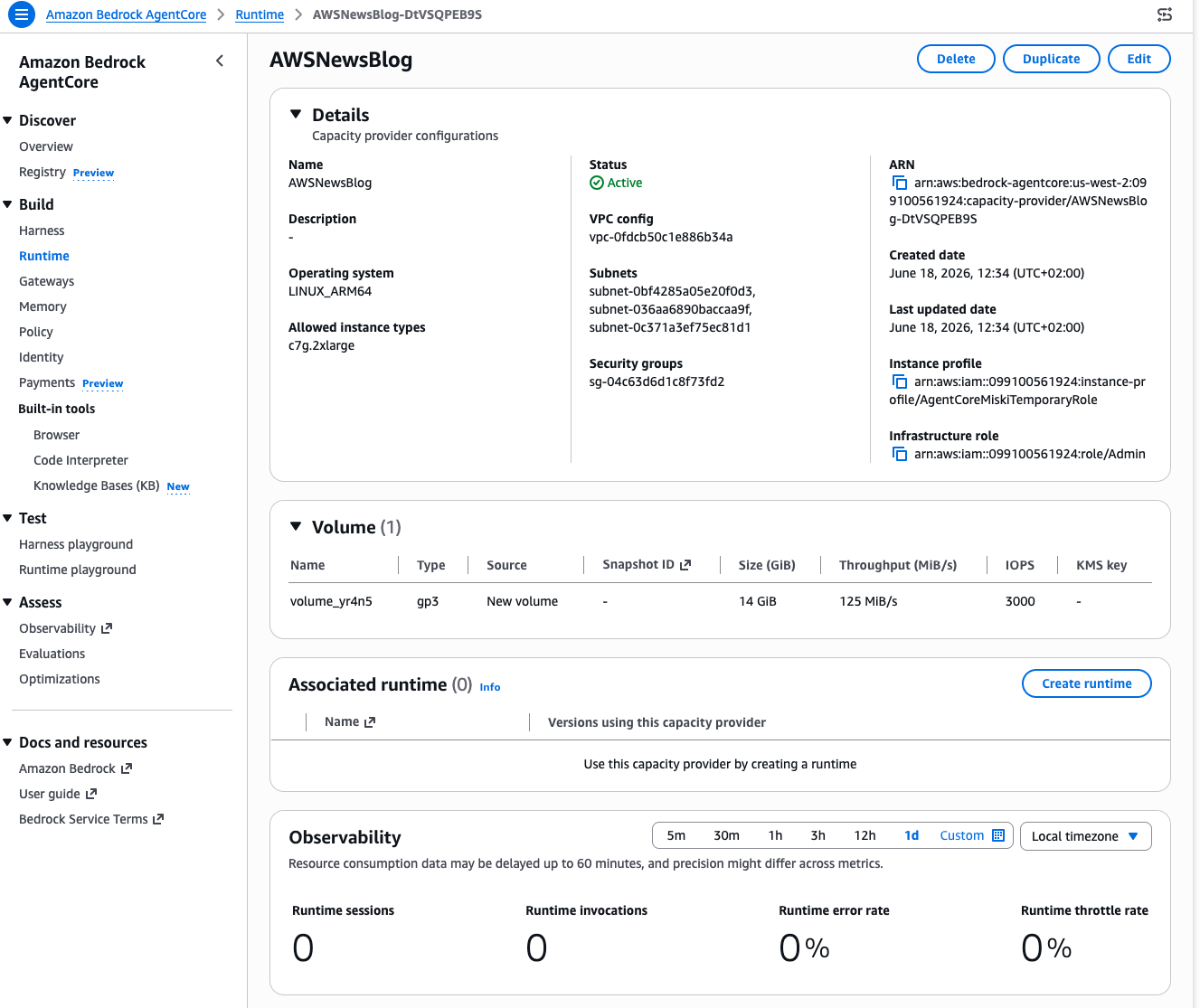
Step 1: Establishing a Capacity Provider
A capacity provider defines the underlying EC2 compute infrastructure that your agents will inhabit.
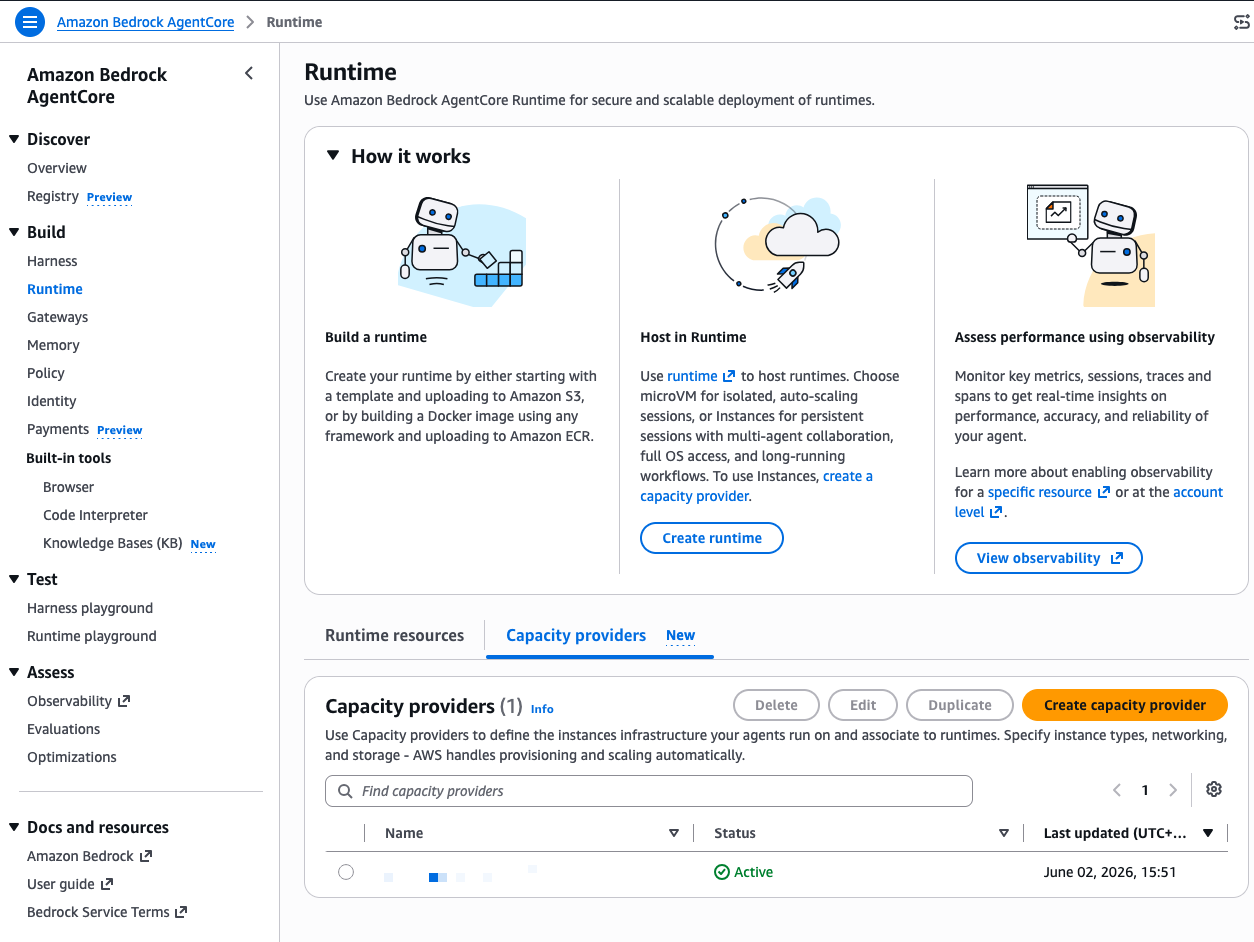
Navigate to the Amazon Bedrock console, select Runtime in the navigation pane, and open the Capacity providers tab.
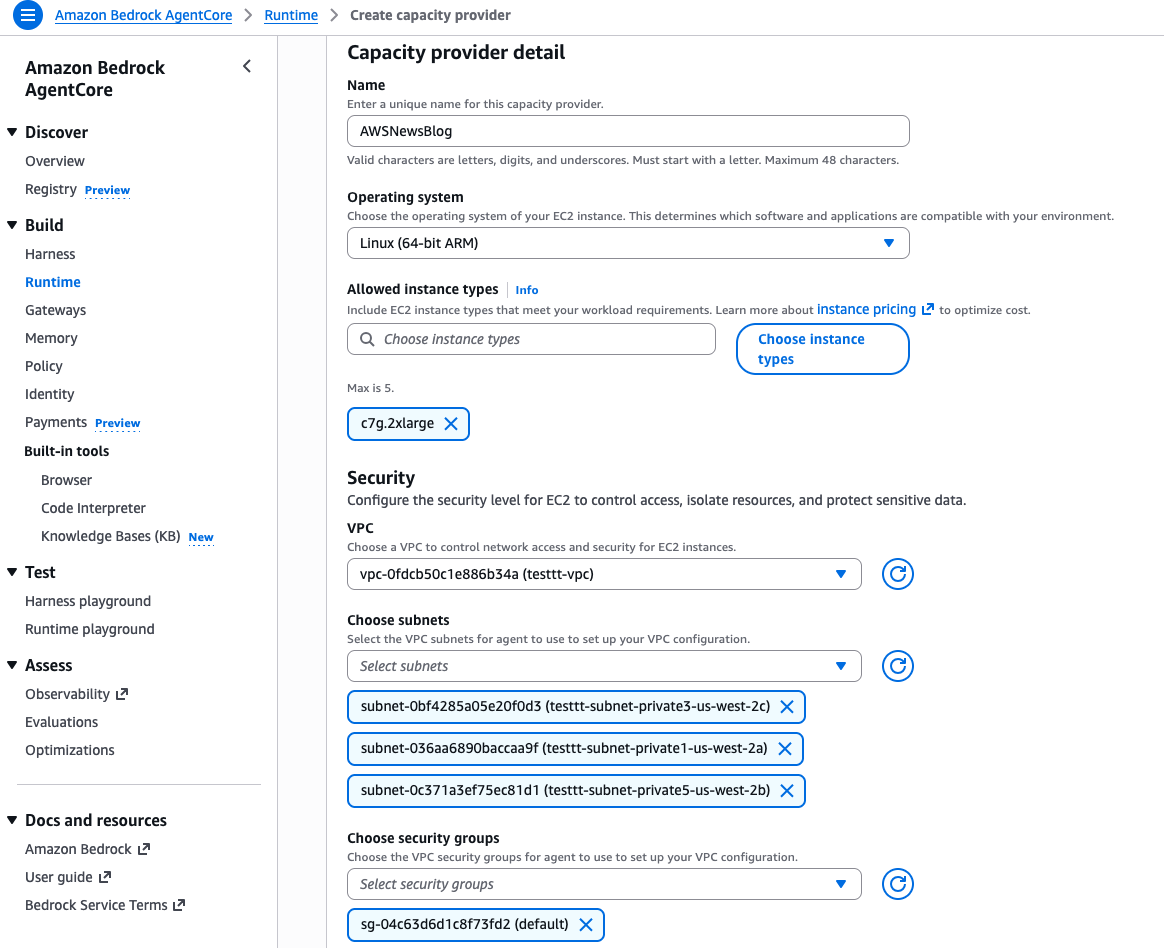
Click Create capacity provider, assign a unique name, choose an operating system (such as Linux 64-bit ARM), and select an appropriate instance type (e.g., c7g.2xlarge).
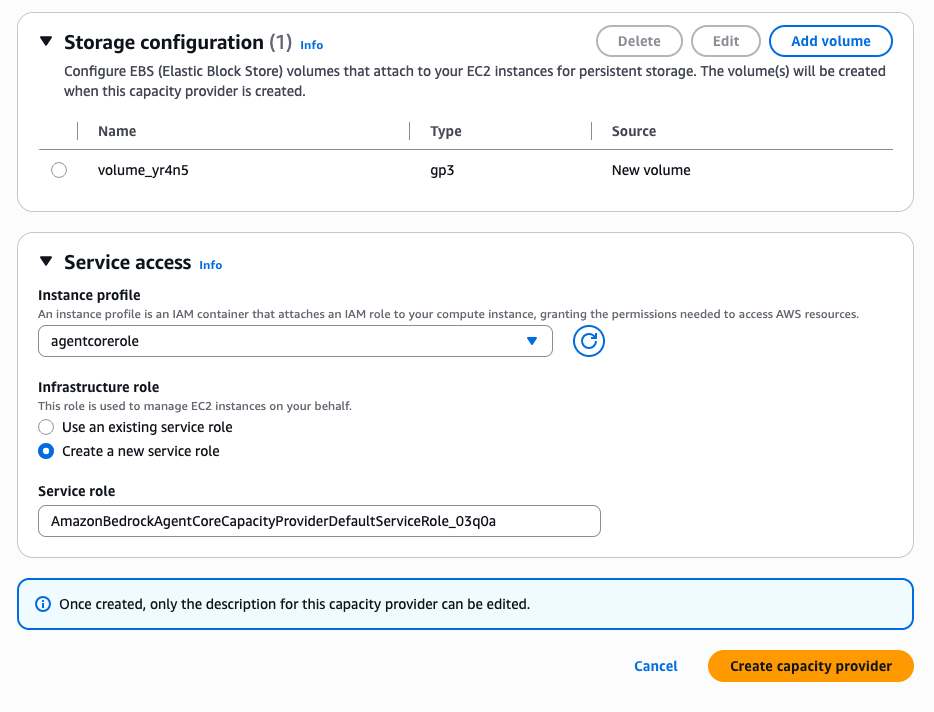
Configure your Virtual Private Cloud (VPC), subnets, security groups, and storage volumes (such as default gp3 EBS volumes).
Select Create a new service role to allow AWS to manage the underlying EC2 resources automatically. Once active, your infrastructure is primed for deployment.
Step 2: Creating Runtimes and Deploying Agent Packages
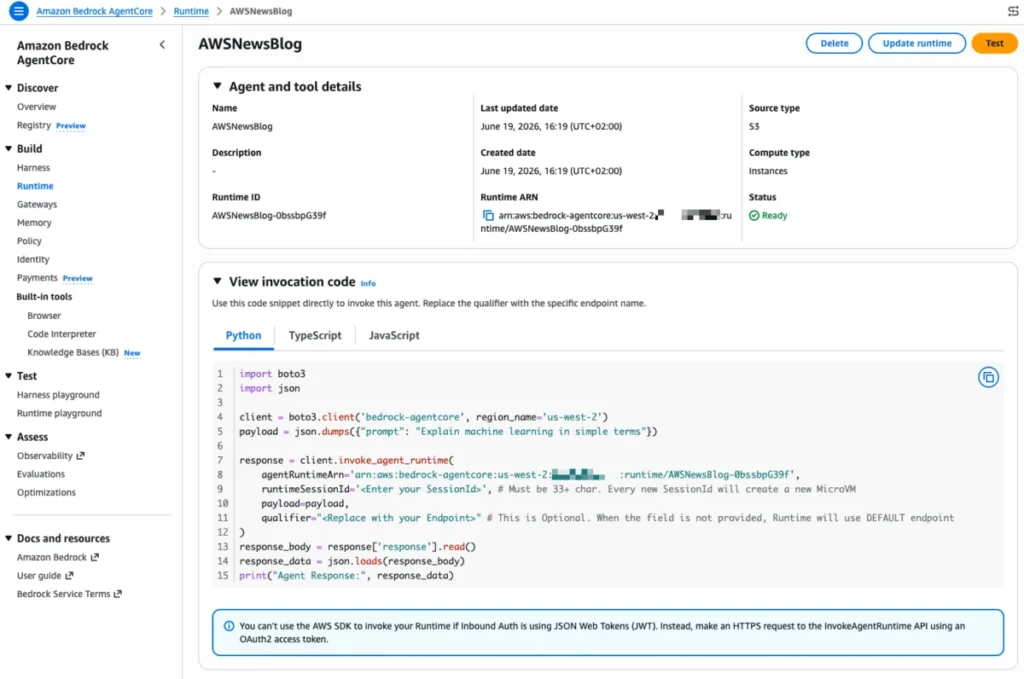
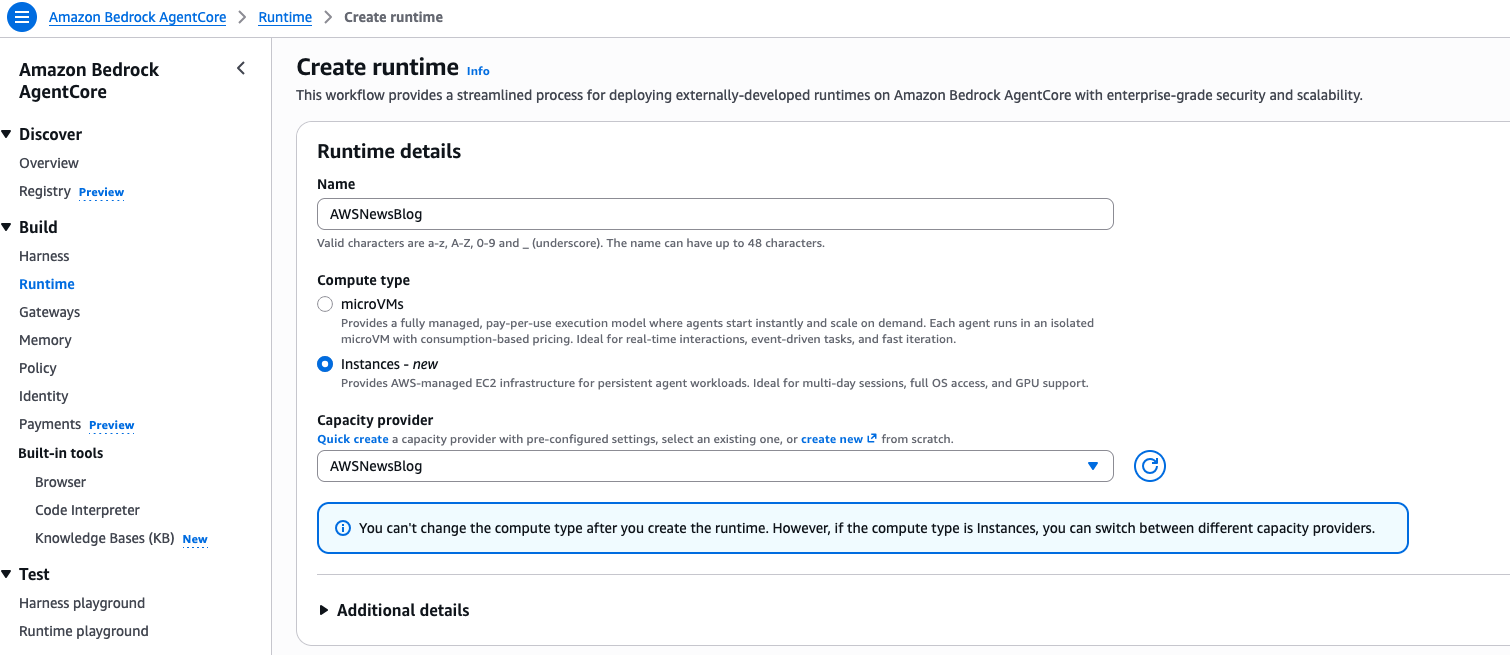
Return to the Runtime page and select Create runtime.
Choose Instances as your compute type and select your newly minted capacity provider.
Under agent source, upload your zipped agent deployment package (containing your Python script and configuration files), specify your language runtime (e.g., Python 3.13), and define your designated agent entry point function.
Provision default IAM permissions and wait for the runtime status to shift to Ready. Repeat this process for any collaborating worker agents.
Step 3: Testing and Cross-Agent Collaboration
Utilize the built-in Runtime playground inside the AWS console to initiate test sessions.
Pass a JSON input payload containing your task prompt. The console will automatically generate and display a unique Session ID.
Switch between different deployed agents in the interface while maintaining the identical Session ID to observe seamless multi-agent workflows operating over shared local session storage.
Official Responses and Industry Implications
Industry analysts and early enterprise adopters have praised the flexibility and foresight of the new offering. By removing the heavy lifting associated with infrastructure provisioning, AWS is accelerating the timeline for organizations moving sophisticated multi-agent automation into production.
"When enterprises attempt to scale AI agents beyond simple question-and-answer bots, infrastructure management quickly becomes the primary bottleneck," noted an enterprise cloud architect close to the AWS ecosystem. "Providing managed, persistent EC2 instances integrated natively with session storage and state management allows developers to focus entirely on agent logic and orchestration rather than battling network configurations and scaling policies."
Key Enterprise Implications:
Reduced Time-to-Market: Engineering teams no longer need to build custom infrastructure scaffolding to support multi-day agent loops or local file-sharing between discrete models.
Enhanced Security and Compliance: Because runtime instances inherit standard AWS Identity and Access Management (IAM) controls, Virtual Private Cloud isolation, and robust encryption standards, organizations can deploy autonomous agents into highly regulated industries with confidence.
Optimized Operational Expenditures: The ability to hibernate active agent sessions during inactive windows ensures that companies only pay for compute resources when active work is being performed, curbing runaway cloud costs.
Summary and Next Steps
The introduction of runtime instances for Amazon Bedrock AgentCore marks a watershed moment for generative AI application development. By combining the rapid scalability of managed microVMs with the persistent, high-capacity muscle of dedicated EC2 instances, AWS has provided developers with a comprehensive, flexible foundation for the next generation of autonomous AI systems.
To begin building your own multi-agent workflows, review the official Amazon Bedrock AgentCore Documentation to configure your first capacity provider and deploy your custom agent runtimes today.