Empowering Local AI: A Guide to Implementing Zero-Shot Text Classification with Scikit-LLM and Ollama
In the rapidly evolving landscape of artificial intelligence, the barrier to entry for developers has traditionally been the cost and complexity of cloud-based APIs. Whether using OpenAI’s GPT-4 or Anthropic’s Claude, relying on proprietary cloud infrastructure for machine learning tasks often results in recurring costs, data privacy concerns, and latency issues. However, a powerful paradigm shift is currently underway: the democratization of Large Language Models (LLMs) through local hosting.
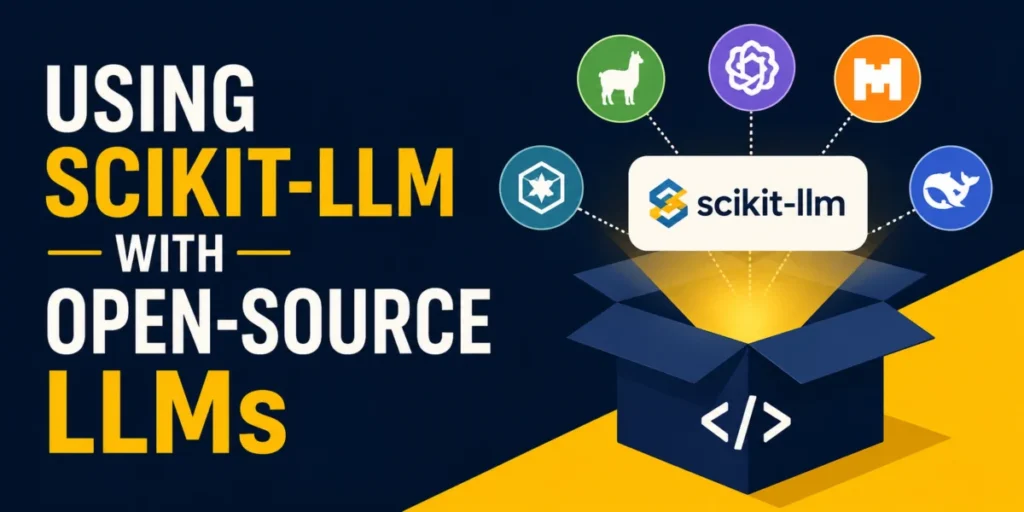
This article explores how developers can harness the synergy between Ollama, an open-source tool for running LLMs locally, and Scikit-LLM, a library that bridges the gap between advanced generative AI and the familiar, robust syntax of the scikit-learn ecosystem. By following this guide, you will learn how to perform professional-grade text classification—entirely on your own hardware, at no cost, and with complete data sovereignty.
Main Facts: The New Standard in Local Machine Learning
The convergence of local model serving and classical machine learning workflows marks a significant milestone for data science. The core challenge in modern text classification is the "cold start" problem: training models that can categorize data without requiring massive, labeled datasets. Traditionally, this required complex neural network architectures. Today, we can leverage the inherent semantic understanding of LLMs to perform "Zero-Shot" classification.
The Toolkit
- Ollama: A high-performance, lightweight runtime that abstracts the complexity of downloading, managing, and serving LLMs like Llama 3, Mistral, and Gemma.
- Scikit-LLM: A sophisticated wrapper that integrates LLMs into the
scikit-learnpipeline. It allows developers to use standard methods like.fit()and.predict()while routing requests to an LLM rather than a local training loop. - Zero-Shot Classification: The ability of a model to categorize text into classes it has never been explicitly trained on, relying instead on the model’s pre-existing knowledge of language.
By routing these calls to a local localhost port rather than a cloud endpoint, you effectively eliminate API latency and operational expenditure, making this an ideal solution for prototyping, privacy-sensitive applications, and high-volume local processing.
Chronology: From Installation to Deployment
Building a local classification pipeline is a process of configuring the bridge between your development environment and your local inference engine.
Phase 1: Environment Setup
Before diving into code, ensure your local environment is prepared to handle model inference.
- Install Ollama: Visit ollama.com and follow the installation instructions for your operating system. Once installed, ensure the daemon is running.
- Pull Your Model: Open your terminal and pull a model. Llama 3 is highly recommended for its balance of performance and efficiency:
ollama run llama3Once the interactive session begins, type
/byeto return to your shell. The model remains active in the background, listening onhttp://localhost:11434.
Phase 2: Dependency Management
In your chosen Python environment, install the necessary libraries:
pip install scikit-learn pandas scikit-llmIf you encounter dependency conflicts, consider utilizing a virtual environment (venv or conda) to maintain a clean workspace.
Phase 3: Configuration and Implementation
The magic happens by configuring the SKLLMConfig. Because Scikit-LLM was originally designed for OpenAI, we must point it toward our local Ollama server.
from skllm.config import SKLLMConfig
from skllm.models.gpt.classification.zero_shot import ZeroShotGPTClassifier

# Point the library to the local Ollama API
SKLLMConfig.set_gpt_url("http://localhost:11434/v1")
# A dummy key is required for internal validation
SKLLMConfig.set_openai_key("local-ollama-is-free")
Supporting Data: The Mechanics of the Workflow
To understand why this approach is effective, one must look at how the data flows through the system. We define a sample dataset—in this case, customer feedback—and categorize it into "Positive Feedback," "Technical Issue," or "Support Request."
The Data Structure
The power of Zero-Shot classification is that we do not need to "train" the model in the traditional sense. We provide the label definitions, and the LLM interprets the semantic intent of the input text against those labels.
import pandas as pd
from sklearn.model_selection import train_test_split

# Sample Data
data =
    "review": [
        "The new macOS update is fantastic and runs smoothly.",
        "My battery is draining incredibly fast after the patch.",
        "I need help resetting my account password.",
        "The display on this monitor is breathtakingly crisp.",
        "Customer support hung up on me, very disappointing."
    ],
    "category": ["Positive Feedback", "Technical Issue", "Support Request", "Positive Feedback", "Negative Feedback"]


df = pd.DataFrame(data)
X_train, X_test, y_train, y_test = train_test_split(df["review"], df["category"], test_size=0.4)
Inference and Execution
By instantiating the ZeroShotGPTClassifier with the custom_url::llama3 prefix, we instruct the classifier to treat our local instance as the primary engine.
clf = ZeroShotGPTClassifier(model="custom_url::llama3")
clf.fit(X_train, y_train)
predictions = clf.predict(X_test)
The resulting output demonstrates that the model successfully maps the input strings to our predefined categories, demonstrating that even with minimal data, the LLM’s pre-trained logic can perform highly accurate categorization.
Official Perspectives and Industry Implications
The transition toward local LLM usage is not merely a hobbyist trend; it is a strategic response to the limitations of cloud-only architectures.
Privacy and Security
In sectors such as healthcare, finance, and legal tech, sending raw data to a third-party API is often a non-starter due to regulatory constraints (e.g., GDPR, HIPAA). By utilizing Ollama, the data never leaves the developer’s machine, effectively mitigating the risk of data leakage or unauthorized training on sensitive user information.
Cost Efficiency
Cloud API usage scales linearly with cost. For high-throughput applications, the expenses associated with tokens can become prohibitive. Running models locally shifts the cost from an operational expense (OpEx)—paying per query—to a capital expense (CapEx)—investing in hardware (GPUs/RAM). Over time, for enterprise-level applications, the latter is significantly more sustainable.
Latency and Connectivity
Dependency on cloud APIs introduces "network jitter." Local models provide predictable response times, independent of internet stability, which is crucial for edge computing and offline applications.
Conclusion: The Future of Accessible AI
The ability to perform sophisticated NLP tasks like zero-shot classification using only local tools represents a profound democratization of technology. By leveraging Ollama and Scikit-LLM, developers are no longer shackled to expensive cloud providers. Instead, they can build robust, private, and cost-effective applications using the same underlying logic that powers the world’s most advanced AI models.
As hardware becomes more capable and local models continue to shrink in size while increasing in intelligence, the gap between local and cloud-based performance will continue to narrow. For the developer, the message is clear: the future of AI is not just in the cloud—it is on your machine. Whether you are building a small-scale sentiment analysis tool or a complex enterprise classifier, the power to innovate is now truly in your hands, without costing you a single cent.