Empowering Movement: Andhra Pradesh Observes World Arthritis Day 2026 with Focused Advocacy
By Staff Reporter
Kadapa/Nellore | October 12, 2026
As the global medical community marks World Arthritis Day 2026, healthcare institutions across Andhra Pradesh have mobilized to confront a rising tide of musculoskeletal disorders. With a dual focus on early diagnosis and the preservation of mobility, hospitals in Kadapa and Nellore held extensive outreach programs on Monday, emphasizing that while arthritis is a chronic condition, it need not be a barrier to an active and fulfilling life.
The Core Mission: Raising Awareness for Joint Health
World Arthritis Day serves as a critical annual reminder of the burden of rheumatic and musculoskeletal diseases (RMDs). This year, the collective efforts of the Vidyasagar Arthritis Foundation, Vidyasagar Hospital, and the Community Paramedics and Primary Health Care Providers Welfare Association of India were centered on the theme: “Achieve Your Dreams — Arthritis Should Not Stop Your Dreams.”
The initiative aimed to bridge the gap between medical knowledge and public practice. By moving the conversation from the clinical confines of hospital wards to the public streets, organizers sought to demystify joint pain, which is often dismissed as an inevitable consequence of aging, rather than a condition that can be managed or even prevented with proactive intervention.
Chronology of Events: From Streets to Seminar Halls
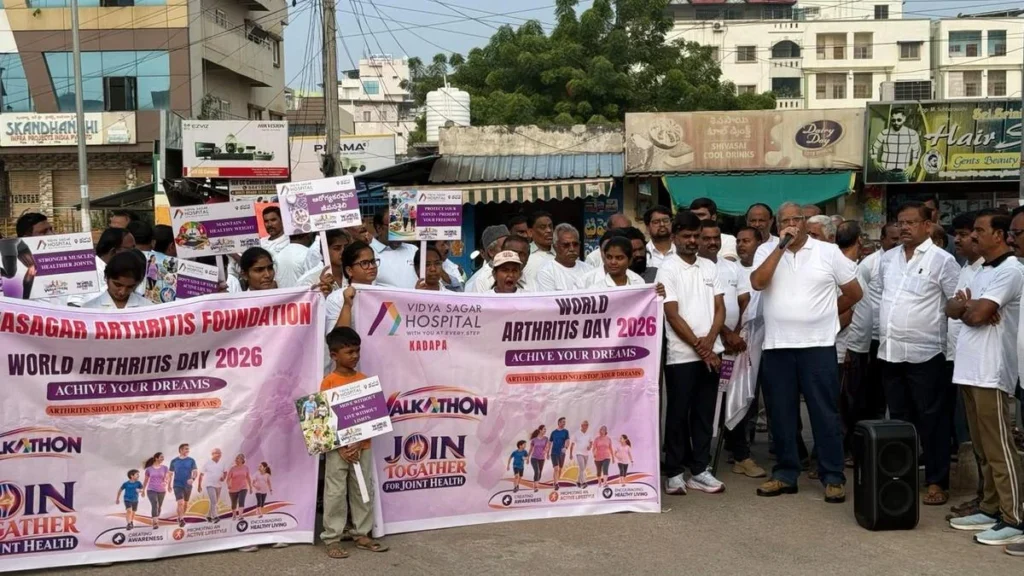
The day’s proceedings began in Kadapa with a symbolic and energetic walkathon. At the crack of dawn, participants gathered at Vidyasagar Hospital, creating a diverse tableau of the community. The route, which stretched from the hospital premises to the prominent Mahaveer Circle, saw a sea of participants ranging from school children and young professionals to senior citizens who have lived with the realities of joint stiffness for decades.
The walkathon was more than a physical exercise; it was a public declaration of solidarity. Local law enforcement supported the effort, with Kadapa District Additional Superintendent of Police, Mr. Prakash Babu, lending his presence to the event. His participation underscored the importance of public health initiatives being supported by administrative leadership.
Following the morning’s outdoor activities, the focus shifted to the coastal city of Nellore. At the Bhaskar Orthopedic Hospital, the atmosphere transitioned from physical mobilization to intellectual engagement. An awareness seminar, organized under the aegis of the Community Paramedics and Primary Health Care Providers Welfare Association of India, provided a platform for deeper medical discourse. Here, the focus remained on the technical aspects of treatment, the warning signs of degenerative joint disease, and the vital role of primary healthcare providers in identifying symptoms before they lead to permanent disability.
Supporting Data and Medical Insights: The Expert Perspective
The medical experts leading these events offered a unified front regarding the management of arthritis. Dr. C. Vidyasagar Reddy, a renowned orthopaedic and robotic joint replacement surgeon, took the opportunity to explain the physiology of joint health to the Kadapa gathering.
"Arthritis is not a single disease, but a complex family of conditions that affect the joints," Dr. Reddy explained. "The modern sedentary lifestyle, characterized by long hours of inactivity and poor ergonomic habits, has accelerated the onset of joint-related issues in younger populations."
According to the experts, the following pillars are essential for maintaining joint longevity:

- Weight Management: Every additional kilogram of body weight places an exponential amount of pressure on the knee and hip joints. Reducing excess weight is the single most effective non-surgical intervention for osteoarthritis.
- Muscle Strengthening: Joints do not function in isolation; they are supported by a complex network of muscles, tendons, and ligaments. Strengthening the quadriceps and core muscles can significantly reduce the load on knee and hip joints.
- Early Detection: In conditions like Rheumatoid Arthritis—an autoimmune disorder—the window for preventing permanent joint damage is narrow. Delaying treatment can lead to irreversible bone erosion.
- Physical Activity: Contrary to the belief that joint pain requires absolute rest, experts advocate for low-impact, regular movement. "Motion is lotion," Dr. Reddy noted, highlighting that consistent, controlled exercise keeps the synovial fluid in joints moving, preventing stiffness.
In Nellore, Dr. Konatham Bhaskar echoed these sentiments, specifically addressing the diagnostic challenges of autoimmune-driven arthritis. "The public often ignores early symptoms like morning stiffness or localized swelling," Dr. Bhaskar stated. "When we finally see these patients in the clinic, the damage is often advanced. The goal of today’s seminar is to teach the public that joint pain is not just a sign of ‘old age’—it is a signal that requires a medical response."
Official Responses and Public Engagement
The success of the events was reflected in the turnout. By involving various stakeholders—doctors, nurses, paramedics, and the general public—the organizers were able to foster a sense of shared responsibility.
The inclusion of the Community Paramedics and Primary Health Care Providers Welfare Association of India was particularly strategic. By training those at the grassroots level of the healthcare system, the medical community ensures that patients in rural and semi-urban areas have access to the same quality of diagnostic advice as those in metropolitan hubs.
Mr. Prakash Babu, in his address, emphasized the role of community health in the broader security and well-being of the district. "A healthy population is the foundation of a prosperous district. When our senior citizens remain active, they remain independent, which reduces the socio-economic burden on families and the state," he remarked.
Implications: A Call to Action for Future Health
As the dust settles on World Arthritis Day 2026, the implications for public health policy in Andhra Pradesh are clear. The rise in joint-related ailments necessitates a long-term strategy that moves beyond awareness campaigns to structural changes in lifestyle.
1. Shift in Public Perception
The events succeeded in challenging the stigma associated with joint pain. By reframing the condition through the lens of "healthy ageing," the organizers encouraged patients to seek help earlier. The messaging "Join Together for Joint Health" was a powerful tool in mobilizing a multi-generational response.
2. Preventive Healthcare as a Priority
The seminars highlighted that the cost of preventing joint degeneration—through diet, exercise, and physiotherapy—is significantly lower than the cost of surgical interventions like robotic joint replacement. Hospitals are now looking to integrate long-term wellness programs that assist patients in maintaining their mobility long after the awareness day has concluded.
3. Strengthening the Referral Chain
The collaboration with paramedical staff is expected to improve the "time-to-treatment" metric. By educating primary caregivers, patients are more likely to be referred to specialists like Dr. Reddy or Dr. Bhaskar at the onset of symptoms, rather than when mobility is already severely compromised.
Conclusion
The activities of October 12, 2026, serve as a milestone in the state’s ongoing battle against chronic musculoskeletal conditions. With the convergence of clinical expertise and public enthusiasm, the message is clear: arthritis may be a challenging diagnosis, but with early intervention, a disciplined approach to lifestyle, and a supportive community, individuals can continue to pursue their dreams, unhindered by pain.
As these institutions continue their outreach, the focus remains firmly on the future—a future where joint health is prioritized, preventive care is accessible to all, and the mobility of the population is preserved for years to come. Through such collective action, the dream of "Healthy Ageing" in Andhra Pradesh is slowly but surely becoming a reality.