Forensic Breakthrough: AIIMS Delhi Report Links Gymnastics Belt to Death of Former Model Twisha Sharma
Introduction: A Search for Truth
The tragic death of 33-year-old former model and actress Twisha Sharma, who was found hanging in her marital home in Bhopal on May 12, has taken a definitive, scientific turn. After months of legal battles, familial allegations, and investigative hurdles, a final forensic report from the All India Institute of Medical Sciences (AIIMS) Delhi has provided what investigators are calling a “crystal-clear” link between physical evidence and the circumstances of her passing.
The 11-page report, submitted to the Central Bureau of Investigation (CBI) on July 10, confirms that a gymnastics belt—previously recovered by police—contains traces of skin tissue that match the ligature marks found on the victim’s neck. This finding is a watershed moment in a case that has been marred by allegations of dowry harassment, domestic abuse, and administrative lapses in the initial autopsy.
Chronology of a Tragedy: From Marriage to Investigation
The Final Hours
Twisha Sharma’s life, which had taken a new trajectory following her marriage to lawyer Samarth Singh last December, ended abruptly on the night of May 12. According to the FIR lodged by her family, the sequence of events leading up to her death remains a subject of intense scrutiny.
At 9:41 p.m., Twisha was in conversation with her mother. During this final call, the family alleges they could hear Samarth Singh shouting in the background before the call was abruptly disconnected. When subsequent attempts to reach Twisha failed, her mother-in-law, Giribala Singh—a retired judge—reportedly answered the phone, informing the family that “she is no more” before severing the line.
The Immediate Aftermath
Samarth Singh claimed he found his wife hanging at their residence at approximately 10:20 p.m. and rushed her to AIIMS Bhopal. However, medical staff at the facility informed the authorities that Twisha was “brought dead.” This discrepancy triggered a medico-legal case, leading to the first post-mortem examination.
The Legal and Forensic Impasse
The initial autopsy conducted at AIIMS Bhopal was hampered by a critical failure: the alleged ligature material (the gymnastics belt) was not produced before the medical board. Consequently, while the report noted “antemortem hanging” and “multiple antemortem injuries,” it remained inconclusive regarding the precise mechanics of the death.
Sensing a cover-up and citing massive procedural lapses, Twisha’s family petitioned the Madhya Pradesh High Court. The court responded by ordering a second, independent autopsy to be conducted by a specialized board at AIIMS Delhi and subsequently transferred the investigation to the CBI to ensure impartiality.

Supporting Data: The AIIMS Delhi Forensic Findings
The second post-mortem, performed on May 24, was conducted by a five-member board of forensic experts led by Dr. Sudhir Gupta, the Head of the Department of Forensic Medicine at AIIMS Delhi. The depth of the investigation reflects the gravity of the allegations.
Scientific Justification
The board spent nearly a month conducting an exhaustive evaluation. This process involved:
- Histopathological Analysis: Laboratory testing identified human skin tissue on the gymnastics belt.
- Injury Pattern Matching: Experts compared the physical dimensions and characteristics of the belt—which featured a metal ring at one end—against the specific ligature marks on the victim’s neck. The correlation was found to be consistent.
- Cross-Referencing: The team consulted a wide array of national and international forensic journals to ensure their methodology met the highest global standards for death investigation.
Dr. Sudhir Gupta described the deliberation process as “minutely detailed,” noting that the board examined every possible angle before reaching a consensus. “It is a crystal-clear opinion for the CBI and for the judiciary in the interest of truth and justice,” Dr. Gupta stated, though he remained cautious about releasing specific details due to the ongoing nature of the CBI probe and the sealed-cover submission protocol mandated by the High Court.
Official Responses and Procedural Status
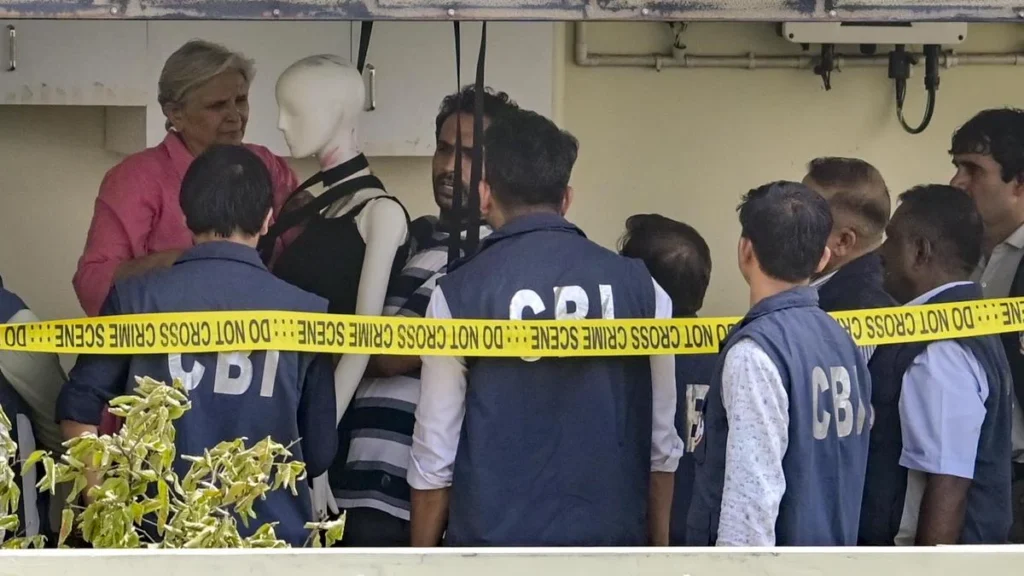
The submission of the 11-page report marks a transition point for the CBI. The agency is currently analyzing the forensic evidence to reconcile it with witness statements and the electronic evidence—including the phone call logs and the video recordings of the second autopsy, which remain in the custody of the investigative officers.
The report has also been formally communicated to the Registrar General of the Madhya Pradesh High Court, fulfilling the court’s compliance orders. The CBI is now tasked with integrating this scientific confirmation into their broader case, which focuses on the allegations of dowry harassment and mental torture.
The inclusion of the belt as a definitive piece of evidence significantly weakens potential defense arguments that the death was a simple suicide without external influence or physical struggle. The presence of “multiple antemortem injuries” noted in the first report, coupled with the new evidence, shifts the narrative toward a potential criminal homicide or coerced suicide.
Implications: The Quest for Accountability
The implications of this forensic report extend beyond the immediate case. The Twisha Sharma matter has become a rallying point for activists highlighting the vulnerabilities of women within affluent, influential families.

Allegations of Dowry and Domestic Abuse
Twisha’s family has maintained that her marriage was marked by intense pressure. They allege that her in-laws were dissatisfied with the dowry provided at the time of the wedding and that this dissatisfaction, compounded by domestic violence, created an environment that rendered her life unbearable. The fact that the mother-in-law is a retired judge has led to widespread public discourse regarding the influence of the judicial class in the investigation of crimes committed by their own kin.
Institutional Trust and Forensic Reform
The need for a second autopsy at AIIMS Delhi serves as an indictment of the initial investigative failures in Bhopal. The inability of the local medical board to secure the primary evidence—the ligature material—raises questions about the training and rigor of local forensic protocols. The intervention of the High Court and the subsequent involvement of a central agency were deemed necessary to bypass potential local influence.
Future Legal Proceedings
With the forensic evidence now scientifically established, the legal trajectory of the case is likely to accelerate. The CBI is expected to move toward filing a chargesheet based on the findings. For the family of Twisha Sharma, the report is a bitter validation of their persistent claims. For the legal system, it remains a test of whether justice can be served impartially when the accused are connected to the very institutions tasked with upholding the law.
As the CBI continues to synthesize the forensic report with the testimonies collected, the focus will likely shift to the motive and the exact timeline of the night of May 12. The “metal ring” on the gymnastics belt may well be the key that unlocks the final truth of what transpired in that Bhopal household, transforming a case of suspicious death into a landmark trial on domestic violence and institutional accountability.
Conclusion
The path to justice is rarely linear, and in the case of Twisha Sharma, it has been particularly arduous. The forensic breakthrough from AIIMS Delhi provides a foundation of cold, hard facts that can no longer be ignored. As the investigation enters its next phase, the spotlight remains on the CBI to ensure that the scientific evidence leads to a conclusion that brings closure to a grieving family and serves as a firm deterrent against the systemic abuse that continues to plague many households across the country.