From Ad Manager to BigQuery: The Strategic Guide to Centralizing Your Facebook Ads Data
In the modern digital marketing landscape, data is the lifeblood of decision-making. Yet, for many growth teams, Facebook Ads Manager has become a "walled garden." While the platform provides essential metrics for individual campaigns, analyzing that data at scale—or attempting to correlate it with CRM, product usage, or revenue data—often leads to fragmented insights and operational bottlenecks.
As businesses pivot toward data-driven decision-making, the demand for moving Facebook Ads data into a centralized, cloud-based data warehouse like Google BigQuery has reached an all-time high. This transition is no longer just a technical preference; it is a strategic imperative for companies that need to calculate true Return on Ad Spend (ROAS) and lifetime value (LTV).
The Main Challenge: The Data Silo Problem
The primary hurdle for marketing teams is the inherent limitation of Ads Manager. While it is excellent for tactical, real-time campaign management, it is not designed to be an analytical engine. When you attempt to join Facebook performance data with your backend database, you encounter "the silo problem."
Without a unified view in a tool like BigQuery, marketing teams are forced to manually export CSVs, resulting in data that is stale the moment it is saved. Furthermore, the volatility of the Facebook Marketing API—characterized by frequent schema updates and deprecation cycles—makes building and maintaining custom integration pipelines a significant burden for data engineering teams.
Methods of Integration: A Chronological Assessment
To bridge the gap between Facebook and BigQuery, organizations typically choose one of three paths, each with distinct trade-offs in terms of cost, engineering effort, and reliability.
1. The Manual Export Approach (The Legacy Method)
For small businesses or ad-hoc reporting, manual export remains the most accessible, albeit inefficient, method.
- The Workflow: Data is exported as a CSV from the Ads Manager dashboard and uploaded manually to a BigQuery dataset.
- The Reality: This method is plagued by human error, lack of historical consistency, and an inability to scale. It is a reactive process that prevents real-time, high-velocity decision-making.
2. Custom Engineering (The "Build" Approach)
Engineering-reliant teams often opt to build custom ETL (Extract, Transform, Load) pipelines using Python or specialized scripts interacting with the Facebook Marketing API.
- The Workflow: Engineers write code to authenticate with the API, fetch granular campaign metrics, handle pagination and rate limits, and push the data into BigQuery.
- The Reality: While this offers total control, it introduces "technical debt." When Meta updates its API—a recurring event—scripts break, and engineering time is diverted from core product development to maintenance.
3. Automated Pipelines (The "Buy" Approach)
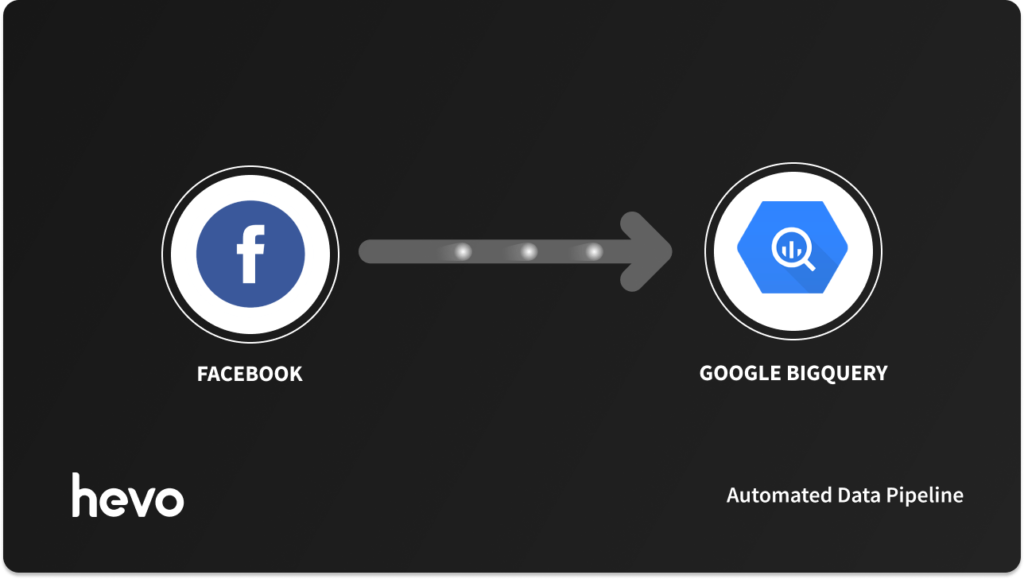
The industry is increasingly shifting toward automated, no-code data pipelines like Hevo. These tools act as a middleware, handling the complexities of schema mapping, API version management, and incremental data syncing.
- The Workflow: A pre-built connector authenticates with the Facebook Ads account, automatically ingests the required tables, and loads them into BigQuery in real-time or near-real-time.
- The Reality: This approach provides the reliability of an enterprise-grade solution without the overhead of ongoing maintenance, allowing analysts to focus on SQL-based insights rather than pipeline debugging.
Supporting Data: The Impact of Centralization
Why invest the effort to move this data? The benefits extend beyond mere convenience. According to industry benchmarks, companies that centralize their marketing data in a warehouse like BigQuery experience three major performance improvements:
- Reduced Reporting Latency: By automating the data flow, teams eliminate the 24-to-48-hour delay associated with manual reporting, allowing for mid-campaign optimizations.
- Granular Attribution: When Facebook data resides in the same environment as sales data, marketers can map an ad click directly to a closed-won deal, moving beyond "last-click" attribution models.
- Predictive Modeling: With a longitudinal dataset stored in BigQuery, data scientists can apply machine learning models to identify seasonality patterns, churn triggers, and optimal spend allocation.
Technical Implementation: Integrating with Hevo
For organizations prioritizing speed and reliability, the integration process via a platform like Hevo can be broken down into three logical stages:
Step 1: Configuring the Source
The user authenticates their Facebook Ads account within the Hevo interface. The system prompts the user to select the specific Ad Accounts, campaign objectives, and attribution windows. This configuration ensures that only relevant data is synced, optimizing costs.
Step 2: Mapping to the Destination
Once the source is verified, the user connects their Google BigQuery project. Hevo handles the schema creation, ensuring that the nested JSON objects returned by Facebook’s API are correctly flattened or parsed into BigQuery tables, maintaining data integrity.
Step 3: Pipeline Activation
After the initial full-load (historical data synchronization), the pipeline switches to an incremental mode. Using "high-watermark" logic, the system only fetches new or modified records, keeping the BigQuery dataset fresh without exceeding API rate limits.
Implications for Modern Business
The integration of Facebook Ads data into a cloud data warehouse has profound implications for the marketing tech stack.
Unified Customer Profiles
When you correlate Facebook ad sets with CRM data, you stop seeing "anonymous conversions" and start seeing the specific customer segments that respond to particular creative assets. This allows for highly personalized retargeting, which significantly improves conversion rates.
The Death of "Vanity Metrics"
In Ads Manager, it is easy to fixate on "Likes" or "Clicks." In BigQuery, however, those metrics are meaningless unless they are tied to revenue. By joining Facebook spend data with transaction logs, teams can calculate true profitability, identifying which campaigns are actually driving business value rather than just traffic.
Competitive Benchmarking
BigQuery allows teams to aggregate their performance data alongside industry benchmarks. By normalizing your performance data (e.g., comparing your CPA against sector averages), you can move beyond internal self-evaluation and gain a clear understanding of your competitive positioning.
Frequently Asked Questions (FAQ)
Q: Why does the Facebook API require so much maintenance?
A: Meta frequently updates its API to enhance privacy, security, and performance. Each "version" (e.g., v25.0) has a lifecycle. If your code is not updated to handle these deprecations, your data pipeline will eventually fail.
Q: Is BigQuery expensive to run?
A: BigQuery uses a pay-as-you-go model. For most businesses, the storage and query costs are highly efficient, especially when compared to the cost of human hours spent on manual data consolidation.
Q: Can I use Webhooks for real-time reporting?
A: Yes, webhooks allow Facebook to "push" events to your server as they happen. This is excellent for immediate alerts (e.g., if ad spend spikes unexpectedly), but it should be paired with a bulk API sync for comprehensive historical reporting.
Q: How do I handle PII (Personally Identifiable Information)?
A: When syncing data to BigQuery, it is crucial to implement data masking or hashing protocols. Most enterprise ETL tools provide features to strip or encrypt sensitive user information during the ingestion process, ensuring GDPR and CCPA compliance.
Conclusion: The Path Forward
The transition from manual spreadsheet management to automated data pipelines is a hallmark of a maturing digital marketing organization. As Meta continues to evolve its API and privacy standards, the ability to maintain a robust, reliable data pipeline becomes a distinct competitive advantage.
By leveraging platforms like BigQuery for storage and automated tools like Hevo for ingestion, marketing teams can finally shed the burden of technical maintenance. This shift allows the focus to return to where it belongs: crafting creative campaigns, refining audience segments, and driving measurable, sustainable business growth in an increasingly complex digital ecosystem.