India’s Used-Car Market Shifts Gears: Spinny Leads New Wave of Auto Tech IPOs
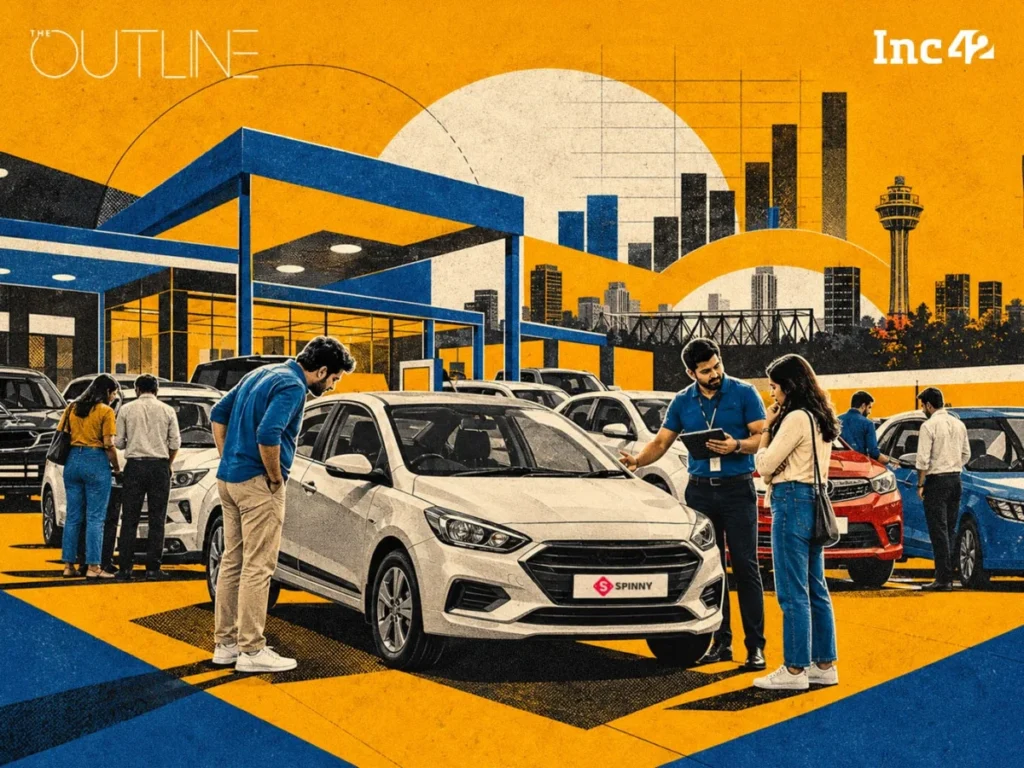
New Delhi — Five years ago, CarTrade made history as one of the first digital automotive marketplaces to brave India’s public markets. Debuting in August 2021 at an issue price of INR 1,618 per share, the stock has since appreciated to hover around INR 3,000. That trajectory has provided public market investors with a multi-year case study on how to price the intersection of technology and pre-owned vehicle retail in a rapidly developing economy.
Today, a prominent new cohort of used-car and auto commerce unicorns is gearing up to follow in those footsteps. Industry heavyweights including Spinny, Cars24, and CarDekho are actively laying the groundwork for public market debuts. Among them, Gurugram-based full-stack used-car platform Spinny has taken a definitive lead, pre-filing its initial public offering (IPO) papers. According to sources close to the development, the company is looking to raise between INR 2,500 Cr and INR 3,000 Cr through a strategic combination of fresh equity issues and an offer for sale (OFS).
While the startup is eyeing an aggressive public market debut by 2027, industry insiders note that final timelines will remain subject to regulatory greenlights from the Securities and Exchange Board of India (SEBI). Furthermore, the ultimate issue size, valuation targets, and structural makeup of the offering are bound to evolve as the IPO process progresses.
The Macro Picture: A Maturing Pre-Owned Auto Ecosystem
Spinny’s public market ambitions arrive at an inflection point for Indian retail. Buying a pre-owned vehicle is rapidly shedding its historical stigma, transitioning into a mainstream, pragmatic choice for value-conscious Indian consumers facing rising price tags on new vehicle registrations.
According to market research firm Redseer, India’s used-car market is on an explosive growth trajectory. The sector is expected to balloon into a staggering $70 billion industry by FY31. Annual sales are projected to scale between 9 million and 10 million vehicles, translating to a robust compound annual growth rate (CAGR) of 14% to 18%.
Yet, for a heavily capitalized business like Spinny, the underlying narrative extends far beyond top-line expansion. The critical test for management will be demonstrating a clear, repeatable path to converting sheer operational scale into sustainable profitability.
Chronology of Evolution: From Startup to Public Market Contender
To understand Spinny’s current positioning, it is essential to examine the strategic evolution of the company:
- The Inception Years: Built around an inventory-led, full-stack model, Spinny opted out of the asset-light classifieds approach. Instead, the company directly procures used cars from individual sellers, runs them through rigorous multi-point mechanical inspections, executes deep refurbishment, and retails them straight to buyers with warranties.
- Rapid Scale-Up: Over the past several fiscal cycles, the company expanded aggressively into major tier-1 and tier-2 consumption hubs across India, building out vast physical parking hubs, refurbishment facilities, and localized delivery infrastructure.
- Ecosystem Expansion: To widen its monetization funnel, Spinny progressively integrated allied services—facilitating vehicle financing, third-party insurance, and certified buyback warranties.
- The GoMechanic Acquisition: In November 2025, Spinny executed a pivotal cash-and-stock transaction valued at approximately INR 450 Cr to acquire distressed car-servicing and repair startup GoMechanic. This move integrated end-to-end after-sales maintenance directly into the Spinny brand architecture.
- The B2B Pivot (Spinny Circle): Launching its Spinny Circle platform, the company branched out to assist traditional new-car dealerships in managing exchange vehicles—handling everything from inspection and valuation to final resale settlement.
- Pre-Filing for IPO (2026): Reaching multi-billion-rupee revenue scale, Spinny officially pre-filed its IPO documentation, targeting a public listing window by 2027 to capture the tailwinds of India’s organized pre-owned auto boom.
Financial Breakdown: Fast Lane Growth vs. Bottom-Line Realities
Spinny’s financial filings paint a picture of an organization operating in the fast lane, scaling revenues at an impressive clip while continuously tightening its structural deficit.
Revenue Acceleration
Spinny’s operating revenue nearly doubled across a two-year window, touching INR 4,656 Cr in FY25. Momentum carried forward into FY26, with estimates pointing to a 29% jump, pushing top-line revenues to approximately INR 6,000 Cr. Company projections indicate another robust 25% to 30% growth phase for the current fiscal year.

A deeper dive into the FY25 metrics reveals that revenue from contracts with customers stood at INR 4,650 Cr. Notably, nearly 98% of this figure was generated directly from vehicle sales, while ancillary streams like transaction commissions and service fees remained minor contributors.
Cost Structure and Margins
Fueling that growth requires massive capital outlays. In FY25, Spinny expended INR 4,304 Cr on the procurement of goods, which included INR 4,250 Cr dedicated strictly to stock-in-trade purchases. An additional INR 136.8 Cr was burned through direct operational costs, encompassing refurbishment work, logistics management, and warranty provisions.
Consequently, profitability continues to lag behind scale. Spinny reported a net loss of INR 423.8 Cr for FY25. However, the silver lining for equity researchers is that this loss reflected a 28% contraction compared to the preceding fiscal year, demonstrating progressive operational leverage.
Meanwhile, its newly acquired asset, GoMechanic, added FY25 revenues of INR 144.5 Cr prior to integration, providing a foundation for future after-sales earnings once unified FY26 consolidated reports are released.
Supporting Data & Market Sentiment
Public market appetite for technology-driven consumer plays remains volatile. The broader macroeconomic environment adds nuance to Spinny’s timing.
For instance, the Nifty Auto index experienced a correction, dipping nearly 6% over a recent monthly cycle following a prolonged bull run, with several major Original Equipment Manufacturers (OEMs) facing steep pullbacks.
"Although used-car marketplaces operate under a fundamentally different business model from traditional auto manufacturing companies, a softer sentiment towards the broader automotive sector can inevitably influence how institutional investors initially price the category," noted an automotive sector analyst tracking the upcoming IPO pipeline.
Furthermore, the structural fragmentation of the Indian market represents both a challenge and an opportunity. Currently, roughly 80% of all used-car transactions in India occur through unorganized, localized channels—mom-and-pop dealerships and peer-to-peer deals marred by information asymmetry.
Organized players are working to shift this dynamic. Value propositions such as standardized inspection reports, transparent pricing engines, instant financing approvals, buyback guarantees, transfer of ownership paperwork, and doorstep delivery are transforming consumer expectations. Crucially, the target demographic is no longer restricted to entry-level hatchbacks; rising disposable incomes and compressed vehicle ownership cycles are pulling premium sedans and compact SUVs into the resale funnel at an unprecedented rate.

Official Perspectives and Industry Implications
Industry leaders and competitor executives are closely monitoring Spinny’s trajectory, viewing it as a bellwether for the broader tech-enabled commerce ecosystem in India.
"The strategic logic driving Spinny is clear: they want to bring after-sales vehicle servicing into a unified ecosystem," shared a CXO at a rival marketplace who requested anonymity. "By doing so, they hope to monetize customers well beyond the initial vehicle purchase. They are attempting to build a lifetime ownership ecosystem rather than relying solely on the thin margins fetched from the initial retail flip."
The core strategic debate within the industry centers on business models. A distinct divide is emerging between asset-light marketplaces and inventory-heavy enterprises:
- Asset-Light Models (e.g., CarTrade): Operating primarily across classifieds, online auctions, and vehicle remarketing, these entities avoid heavy inventory holding costs and balance-sheet risks.
- Inventory-Led Models (e.g., Spinny): By taking direct ownership of cars, these platforms maintain absolute quality control over sourcing, multi-point refurbishment, pricing integrity, and the end-user delivery experience.
However, holding inventory exposes companies to distinct risks. Market fluctuations, sudden regulatory shifts—such as changes in fuel norms, the push toward E20 petrol blends, or EV adoption rates—can sharply alter the residual values and demand dynamics of internal combustion engine (ICE) used vehicles.
The Road Ahead
For Spinny, the upcoming IPO marks the end of its foundational phase as a venture-backed startup and the beginning of its test as a publicly accountable enterprise.
The next chapter will not merely be about opening more parking hubs or entering new municipal markets. Success on the public bourses will depend heavily on algorithmic intelligence—optimizing vehicle acquisition pricing, predicting localized demand matching, accelerating inventory turnover cycles, and extracting long-term lifetime value from consumers via financing, insurance, and repairs.
As India’s $70 billion pre-owned car market races toward its 2031 projections, Spinny’s performance in the public markets will serve as a definitive litmus test for whether capital-intensive, full-stack commerce models can successfully deliver sustainable bottom-line returns to public shareholders.