Jio Platforms Files DRHP: A Deep Dive Into India’s Most Anticipated IPO
In what is poised to be a watershed moment for the Indian equity markets, Reliance Industries’ (RIL) digital and telecom juggernaut, Jio Platforms, has officially filed its Draft Red Herring Prospectus (DRHP). This move signals the beginning of one of the largest public offerings in the history of the Indian capital markets. Unlike typical market debuts that often include a mix of new shares and existing stakes, Jio’s IPO is set to be a "fresh issue only" offering, comprising 27 crore shares aimed at fueling the company’s next phase of growth.
The Financial Landscape: Powering Growth and Debt Reduction
The primary objective behind this massive capital raise—estimated to be in the range of $4 billion—is twofold: strengthening the balance sheet and operational expansion. According to the draft papers, the company intends to utilize approximately ₹27,500 crore (roughly $3 billion) to prepay outstanding borrowings of its subsidiary, Reliance Jio Infocomm Ltd (RJIL).
This strategic debt reduction is crucial. As of 2024, RJIL had entered into significant external commercial borrowing and term loan facility agreements totaling $676 million and JPY 44,923 million. With a consortium of 16 global lenders—including heavyweights such as Citibank, Standard Chartered, SBI, and MUFG Bank—the IPO provides a clear roadmap for Jio to deleverage and improve its interest coverage ratios.
The fiscal health of the entity remains robust, reflecting its dominance in the Indian digital ecosystem. In the fourth quarter of FY26, Jio Platforms reported a net profit of ₹7,935 crore, a 13% year-on-year increase from the ₹7,023 crore recorded in the corresponding quarter of the previous year. Operating revenue also saw a healthy uptick of 12.6%, climbing to ₹38,259 crore, underscoring the platform’s ability to scale revenue even amidst fierce competition.
Chronology: From 2016 Disruption to Global Powerhouse
To understand the scale of this IPO, one must look back at the trajectory of Jio. Since its inception in 2016, Jio has effectively rewritten the rules of the Indian telecom sector, bringing affordable high-speed data to millions and creating a digital infrastructure that supports a vast array of services.

The year 2020 served as the pivotal turning point for the company. Amidst the global pandemic, Jio executed a masterstroke by securing ₹1.52 lakh crore in funding from a cohort of 13 marquee global investors. This move not only provided the necessary liquidity to expand its footprint but also validated Jio’s business model on the global stage.
The investment round saw two distinct tiers of shareholders emerge:
- Group A Investors: Led by Meta (Facebook) and Google, which took stakes of 9.98% and 7.73%, respectively.
- Group B Investors: A prestigious list of global institutional giants, including KKR, Vista Equity Partners, General Atlantic, the Public Investment Fund (PIF) of Saudi Arabia, the Abu Dhabi Investment Authority (ADIA), Mubadala, Intel, and Qualcomm.
These partnerships transformed Jio from a domestic telecom operator into a diversified digital conglomerate. Today, the company boasts 34 subsidiaries, spanning a wide array of sectors including satellite communications, digital media (Saavn), and AI-driven consumer services (Haptik), with 14 of these subsidiaries based in India and the remainder operating internationally.
The Leadership Deck: A Blend of Vision and Governance
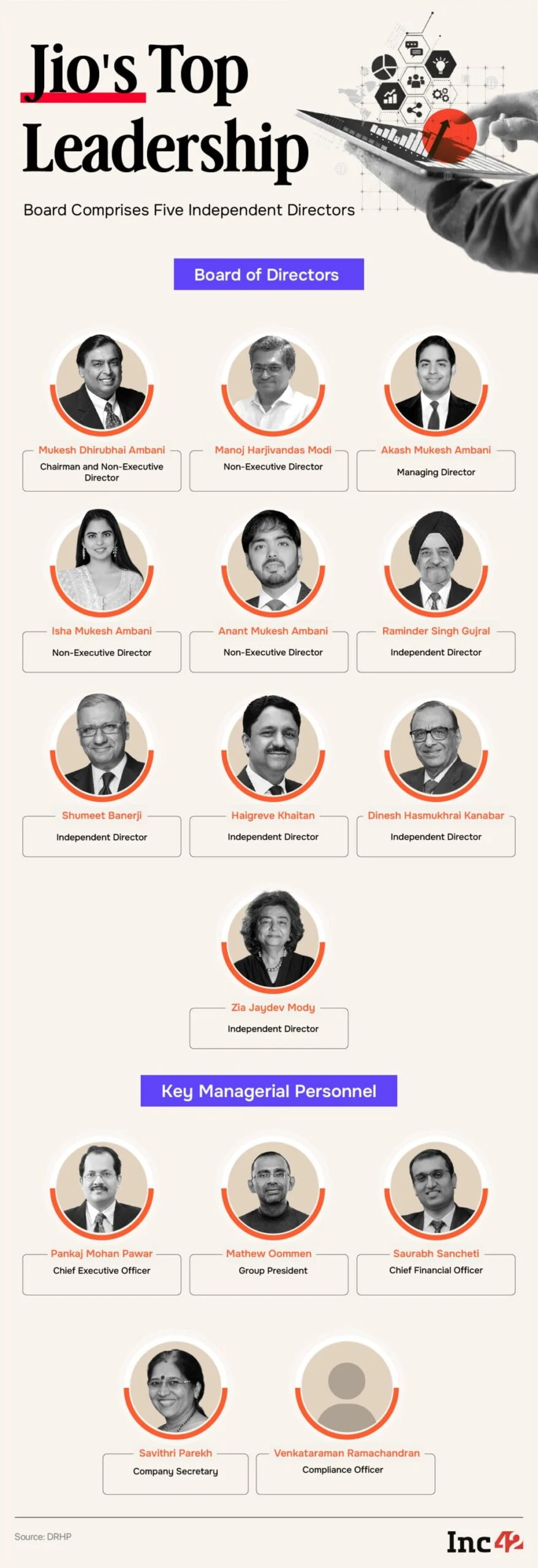
The governance structure of Jio Platforms reflects the strategic importance placed on both family-led vision and professional management. The board is a powerhouse of industry veterans and Reliance stalwarts.
The Board of Directors
- Mukesh Dhirubhai Ambani (Chairman & Non-Executive Director): The architect of Reliance’s digital pivot, Ambani has steered the company from a traditional energy conglomerate to a technology-first leader.
- Manoj Modi: A critical strategist who has been with RIL since 1980. His role in conceptualizing the roadmap for both Reliance Jio and Reliance Retail is widely regarded as a cornerstone of the group’s success.
- Akash Ambani (Managing Director): As the chairman of RJIL since 2022, Akash is central to the operational execution of Jio’s digital and connectivity goals.
- Isha and Anant Ambani: Both serve as non-executive directors, providing oversight and strategic alignment with the broader Reliance group interests, including retail, foundations, and sustainability initiatives like the Vantara wildlife project.
Independent Oversight
Jio has bolstered its board with high-profile independent directors, including Raminder Singh Gujral (former Secretary of Revenue and Chairman of the NHAI), Shumeet Banerji (founder of Condorcet LP), Haigreve Khaitan (managing partner at Khaitan & Co), Dinesh Hasmukhrai Kanabar (founder of Dhruva Advisors), and Zia Jaydev Mody (co-founder of AZB & Partners). This board composition signals a commitment to global standards of corporate governance and legal compliance.

Key Managerial Personnel
The daily operations are helmed by a team of veterans:
- Pankaj Mohan Pawar (CEO): With three decades of experience, Pawar is the engine behind Jio’s consumer service expansion.
- Mathew Oommen (Group President): A key figure in managing Jio’s global technology relations and licensing efforts.
- Saurabh Sancheti (CFO): Having joined in 2020, Sancheti has been instrumental in navigating the complex financial landscape of the last six years.
Market Implications: What to Expect
The filing of the DRHP is not merely a fundraising event; it is a signal of the maturity of the Indian digital economy. For investors, the Jio IPO offers a rare opportunity to own a piece of a company that is at the heart of India’s internet consumption.
However, the IPO also arrives at a time of increased scrutiny. Regulators will likely focus on the company’s capital structure and the concentration of ownership within the Reliance promoter group, which currently holds 66.43% of the equity. Furthermore, with 105 diverse shareholders in the cap table, the IPO will be a massive exercise in liquidity management for early-stage investors looking to exit or rebalance their portfolios.
Industry analysts suggest that the "fresh issue" nature of the IPO indicates that Reliance is confident in its internal cash flows and is prioritizing the reduction of debt over simply creating an exit for existing shareholders. By clearing the books of RJIL’s debt, Jio is positioning itself to be a leaner, more agile entity, potentially allowing for higher dividend payouts or more aggressive investment in emerging technologies like 6G and satellite-based internet in the future.
Conclusion
Jio Platforms has come a long way since its 2016 launch. By moving toward an IPO, it is entering its next chapter as a publicly listed entity. While the exact pricing and subscription dates are yet to be finalized, the filing of the DRHP provides sufficient evidence that the company is ready for the rigors of the public market. With a formidable board, a robust financial performance, and a clear strategy to reduce debt, Jio’s public offering is set to test the depth and appetite of the Indian capital markets, promising to be a defining event for years to come.