Madras High Court Questions State’s Reluctance to Permit RSS Route Marches
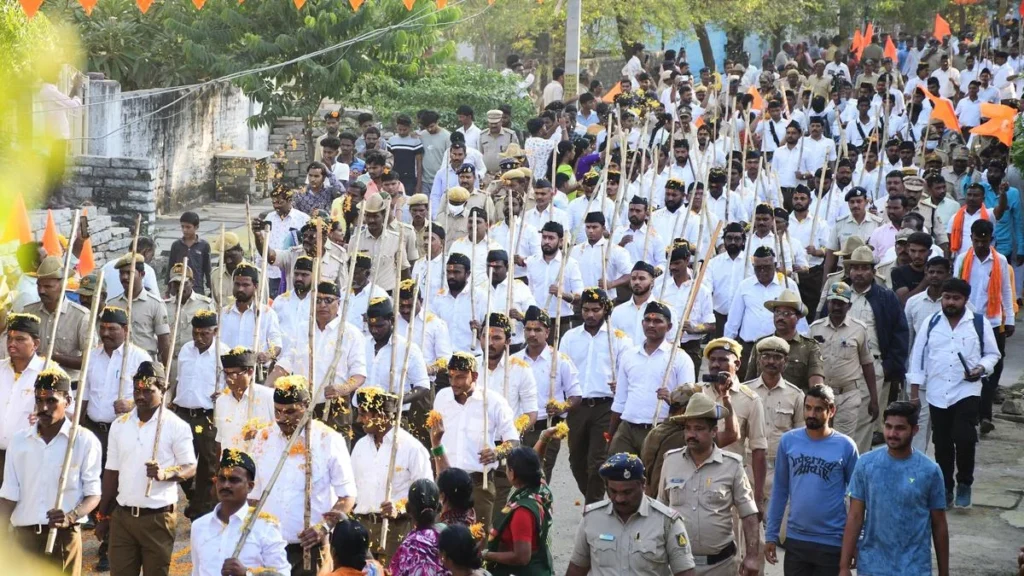
CHENNAI – In a significant judicial observation that underscores the delicate balance between public order and the freedom of assembly, the Madras High Court on Wednesday, October 14, 2026, expressed strong reservations regarding the recurring denial of permission for route marches and public rallies by the Rashtriya Swayamsevak Sangh (RSS) in Tamil Nadu.
Presiding over a writ petition filed by V.G. Jagadeesan, the RSS North Tamil Nadu secretary, Justice V. Lakshminarayanan questioned the state’s consistent policy of withholding approval for such events, noting that the pattern of denial appeared to transcend the specific government currently in power.
The Core of the Petition: Seeking Democratic Expression
The legal challenge stems from the RSS’s intent to conduct route marches across various districts in Tamil Nadu, specifically scheduled for October 18, October 25, and November 1, 2026. Represented by counsel V. Chandrasekaran and K. Srinivasa Murthy, the petitioner submitted that these marches are a quintessential component of the organization’s foundational activities.
The petition detailed the planned decorum of the events, with members intending to march in their traditional uniform: dark olive brown trousers, white shirts, caps, belts, and black shoes. The proposed events were slated to be accompanied by a musical band and conclude with public meetings. The petitioner argued that these marches are not merely symbolic but are a long-standing tradition meant to demonstrate organizational discipline and public outreach.
Chronology of the Legal Conflict
The friction between the RSS and the Tamil Nadu state administration over public rallies is not a new development. For several years, the state has cited law-and-order concerns, potential communal tensions, and public inconvenience as reasons to deny or restrict these marches.
- Initial Applications: The RSS filed applications with the Tamil Nadu police seeking permission for route marches across various districts.
- Administrative Denial: Following the standard protocol, local police authorities indicated that the proposed routes or dates were unsuitable, effectively denying the applications.
- The Writ Petition: Faced with systemic rejection, the organization moved the Madras High Court, seeking a judicial mandate to allow the events to proceed.
- The October 14 Hearing: During the proceedings, Justice V. Lakshminarayanan scrutinized the state’s rationale, leading to the current directive for both parties to seek an amicable resolution through mediation.
Arguments and Judicial Observations
During the hearing, Senior Counsel N.L. Rajah, appearing for the RSS, emphasized the global nature of the organization’s activities. He noted that the RSS has conducted such marches annually since its inception in 1925. Furthermore, he highlighted that the organization’s reach is international, with similar events occurring in major global cities, including New York, London, Sydney, Auckland, Paris, and Ottawa.
The Court’s Critique
Justice Lakshminarayanan’s observations were particularly pointed. He questioned the logic of the state’s refusal, especially in the context of security. The Judge remarked:
"If RSS members can conduct route marches in terrorist-infested areas such as Jammu and Kashmir, why can they not do so in Tamil Nadu?"
The Court further observed that by consistently denying permission, the police were inadvertently inviting negative publicity and creating an impression of an obstructionist administration rather than a facilitator of democratic rights. The Judge noted that the state’s stance appeared to be a systemic issue, affecting not just the RSS but also other groups, including the Dravidar Kazhagam (DK) and various political parties, irrespective of the ruling party’s ideology.
The State’s Position: Public Order and Logistics
Representing the State, Advocate General Vijay Narayan presented a defense centered on the preservation of public order and convenience. He argued that the specific routes requested by the petitioner were deemed "not conducive" to large-scale marches.

The Advocate General further emphasized the timing of the request, noting that the proposed dates coincided with the festival season. He argued that allowing such marches during a period of high public activity would cause significant inconvenience to the general public and stretch police resources thin, potentially leading to administrative challenges in managing traffic and crowd control.
Implications for Civil Liberties and Governance
The dialogue between the bench and the state counsel reflects a fundamental tension in Indian democracy: the limits of the state’s power to restrict public assembly in the name of "public order."
The "Public Order" Threshold
Under Indian law, the state is empowered to restrict freedom of assembly under Article 19 of the Constitution if it is deemed necessary to maintain public order. However, the judiciary has frequently clarified that this power cannot be used arbitrarily to stifle political or ideological expression. The Madras High Court’s intervention signals a judicial expectation that the state must provide a more robust, evidence-based justification for denying such permissions.
Political Neutrality
The court’s comment that the issue persists "irrespective of the government in power" is a critique of the administrative machinery. It suggests that the police department, regardless of the political leadership in the Secretariat, has adopted a default posture of denial. This observation poses a challenge for the state’s bureaucracy to adopt a more nuanced, site-specific approach to permissions rather than blanket refusals.
The Path Forward: A Mandated Resolution
Recognizing that a protracted legal battle might not be the most efficient way to balance the competing interests of freedom of speech and public safety, Justice V. Lakshminarayanan took a pragmatic approach.
The Court directed the petitioner’s counsel to meet with the State Public Prosecutor, R. John Sathyan, on Wednesday afternoon. The objective of this meeting is to:
- Discuss and potentially modify the proposed routes to minimize public inconvenience.
- Determine appropriate timings that do not clash with peak festival hours.
- Address specific security concerns raised by the police in a collaborative manner.
The court has ordered both parties to report the outcome of these discussions on Thursday, October 15, 2026. This directive places the onus on the state to demonstrate that it is willing to facilitate constitutional rights where reasonable safety conditions can be met, rather than simply acting as a gatekeeper of public spaces.
Conclusion
The developments in the Madras High Court serve as a reminder of the evolving relationship between state authorities and non-state organizations. While the state government maintains its duty to ensure the safety and comfort of the citizenry, the judiciary’s role remains to ensure that these concerns do not serve as a pretext for the suppression of ideological visibility.
As the matter proceeds, all eyes will be on whether the state and the RSS can reach a middle ground. The outcome of the meeting between the petitioner and the Public Prosecutor will not only determine the fate of the upcoming October and November marches but may also set a precedent for how public rallies are handled in Tamil Nadu in the future. If a resolution is reached, it could signify a shift toward a more transparent and negotiation-based administrative process, reinforcing the vibrancy of the state’s democratic fabric.
Whether the state finds the proposed compromise acceptable will ultimately test the strength of the administrative policy on "sensitive" public events in an increasingly polarized political landscape. For now, the legal discourse remains focused on balancing the right to march with the state’s duty to maintain peace.