Mastering Cinematic AI Video: A Comprehensive Professional Workflow with Seedance
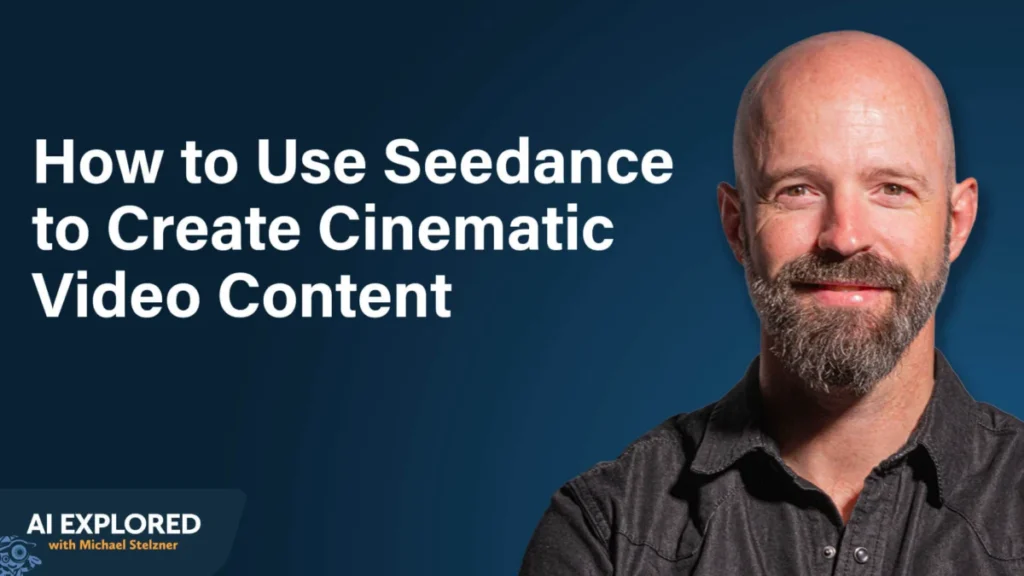
As artificial intelligence continues to reshape the landscape of digital media production, a persistent divide remains among creators: those who view AI-generated video as a novelty plagued by "sloppy" visual artifacts, and those who wield it to produce cinematic, professional-grade content. According to industry experts, the disparity does not stem from the limitations of the technology itself, but rather from how effectively creators communicate with underlying AI models.
Co-created by digital media strategist Michael Stelzner and Ross Symons, Chief Creative Officer of Zen Robot, a comprehensive framework has emerged to bridge this gap. By combining traditional filmmaking principles with structured prompt engineering and advanced video models like ByteDance’s Seedance, creators can now transform simple concepts into polished, high-end video productions.
Main Facts: The Core Mechanics of AI Video Production
The foundation of high-quality AI video generation relies on understanding how different AI architectures interpret human instruction.
A primary misconception among novices is that video models process text in the same conversational manner as Large Language Models (LLMs) like ChatGPT, Claude, or Gemini. While LLMs excel at conversational intent, most AI image and video generators—including Midjourney, Kling, and Seedance—are powered by diffusion models.
Diffusion models do not "read" sentences; instead, they scan prompts for isolated visual keywords while ignoring conversational filler. Typing a conversational request yields generic or distorted results because the model is merely hunting for recognizable objects, lighting cues, and textures.
To bypass this barrier, professionals utilize a multi-step workflow:
- Concept Development: Establishing a clear narrative intent before touching any software.
- Visual Asset Creation: Utilizing the "Subject, Environment, and Character" framework alongside cinematic framing techniques.
- Storyboard and Keyframe Architecture: Structuring pacing through precise reference images rather than overloading single clips with complex actions.
- Execution and Assembly via Seedance: Leveraging advanced video generation models that support time-segmented prompting and high-fidelity reference tracking.
Chronology: The Evolution of the Seedance Workflow
The journey from a raw creative thought to a finalized, high-resolution AI video follows a rigorous, chronological pipeline.
Step 1: Conceptualization and Narrative Foundation
Every professional AI video begins with a strong, intentional concept. Creators do not need complex artistic manifestos; a straightforward visual metaphor or product placement idea suffices.
To demonstrate this, Symons points to a classic stop-motion commercial he created years ago for Red Bull: a piece of paper slides onto a table, folds itself into an origami bull, opens a Red Bull can, drinks the liquid, sprouts wings, and flies away. Recently, Symons translated this exact concept into the modern AI ecosystem. By feeding the conceptual sequence into Seedance alongside a few image references, the narrative held up seamlessly—proving that a strong core idea transcends the production medium. Creators are advised to leverage LLMs like ChatGPT to extrapolate narratives, suggest visual sequences, and brainstorm variations prior to visual development.
Step 2: Constructing Key Visuals (The SEC Framework)
Once the narrative is locked in, creators build key visuals utilizing the Subject, Environment, and Character (SEC) framework:
- The Subject (Hero): The focal point of the story, such as a product or primary object. When professional product photography is unavailable, mock product images can be generated using tools like Midjourney or ChatGPT.
- The Environment: The setting of the scene. Rather than utilizing vague descriptors like "cool" or "nice," creators must articulate specific visual qualities—such as the time of day, light falling on surfaces, color temperature, and depth of field.
- Secondary Elements: Objects or characters introduced to create tension and dynamic motion, such as a black panther wandering into a static product shot.
Step 3: Storyboarding and Keyframe Management
A storyboard consisting of 6 to 12 keyframes maps out the major beats of a video. Creators generally rely on two prompting methodologies:
- Start Frame + End Frame + Prompt: Providing the model with an exact starting image, an ending image, and a text prompt governing the transition between them.
- Start Frame + Prompt Only: Utilizing a single starting image and letting the prompt guide the action dynamically over a 5-to-10-second duration.
Step 4: Generation and Cost-Effective Upscaling
Once storyboards are established, clips are generated using advanced models. Because native high-resolution renders carry steep costs, professionals often employ a strategic workaround: generating clips at lower resolutions (such as 480p) and utilizing specialized upscalers (such as Topaz Labs or Magnific) to achieve near-4K visual fidelity at a fraction of the native rendering cost.
Supporting Data: Resolution, Economics, and Model Capabilities
The economics of AI video generation have shifted dramatically alongside quality leaps. While older models generated 5-second clips for fractions of a dollar, newer high-fidelity models operate on a different financial scale.
- Seedance Pricing Tiers: Generating a 30-second clip at 720p resolution through Seedance aggregator platforms typically costs around $14. Escalating the output to 1080p roughly doubles the cost to $28 to $32 per clip.
- The Upscaling Alternative: Creators can drastically reduce expenses by generating a 480p clip for approximately $6, then applying platform-integrated upscaling tools twice for an additional $3. This brings the total production cost to roughly $9 while delivering quality comparable to native high-resolution outputs.
- Time-Segmented Prompting: Seedance stands out in the marketplace due to its native support for time-segmented instructions. Within a single 15-second clip, creators can explicitly script actions across specific intervals (e.g., "Between 0 and 4 seconds, X happens; between 4 and 8 seconds, Y happens"), minimizing the need to chain multiple short clips together.
Official Responses and Industry Perspectives
Industry leaders emphasize that mastering AI video requires treating the software like a collaborative human crew rather than a magic wand.

According to Ross Symons, much of the public skepticism surrounding AI video stems from user error. When creators input vague, conversational prompts, diffusion models produce erratic movements, warped perspectives, and distorted anatomy. By contrast, applying structured cinematic vocabulary—such as referencing specific camera angles (low-angle shots for dominance, close-ups for intensity) or mimicking the signature visual styles of acclaimed directors like Guy Ritchie—yields dramatically superior results.
Furthermore, creators are cautioned against action cramming. Attempting to pack a slide-in, a paper flight, a transformation, and an explosion into a single 5-second clip overwhelms the model’s processing capacity. Matching the complexity of the prompt to the duration of the clip remains a cardinal rule of professional AI cinematography.
Implications for the Future of Content Creation
The rise of hyper-capable video models like ByteDance’s Seedance, integrated across aggregator platforms such as Luma AI, Krea, and Open Art, signals a profound shift in digital content creation.
Democratization of High-End Production
Small businesses, independent creators, and marketing teams that previously lacked the budgets for live-action shoots, complex CGI, or high-end animation studios can now prototype and execute cinematic ad campaigns independently. The ability to generate custom product environments, synthetic heroes, and intricate visual metaphors lowers the barrier to entry for commercial storytelling.
The Shift Toward "Prompt Literacy"
As AI models evolve, technical aptitude is shifting from traditional editing suites to prompt literacy and visual direction. Creators who understand the nuances of diffusion models, time-segmented scripting, and cinematography principles will consistently outperform those relying on trial-and-error text generation.
Ultimately, the barrier separating amateur output from professional cinema is no longer technological—it is conceptual. By treating AI models as responsive visual engines rather than text-based chat windows, creators are redefining the boundaries of digital filmmaking.