Navigating the Labyrinth of Big Media Product Recommendations: How Trust, SEO, and Affiliate Marketing Shape What You Buy
By [Author Name]
Published: January 2025
Main Facts
In the modern digital economy, online shopping has evolved far beyond simple e-commerce storefronts and customer reviews. Today, consumers are met with a vast landscape of product recommendation lists, “best-of” roundups, and expert buying guides published by some of the most trusted names in mainstream journalism.
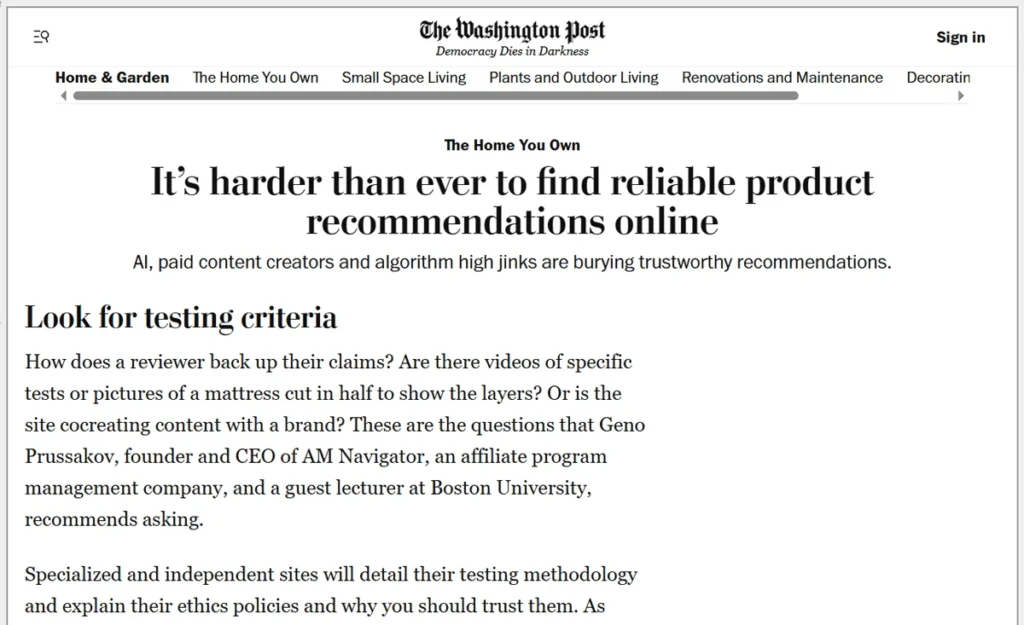
Earlier this year, The Washington Post reached out for expert commentary on how consumers should evaluate, interpret, and treat the online product recommendation lists published by major media organizations. While the resulting feature offered concise insights, the nuances of how major publishers monetize their brand authority require a much deeper, more comprehensive exploration.
For years, prominent media outlets have leveraged their hard-earned search engine authority and public trust to generate lucrative secondary revenue streams through affiliate marketing and sponsored product placements. This shift raises a critical question for modern consumers: How can one truly trust the reviews and product recommendations found online, especially when they are published by high-authority media brands?
While most major publishers maintain rigorous editorial standards, separate their commercial divisions from their newsrooms, and conduct legitimate product testing, financial arrangements—such as placement fees, elevated commission rates, and earnings-per-click (EPC) guarantees—can occasionally influence product rankings. Understanding this intricate ecosystem is vital for anyone looking to make informed purchasing decisions in an era where editorial content and commerce have deeply intertwined.
Chronology
To understand how traditional newsrooms and media corporations became major players in the affiliate marketing space, it is helpful to look back at the historical evolution of digital publishing monetization.
Phase 1: The Traditional Advertising Era (Pre-2010s)
Historically, major newspapers, magazines, and digital publications relied primarily on display advertising, banner ads, and classifieds to generate revenue. Product reviews—whether for books, films, or consumer electronics—were conducted strictly within the firewall of the editorial department, completely independent of commercial considerations.
Phase 2: The Digital Disruption and Ad Revenue Decline (2010–2015)
As the rise of ad-blockers, programmatic ad networks, and social media platforms decimated traditional display advertising revenues, digital publishers faced an existential financial crisis. Newsrooms shrank, print subscriptions plummeted, and media companies desperately searched for alternative monetization models to survive.
Phase 3: The Rise of Commerce Content (2015–2020)
During this period, publishers realized that their high domain authority and search engine optimization (SEO) strength made them prime destinations for consumer search queries like "best vacuum cleaner" or "top running shoes." Media companies began building dedicated "commerce" teams. Instead of merely reporting the news, they started capturing transactional intent, partnering with affiliate networks (such as CJ Affiliate, Rakuten, and Amazon Associates) to earn a commission on every sale referred through their articles.
Phase 4: Institutionalization of Affiliate Operations and Mainstream Integration (2020–Present)
Today, commerce content is no longer a side project for media outlets; it is a foundational pillar of their business models. Major networks and publications routinely feature dedicated shopping sections, hire specialized product testing reviewers, and optimize their digital inventory to capture lucrative holiday shopping traffic (such as Black Friday and Prime Day). Concurrently, affiliate managers and agencies—such as AM Navigator—work closely with these media partners to secure strategic product placements for merchants, bringing a formalized, corporate structure to what was once a decentralized wild west of product roundups.
Supporting Data and Industry Insights
The intersection of SEO authority, affiliate marketing, and media publishing is backed by significant industry trends. To evaluate the integrity of these lists, we must examine how media companies operate behind the scenes and why merchants invest heavily in securing these spots.
How Major Media Publishers Do Their Homework
Having worked extensively with big media publishers as affiliate partners for managed merchant programs, industry experts note that the vast majority of reputable media outlets treat monetization with extreme seriousness. Before converting their brand equity into an endorsement mechanism, these organizations typically implement rigorous safeguards:

- Dedicated Testing and Review Laboratories: Major outlets often build physical testing spaces (or utilize specialized product testing teams) where items are genuinely unboxed, used, tested against competitors, and evaluated for durability, price-to-value ratio, and real-world performance.
- Strict Editorial Firewalls: Reputable publications maintain a clear separation between their commercial/affiliate teams and their news-gathering or investigative journalists. The people writing the commerce roundups are frequently specialized reviewers rather than general news reporters, designed to minimize direct conflicts of interest.
- Data-Driven Performance Tracking: Media publishers monitor user engagement, conversion rates, and reader feedback closely. If a recommended product receives high rates of customer complaints, returns, or negative feedback post-purchase, publishers are quick to demote or remove the item to protect their brand authority.
- Compliance and Disclosure Policies: Driven by Federal Trade Commission (FTC) guidelines and international regulatory standards, legitimate media outlets prominently display affiliate disclosure statements, letting readers know when a link may generate a financial commission for the publisher.
The Influence of Financial Arrangements
Despite these robust internal controls, commercial realities mean that money can and does influence visibility. Affiliate marketing is a performance-based industry, but publishers are businesses seeking to maximize yield per pageview. Financial factors that can subtly or overtly influence product placement include:
- Placement Fees: Direct payments made by merchants or agencies to guarantee a spot in a high-traffic holiday gift guide or top-tier product roundup.
- Inflated Affiliate Commission Rates: Offering a higher percentage payout per sale to incentivize publishers to prioritize a specific brand over competitors.
- EPC (Earnings Per Click) Guarantees: Agreements where a merchant guarantees a minimum return for the publisher’s traffic, heavily incentivizing the media outlet to keep that product prominently featured to maximize shared revenue.
Official Responses and Perspectives
To gain a holistic view of this dynamic, industry stakeholders—including digital publishing executives, affiliate program managers, and consumer advocates—have voiced varied perspectives on the modern state of commerce content.
- The Publisher’s Perspective: Media executives argue that commerce content provides an essential financial lifeline that keeps independent journalism alive in an era of declining ad revenues. Furthermore, they maintain that readers genuinely benefit from well-researched, aggregated buying guides that save consumers time and effort when navigating crowded marketplaces.
- The Affiliate Manager’s Perspective: Industry specialists, such as those at AM Navigator, emphasize that transparency is the ultimate currency in modern affiliate marketing. When merchants and publishers operate with clear communication, realistic expectations, and strict adherence to disclosure guidelines, the affiliate model creates a win-win-win scenario for the merchant, the publisher, and the end consumer.
- The Consumer Advocate’s Perspective: Regulatory bodies and consumer watchdogs continue to urge caution, noting that the average reader often struggles to differentiate between objective journalistic reporting and commercially driven product roundups. Calls for clearer, more prominent disclosures and stricter enforcement against deceptive "pay-to-play" reviews remain a central topic of discussion in digital media ethics.
Implications for Consumers: How to Shop Smart
Given the complex financial incentives driving online product recommendations, consumers cannot afford to take every "best-of" list at face value. Fortunately, being aware of how the system works equips you to make smarter, more discerning purchasing decisions.
Here are four actionable strategies you can use to protect your wallet and find genuinely great products:
1. Cross-Reference Multiple Sources
Never rely on a single publication’s recommendation. If a particular product is truly exceptional, it should appear across multiple independent testing sites, specialized enthusiast forums, and customer review platforms. If a product is heavily promoted by only one major media outlet, investigate whether that specific article carries a heavy commercial or sponsored label.
2. Look Past the "Best" Label to Understand Why
Read the methodology behind the review. Does the article explain how the product was tested? Does it detail specific pros and cons, or does it offer vague, generalized praise? High-quality reviews provide specific context, comparative benchmarks, and explain which type of consumer the product is actually best suited for.
3. Check for Clear Affiliate and Sponsorship Disclosures
Reputable media outlets are transparent about how they make money. Look for a disclosure statement near the top or bottom of the article. While the presence of an affiliate link does not automatically mean a review is biased, complete transparency is a strong indicator of an ethical publisher that respects its audience.
4. Consult Independent Consumer and User Communities
Complement big media roundups with peer-to-peer insights. Platforms like Reddit, specialized enthusiast forums (such as Wirecutter-adjacent communities or niche hobbyist boards), and verified customer reviews on independent retailer sites can offer unfiltered feedback from real-world users who have no financial stake in whether you buy the product or not.
Conclusion
The marriage between big media and affiliate marketing is here to stay. As traditional advertising continues to fracture, publishers will increasingly rely on commerce content to sustain their operations. While this monetization model introduces complex commercial pressures—where placement fees and commission rates can occasionally tip the scales—it also drives many media outlets to invest heavily in rigorous, professional product testing.
By understanding the mechanics behind search engine authority, affiliate incentives, and editorial standards, modern consumers can navigate these digital labyrinths with confidence.
Join the Conversation
What are your thoughts on product recommendation lists published by big media? Have you ever felt misled by a "best-of" roundup, or have you found great value in these guides? The comments section below is open—share your experiences and join the discussion!