Regulatory Shockwave: IRDAI’s Proposed Commission Caps Threaten the Bedrock of India’s Digital Insurance Giants
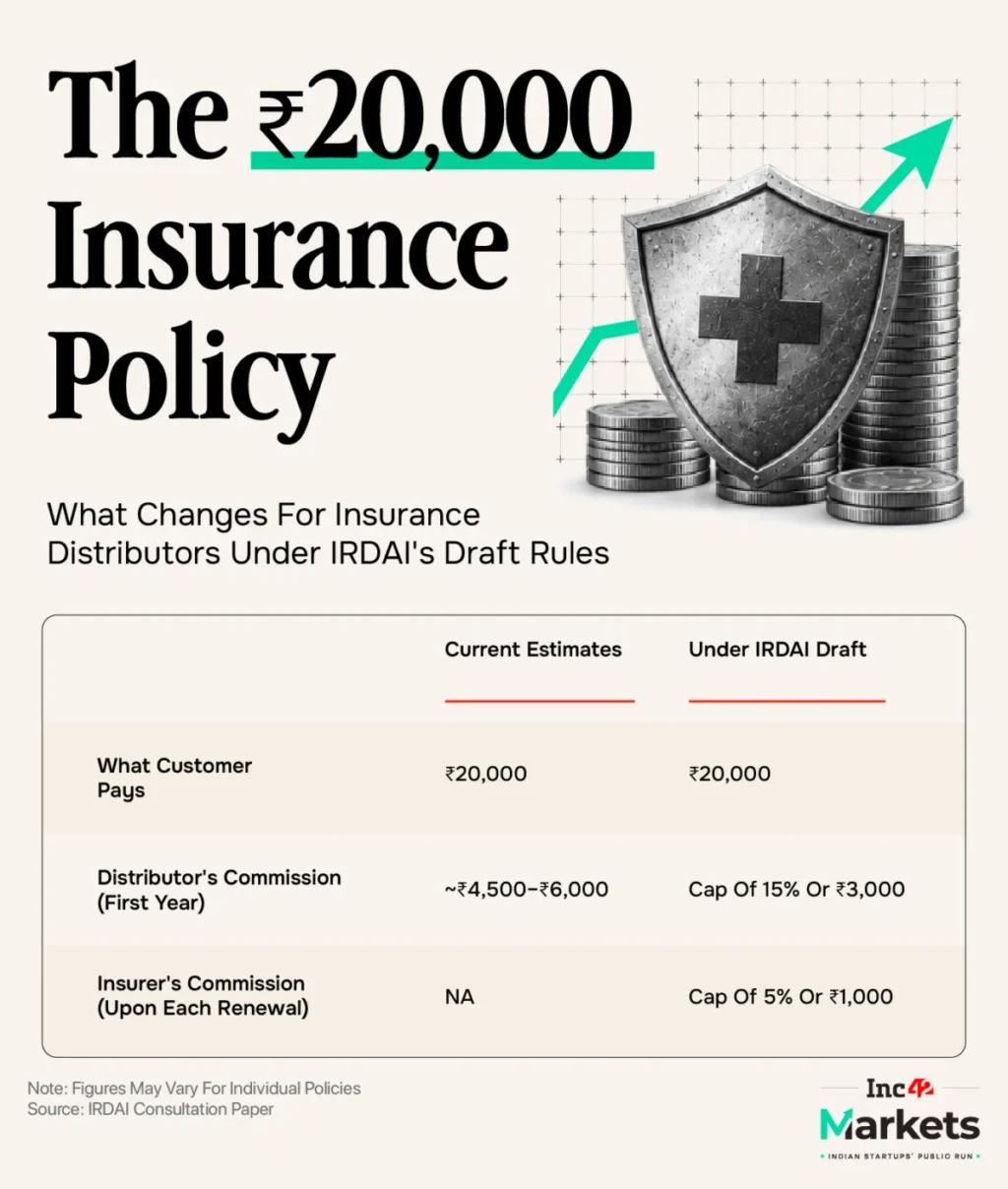
New Delhi: For 27-year-old Riya, buying a family-floater health insurance policy online felt like a straightforward, modern consumer experience. Seeking to secure a plan on Policybazaar, she navigated to the platform, only to be stopped before viewing a single price quote. The app required her name, phone number, and city. Within minutes of submission, her phone began ringing incessantly. Ultimately, she settled on a comprehensive health plan with an annual premium of ₹20,000.
Yet, Riya remained entirely unaware of the invisible machinery driving the other half of the transaction. Out of her ₹20,000 premium, the insurer paid Policybazaar a lucrative commission—part of the economic model that fuels India’s digital insurance distribution ecosystem.
That foundational economic model, however, faces a potential dismantling. In a sweeping regulatory move on September 23, the Insurance Regulatory and Development Authority of India (IRDAI) released a consultation paper proposing the reintroduction of strict commission caps on premiums paid by first-time buyers and those renewing policies. If enacted, the proposal could fundamentally rewrite the playbook for digital aggregators, insurers, and the broader insurtech landscape.
Main Facts: The Anatomy of the Proposed Regulatory Overhaul
For years, digital insurance distributors such as Policybazaar, Paytm, and PhonePe have collected commissions from insurance companies calculated as a sliding percentage of gross premiums. Under the IRDAI’s aggressive new proposals, hard commission caps would be extended across health, term life, and motor insurance lines.

The scope of the cuts is vast:
- Life Insurers: Total expenses of management (EoM) for life policies would be capped at 12.5% of the premium within a five-year horizon.
- General Insurers: Expense caps for general insurance products would drop sharply to 20%, down from the historical ceiling of 30%.
- The "Dark Pattern" Crackdown: Beyond commissions, the IRDAI has trained its sights on digital user experience practices. The regulator formally flagged the mandatory collection of personal details before revealing policy terms and pricing as a "dark pattern," grouping it alongside other practices it classifies as mis-selling.
The regulator’s primary motivation stems from macroeconomic imbalance. Between FY23 and FY25, total commission payouts to distributors surged by a staggering 125%, whereas new business premiums rose by just 28% over the same period. In absolute terms, the value of total industry commissions more than doubled, climbing from ₹48,000 crore in FY21 to ₹1.08 lakh crore in FY25.
The IRDAI views this divergence as evidence of a high-cost, commission-led model that has outpaced actual premium growth, rendering the current framework structurally unsustainable.
Chronology of Events: From Draft Papers to Market Panic
- September 23: The IRDAI releases its consultation paper, introducing proposed commission caps and taking direct aim at dark patterns and renewal incentives.
- September 24–25: Wall Street and domestic brokerages publish panic notes. Major digital distributors experience a catastrophic sell-off. PB Fintech (Policybazaar’s parent) and Turtlemint hit their respective lower circuits, plunging between 30% and 36%.
- September 26: Management teams host emergency analyst calls. PB Fintech acknowledges an "extreme" immediate impact while attempting to reassure investors, hinting at a strategic pivot toward becoming an insurer itself. Meanwhile, direct insurers like Go Digit buck the trend, seeing their stocks gain ground.
- October 25: The formal deadline for industry stakeholders to submit feedback and push back against the draft IRDAI guidelines.
Supporting Data: Financial Impact and Market Metrics
The financial health of India’s leading insurtech players has historically been tied to high take-rates and lucrative renewal streams.

Prior to the regulatory announcement, PB Fintech posted stellar Q1 FY27 results. Net profit nearly doubled year-over-year (YoY) to ₹162.9 crore, up from ₹84.7 crore in Q1 FY26, while operating revenue jumped 40% YoY to ₹1,888.3 crore. During this period, the blended take-rate on core online insurance stood at 18.5%.
However, the proposed caps threaten these margins:
- The Revenue Engine Hit: Health insurance remains Policybazaar’s fastest-growing product, with new premium collections up 59% YoY in Q1 FY27. Simultaneously, renewal revenue—its highest-margin revenue stream—reached ₹1,003 crore, up 55% YoY. Because the IRDAI is specifically targeting renewal commissions, this critical profit center is directly in the crosshairs.
- Brokerage Forecasts: Brokerage firm Jefferies estimates that Policybazaar’s commissions on new health covers could drop by 33% to 50%. Citi warned that distribution economics across high-margin categories could compress by 70% to 90%, while Macquarie, HSBC, and Emkay flagged PB Fintech as acutely exposed.
- Turtlemint’s Vulnerability: Competitor Turtlemint faces an even steeper existential threat. General insurance accounts for nearly 90% of Turtlemint’s revenues. With draft guidelines proposing zero commissions on new-vehicle third-party insurance and a strict 5% cap on own-damage motor policies, Turtlemint’s core revenue base faces severe compression. Furthermore, its agent-partner acquisition costs historically constituted over 77% of total pre-IPO expenses.
Official Responses: Corporate Defense and Strategic Pivots
Faced with the steepest single-day stock crashes in their history, leadership teams at major fintech firms have mounted a defense while sketching out contingency plans.
During an emergency analyst call following a 34% to 36% plunge in PB Fintech’s stock to a 52-week low (closing down 35.98% at ₹1,210 on the BSE, wiping out market capitalization to ₹55,993 crore), management pushed back against the severity of the market reaction.

- PB Fintech’s Stance: Management argued that the stock erosion is "overblown." While conceding that the immediate impact of the guidelines is "extreme," the company noted that its life and non-life insurance businesses are split equally (50:50) in terms of revenue, with non-life expected to absorb the brunt of the damage (projected down by 25% to 33%). PB Fintech anticipates that volume growth of 15% to 20% could partially cushion the blow if general insurance commissions fall by 60%—provided insurers actually pass those savings on to consumers.
- The Long-Term Pivot: PB Fintech management announced plans to shift from "passionate growth" to "rational growth," aiming to stabilize earnings by FY29. Most notably, the company signaled that it would seriously consider becoming an insurer itself, exploring proprietary insurance and reinsurance products to bypass regulatory distribution bottlenecks. This echoes earlier warnings from PB Fintech Chairman Yashish Dahiya that hard commission caps represent an existential threat to pure-play distributors.
Implications: A Bifurcated Future for Insurtech and Insurers
The IRDAI’s proposed framework introduces a complex web of implications across the entire financial services ecosystem.
1. The Benefit to Direct Insurers (Go Digit and Acko)
While digital distributors bled value, direct-to-consumer insurers reaped a relative advantage. Go Digit saw its stock rise by over 6% during the panic week. Unlike aggregators, direct insurers like Go Digit and Acko sell policies independently or through multiple apps. If commission expenses drop substantially under the new caps, insurers’ underlying profitability could improve, even if topline growth softens due to adjustments in retail pricing.
However, long-term risks remain. Both Go Digit and Acko rely heavily on digital distributor channels. If aggregators face margin starvation, they could pivot away from cost-competitive tech-first insurers toward legacy partners offering higher baseline pricing or alternative fee structures.
2. Industry-Wide Pricing Correction for Consumers
Analysts maintain that, over the long term, the regulatory changes could benefit the broader insurance market. By forcing a reduction in high distribution costs, insurers theoretically gain the fiscal headroom needed to pass savings directly to consumers, driving down premium costs nationwide. Lower price barriers could ultimately pull millions of under-insured Indian households into the formal insurance net.

3. The Road Ahead
With the public consultation window closing on October 25, 2026, the industry braces for a coordinated wave of pushback from both legacy insurers and tech-first aggregators. Whether the IRDAI decides to soften its stance on renewal caps or enforce the hard limits uniformly across all policy classes remains to be seen.
What is certain, however, is that India’s digital insurance gold rush is drawing to a close. The era of unchecked, commission-driven expansion is giving way to a heavily scrutinized, margin-compressed paradigm—forcing tech giants to either adapt their business models or evolve into insurers themselves.