Revolutionizing AI Search Measurement: seoClarity Unveils Causation-Driven Split Testing Methodology
London, UK – [Insert Date] – In an era where artificial intelligence increasingly shapes how users discover information, the marketing and SEO industries face a pivotal challenge: accurately measuring the impact of their optimization efforts on AI search features. Moving beyond mere correlation, a groundbreaking methodology presented by seoClarity at a recent Search Engine Journal (SEJ) webinar offers a definitive path to proving causation in AI search performance. The core tenet? "Visibility scores tell you if you showed up. Page-level performance and split testing tell you if what you did actually mattered."
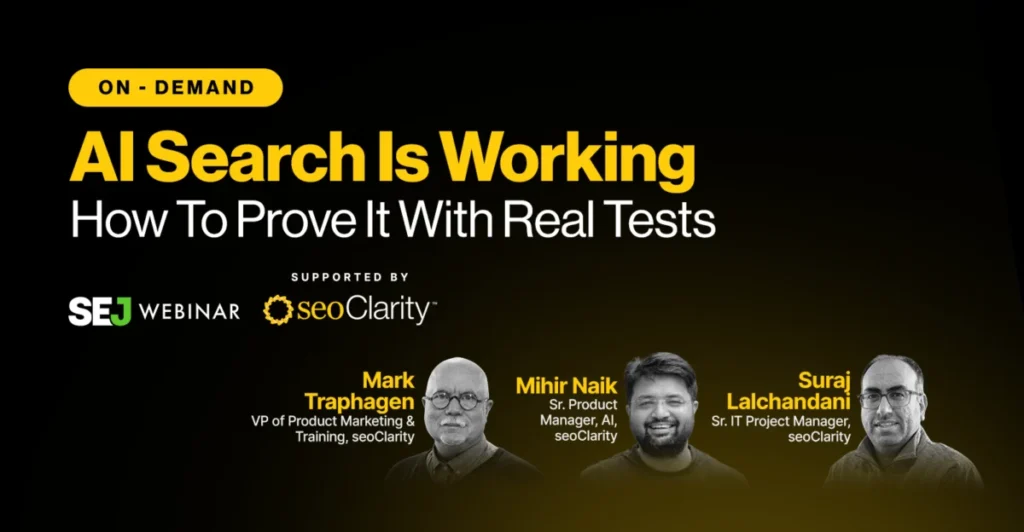
This paradigm shift, championed by seoClarity’s Mark Traphagen, VP of Product Marketing & Training, Mihir Naik, Senior Product Manager, AI, and Suraj Lalchandani, Sr. IT Project Manager, provides a robust framework for enterprise clients to understand and influence their presence across leading AI platforms like ChatGPT, Claude, Perplexity, Gemini, and Google’s AI surfaces. Their approach, meticulously detailed during the webinar, centres on sophisticated split testing, funnel-spanning prompt sets, and the strategic utilization of new data sources, fundamentally redefining the playbook for AI Experience Optimization (AEO).
The Quest for Causation: A New Standard in AI Search Optimization
For too long, AI search measurement has been mired in the ambiguity of correlation. Marketers could observe changes in AI citations following an on-page adjustment, but definitively proving that the adjustment caused the change remained elusive. seoClarity’s methodology directly confronts this challenge, establishing a rigorous standard of proof through the concept of "reversion."
The team unveiled a compelling client case study involving the strategic addition of FAQ sections to a set of test pages. Initial observations showed a clear uplift in AI citations for these pages compared to a carefully selected control group. This positive correlation was encouraging, but seoClarity pushed further. In a critical second phase, the newly added FAQ sections were removed from the test pages. The result was unequivocal: AI citations for those pages dropped back down to their original levels.
"That reversion is the difference between correlation and causation, and almost no team measuring AI search today can produce it," explained Suraj Lalchandani. "Not that citations just went up when we added FAQs, but that they went back down when we took them away. That’s causation, not correlation." This definitive demonstration of cause and effect marks a significant leap forward, providing marketers with the undeniable evidence needed to justify strategic investments and confidently attribute AI search performance improvements to specific actions. This rigorous standard of proof, previously difficult to achieve in the dynamic environment of AI algorithms, is now within reach for organizations committed to data-driven AEO.
Navigating the Evolving Landscape: Google’s New AI Search Console Data
The landscape for AI search measurement received a significant boost with Google’s recent announcement. On June 3rd, Google rolled out dedicated Search Console reports for AI Overviews and AI Mode, offering webmasters unprecedented first-party data. For a subset of sites, these new reports provide page-by-page insights into how often individual URLs appear within Google’s burgeoning AI search features.
Lalchandani hailed this development as the "biggest measurement upgrade AI search testing has received." He noted, "This has been the hardest thing to measure in AI search. Everyone was sampling. Everyone was inferring. But now Google is just giving it to you." The directness of first-party data from Google itself brings an unparalleled level of trust and accuracy, eliminating much of the guesswork previously associated with understanding AI visibility on the world’s dominant search engine.
However, the seoClarity team was quick to contextualize these advancements. While invaluable, the new Search Console reports cover only a portion of what a comprehensive AI search testing program demands. Critical AI platforms such as ChatGPT, Claude, and Perplexity still necessitate structured third-party tracking to gain a holistic view of performance. The webinar provided a detailed map of precisely which gaps the new reports close, which they leave open, and offered a platform-by-platform reference for understanding what each AI engine can crawl and render. This nuanced perspective advises marketers to integrate Google’s new data thoughtfully, ensuring it complements existing strategies rather than replacing the need for broader AI monitoring. The immediate action item for all SEO professionals is to check their Search Console for these new AI reports and strategically assess how this first-party data fits into their overall AI testing program before building around it exclusively.
Crafting the "Golden Set" of Prompts: A Strategic Approach to Testing
Effective AI search optimization begins with understanding the user’s intent as expressed through prompts. seoClarity’s methodology introduces a highly strategic approach to prompt selection, focusing on maximizing early wins and building momentum for more challenging optimizations. The team advocates for building a "golden set" of prompts that spans the entire AI search funnel, from initial awareness queries to those signaling retention intent. Each prompt within this set is meticulously tagged by its corresponding stage in the user journey.
The prompts are then sorted into distinct tiers based on the brand’s current standing within the AI’s response. Tier 1 prompts represent the "easy wins," as Lalchandani described: "You’re relevant, but AI just hasn’t been given a URL worth linking to." These are instances where the AI understands the brand’s relevance but isn’t yet citing its content. Tier 2 encompasses prompts requiring a heavier lift, where the brand might be less directly relevant or face stronger competition. Interestingly, a specific bucket of prompts is intentionally dropped from testing altogether, a decision that surprised many attendees, highlighting the calculated nature of this approach.
This sequencing is deliberate and strategic. Securing early wins with Tier 1 prompts not only demonstrates immediate value but also builds the "political capital" necessary to advocate for and execute more challenging, long-term tests. The webinar delved into the specifics of how to construct and tag this golden prompt set, precisely how the tiers are defined, and the crucial tracking unit that pairs each prompt with the exact page marketers aim to have cited by the AI. This systematic approach ensures that testing efforts are focused, efficient, and aligned with strategic business objectives.
The Art of AI Split Testing: Building Control Groups and Managing Timing
One of the fundamental challenges in AI search testing stems from the inability to conduct traditional A/B split tests on live traffic, as is common in web development or traditional SEO. Large Language Models (LLMs) do not allow for the deterministic 50-50 traffic splits required for such experiments. seoClarity’s solution to this hurdle is the creation of a robust control group: a carefully selected set of correlated pages that acts as an essential noise filter against the inherent volatility of model updates and algorithmic shifts.
"Without a control group, every result would be guesswork," Lalchandani emphasized. "With one, you can tell a real win from the background noise." This control group provides a stable benchmark against which the performance of test pages can be accurately measured, allowing teams to isolate the impact of their specific changes from broader market or algorithmic fluctuations.
Equally critical to the success of this methodology is the discipline of timing. Many teams, eager for quick results, often skip this crucial step. The seoClarity framework mandates a specific baseline period before any change goes live, followed by a minimum test window after the implementation. This is because AI search does not respond overnight in the same way traditional SEO sometimes does. The nuances of how AI models process and integrate new information require a sustained observation period. Cutting the test window short risks misinterpreting data, potentially leading to incorrect conclusions. As Lalchandani cautioned, "Cut the window short and you could be reading noise."
Every test conducted using this methodology will land in one of three outcomes: a clear win, a clear loss, or an inconclusive result. Each of these outcomes, however, is considered valuable. An inconclusive result, for instance, doesn’t signify failure but rather an opportunity to refine the hypothesis or test a different variable, all based on concrete evidence. The full webinar provides comprehensive guidance on how to construct the correlated control group, define the exact baseline and test windows, and interpret all three potential outcomes, ensuring every experiment yields actionable insights.
Beyond FAQs: Real-World Test Outcomes and Invaluable Lessons
The true power of seoClarity’s methodology is demonstrated through its application in real-world client scenarios, yielding diverse and often surprising results. The FAQ test, as previously detailed, stands as a prime example of proving causation, validating a tactic with undeniable evidence. With roughly 1,000 prompts under measurement, the addition of FAQ sections demonstrably pushed citations up against the control group, and critically, these citations remained elevated for the duration of the change. The subsequent reversion, where citations fell back upon removal of the FAQs, solidified the causal link.
However, not all tests yield such clear-cut positive results, and these instances are equally, if not more, valuable. The seoClarity team shared outcomes from two other client tests: one focusing on meta descriptions and another on listicle formatting. These experiments concluded very differently from the FAQ test, and the reasons behind their varying outcomes hold crucial lessons for any organization considering investment in similar tactics. The webinar provided detailed insights into how both these tests played out, offering practical guidance on what to expect and how to interpret results when a clear uplift isn’t observed.
Mihir Naik perfectly encapsulated the philosophy underpinning this approach: "Every result is a win, because you have evidence instead of guesses. That is more than most teams in AI search have today." This perspective reframes "failures" as learning opportunities, ensuring that resources are allocated based on data, not assumptions. Beyond these specific examples, the session also laid out comprehensive blueprints for schema and markdown tests—two of the most hotly debated questions in AEO—along with a set of fast structural tests designed for high-value templates that can be executed and analyzed within a few weeks.
Expert Insights: Key Questions from the Webinar Q&A
The webinar concluded with a lively Q&A session, addressing some of the most pressing concerns and complex questions facing AI search practitioners today.
Measuring AI Authority in a Landscape Without Clear Metrics
One attendee inquired about measuring AI authority in the absence of a clean, singular metric. Suraj Lalchandani acknowledged the challenge, stating, "AI authority is basically how much the model trusts you as a source for this topic. I don’t think there’s a clean number for it or a single number for it, but there’s a couple of signals that you can stack to give you kind of a working picture." He outlined four stackable signals, beginning with citation share on top prompts and, crucially, cross-engine consistency. "Consistency across engines just means that you become the authoritative source in your category for specific kinds of questions," he explained, emphasizing the importance of a unified message across various AI platforms. The full session detailed all four signals and methods for tracking them.
The Visibility of Collapsible Content: Do AI Bots See Hidden FAQs?
A common technical question arose regarding the crawlability of FAQ answers hidden behind collapsible toggles. Lalchandani clarified, "Collapsible can mean many different things. It’s how you are having it collapsible." He explained that implementation is key: some common setups ensure collapsed FAQs are fully readable to both AI search engines and Google, while others render the content invisible, largely because "even Google will not click around on your site." He detailed which implementations are visible and which are not, reinforcing his overarching advice for any technical uncertainty: "If you’re unsure of something, just test it out. It takes effort, but it’ll give you a sure answer."
The ROI of an AI Citation Without Direct Referral Traffic
Perhaps one of the most fundamental questions for marketers is the return on investment for an AI citation that doesn’t directly drive referral traffic. Mihir Naik provided a compelling response: "You want to be cited because you are controlling the answer that is actually going to be showing up." Even in the absence of a direct click, he explained, a cited page significantly shapes the narrative within the AI’s answer. This is particularly vital in comparison queries, where citations actively work to position and differentiate brands. The focus shifts from traffic to effective representation: ensuring Unique Selling Propositions (USPs) are highlighted, comparison sets are accurate, and no inaccuracies surface. Lalchandani supplemented this with a cautionary tale from a restaurant client, illustrating the direct negative consequences when AI cannot access and cite relevant content, a story fully recounted in the recording.
The Enduring Importance of Traditional SEO in the AI Era
Finally, the panel addressed whether traditional SEO still plays a role in moving the AI findability needle. The answer was an emphatic "Absolutely. It is foundational. It is the foundation." Mark Traphagen noted that seoClarity’s longest-standing clients, those with robustly optimized content and technically healthy sites, are consistently the top performers in AI search. AI optimization, in this context, serves as an additional, advanced layer built upon a solid traditional SEO foundation. Lalchandani reinforced this observation: "When we run tests with our clients, we’ve rarely, if ever, found a situation where something works for SEO and does not work for AI search." This underscores that while AI search presents new challenges and opportunities, the fundamental principles of good SEO remain paramount, providing the bedrock for any successful AEO strategy.
Watch the Full Webinar
The comprehensive on-demand recording of the seoClarity webinar contains a wealth of detailed information not fully captured in this recap. This includes the step-by-step guide to building the golden prompt set, precise tier definitions, the exact methodology for constructing a correlated control group with specific baseline and test windows, a platform-by-platform reference for AI crawler capabilities, the full results from the meta description and listicle tests, and complete blueprints for implementing schema and markdown tests. For marketing professionals and SEO teams serious about mastering AI search optimization with verifiable, causation-driven insights, registering to watch the full session on demand is an essential next step.