Strategic Overhaul: BJP President Nitin Nabin Sets New Course for West Bengal Governance
KOLKATA – In a move signaling a definitive shift in the administrative and political architecture of West Bengal, BJP National President Nitin Nabin concluded a high-stakes two-day visit to the state this week. The visit, characterized by a series of closed-door organizational meetings and public interactions, serves as a blueprint for the party’s future governance model under Chief Minister Suvendu Adhikari.
As the state gears up for crucial by-polls in the Rejinagar and Nandigram constituencies, and with the shadow of upcoming municipal elections looming, Mr. Nabin’s primary objective was clear: establishing a functional synergy between the state’s political apparatus and its executive wing while curbing the centralisation of power that defined the previous administration.
The Mandate: Separation of Powers
The core takeaway from Mr. Nabin’s visit was his explicit directive to the State Council of Ministers. According to West Bengal BJP president Samik Bhattacharya, Mr. Nabin insisted that the party organization must not infringe upon the day-to-day operations of the government.
"The mandate is simple," a senior party insider noted. "Ministers must focus on governance and public service, while the party organization functions as a bridge to the people, not a bottleneck for administrative decision-making."
This philosophy marks a stark departure from the previous 15-year Trinamool Congress (TMC) tenure, where power was often concentrated in the hands of a single figurehead who simultaneously steered the party and the government. Under the Adhikari-led BJP administration, the model is shifting toward a bifurcated structure: Chief Minister Suvendu Adhikari leads the government’s policy execution, while Samik Bhattacharya spearheads the party’s outreach and electoral strategy.
Chronology of the Visit
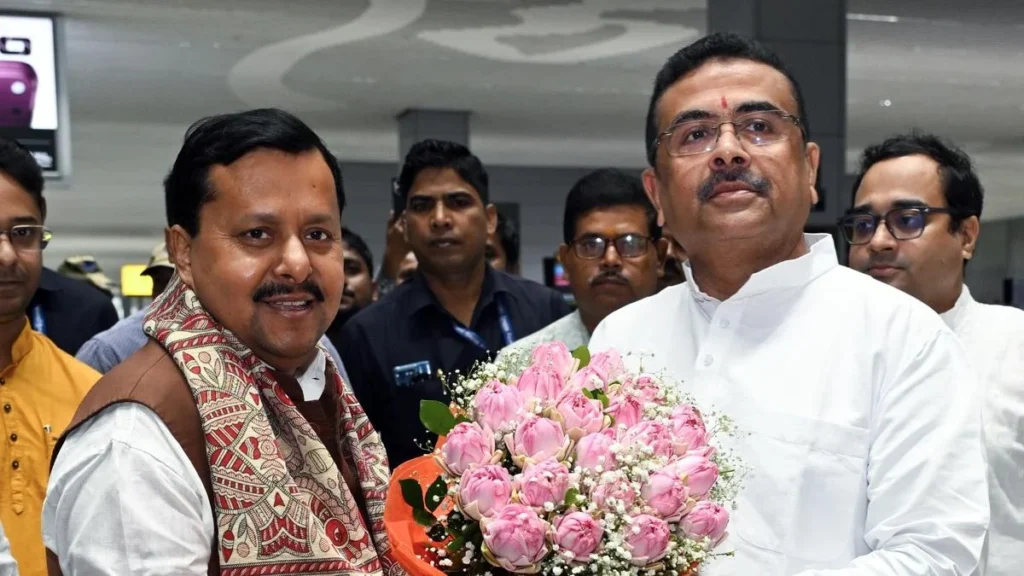
Mr. Nabin arrived at the Netaji Subhas Chandra Bose International Airport on Sunday, where he was formally welcomed by Chief Minister Adhikari. The ensuing 48 hours were a whirlwind of activity designed to tighten the party’s grip on both governance and electoral preparedness.
- Sunday: Following his arrival, Mr. Nabin engaged in a series of high-level organizational meetings. These sessions focused on assessing the readiness of the state machinery for the upcoming by-polls and reviewing the logistical requirements for the municipal elections expected in November.
- Monday: The focus shifted to youth engagement. Mr. Nabin participated in the "Yuva Samvad Conclave," a high-profile event where he shared the stage with Chief Minister Adhikari. The event was used as a platform to unveil the administration’s focus on employment and economic revitalization.
- Post-Conclave: The visit concluded with final briefings to state leadership regarding the implementation of the "one individual, one post" policy, effectively streamlining the state cabinet’s focus.
Organizational Reshuffle: A "One Individual, One Post" Reality
Ahead of the crucial civic polls, the West Bengal BJP has undergone a radical restructuring. To ensure maximum efficiency and prevent burnout, the party has enforced the "one individual, one post" principle. This has necessitated a significant reshuffle, affecting some of the most prominent faces in the current cabinet.
Six high-profile ministers—Tapas Roy, Jagannath Chattopadhyay, Agnimitra Paul, Dipak Burman, Shankar Ghosh, and Indranil Khan—have been relieved of their specific organizational responsibilities to concentrate entirely on their ministerial portfolios. This decision is aimed at ensuring that the government’s ambitious policy rollouts are not stalled by administrative delays.
New Leadership Appointments
The reshuffle has also introduced fresh blood into the party’s hierarchy to energize the grassroots base:
- Mahila Morcha: Actor-turned-politician Anjana Basu has been appointed as the new State President, signaling an effort to boost the party’s outreach among women voters.
- Secretariat: Locket Chatterjee and Bishnupur MP Soumitra Khan have been elevated to State General Secretaries.
- Executive Board: Darjeeling MP Raju Bista has been named Vice-President, broadening the party’s reach into North Bengal.
- Central Oversight: While Sunil Bansal remains the party in-charge for West Bengal, the party has opted to remove Amit Malviya as co-observer, replacing him with a new trio of co-observers tasked with granular oversight of the state’s districts.
Economic Revitalization: Reversing the Trend
During the "Yuva Samvad Conclave," Mr. Nabin did not mince words regarding the economic legacy left by the previous regime. He cited data suggesting that approximately 6,700 companies had ceased operations in West Bengal during the 15-year TMC rule.

"The flight of capital was the defining feature of the previous decade and a half," Nabin stated. "The priority of the current BJP Government is to reverse this. We are here to create an atmosphere of trust, transparency, and opportunity to bring investment back to Bengal."
Chief Minister Adhikari has been lauded by the central leadership for the rapid pace at which he has implemented new policies. The government’s economic agenda is currently focused on:
- Industrial Revival: Simplification of land acquisition and licensing processes.
- Employment Generation: Initiatives targeted at the youth, particularly in the manufacturing and IT sectors.
- Infrastructure Development: Upgrading municipal facilities in anticipation of the upcoming civic body polls.
Implications for the Upcoming Municipal Elections
The timing of these organizational changes is not coincidental. With civic body polls across seven municipal corporations—including the prestigious Kolkata Municipal Corporation and the Howrah Municipal Corporation—scheduled for November, the BJP is attempting to present a unified, government-focused front.
The elections serve as a bellwether for the party’s popularity after their ascent to power. By separating the party’s organizational machinery from the government, the BJP hopes to insulate its administration from political controversies while simultaneously using the party’s grassroots network to mobilize voters.
Political analysts observe that the removal of Amit Malviya and the appointment of fresh, local faces indicate a desire to shift the party’s narrative from "ideological confrontation" to "performance-based governance."
Official Responses and Future Outlook
The opposition, while currently reeling from the transition of power, has been watching these developments closely. However, the internal confidence within the BJP is palpable.
"Our focus is no longer on the past, but on the potential," a party spokesperson said following the meetings. "When you have a Chief Minister who is focused on the pace of implementation and a party that is focused on the pulse of the people, you have a winning formula for West Bengal."
As the state moves toward the Durga Puja festivities, the atmosphere is one of transition. The upcoming municipal elections will be the first major test of this new "synergy" model. If the BJP succeeds in maintaining the momentum generated by Mr. Nabin’s visit, it could fundamentally alter the political landscape of West Bengal for years to come.
The government’s immediate challenge remains balancing the high expectations of an electorate eager for economic reform with the practical constraints of a state that has seen significant capital flight. With the organizational reshuffle complete and the leadership alignment secured, the stage is set for a pivotal autumn in West Bengal.
Summary of Key Leadership Changes
| Position | Appointee/Status |
|---|---|
| State Mahila Morcha President | Anjana Basu |
| State General Secretaries | Locket Chatterjee, Soumitra Khan |
| State Vice-President | Raju Bista |
| West Bengal In-charge | Sunil Bansal (Retained) |
| Co-observers | Three new appointees (Amit Malviya removed) |
As the administration prepares for the upcoming by-polls in Rejinagar and Nandigram, the message from the central leadership is clear: the era of centralized, personality-driven governance is over, replaced by a structure that prioritizes institutional efficiency and economic growth.