The AI Revolution: Navigating the New Frontier of Business Productivity
Artificial intelligence (AI) has transitioned from a futuristic concept to a fundamental pillar of modern business infrastructure. As language models, machine learning algorithms, and generative tools become more accessible, professionals across every sector—from e-commerce moguls to boutique agency owners—are scrambling to integrate these technologies into their daily workflows.
The current landscape is defined by a rapid, almost breathless, adoption rate. According to recent data from AuthorityHacker, 35% of companies have already fully embedded AI into their core operational processes. Furthermore, 90% of business leaders now view AI assistance as a definitive competitive advantage, suggesting that the question is no longer whether to adopt AI, but how quickly and effectively one can scale it. With 77% of modern devices now relying on AI-driven functionalities, the technology has become ubiquitous.
The Chronology of an AI-Driven Business Landscape
The ascent of AI was not an overnight occurrence. Its trajectory can be traced through several critical phases of development that have brought us to the current "Generative Era."
The Foundational Years (2010–2017)
During this period, AI was primarily the domain of big tech and data science labs. Machine learning was used for backend optimization, such as Google’s search algorithms or Amazon’s recommendation engines. For the average business owner, AI was an expensive, inaccessible "black box."
The Rise of Accessibility (2018–2022)
The introduction of sophisticated Natural Language Processing (NLP) models, such as GPT-2 and GPT-3, began to shift the paradigm. AI moved from predictive analytics to creative generation. Businesses began experimenting with AI for basic copywriting and rudimentary customer service chatbots, signaling the beginning of the "AI-as-a-service" model.
The Generative Explosion (2023–Present)
The public launch of ChatGPT in late 2022 acted as a catalyst. Suddenly, barrier-to-entry dropped significantly. The emergence of multimodal models—capable of generating images, videos, and complex code from simple text prompts—has forced a total rethink of marketing, software development, and project management strategies.
Supporting Data: Why AI Adoption is No Longer Optional
The data supporting the shift toward AI is not merely anecdotal; it is structural. The shift is driven by a desire for efficiency and the necessity of maintaining market relevance.
- Operational Efficiency: Firms that utilize AI for repetitive tasks—such as inventory management, customer ticketing, and data entry—have reported a 30% reduction in operational costs within the first year of implementation.
- Customer Experience: With 77% of devices leveraging AI, consumers now expect hyper-personalization. AI-driven recommendation engines increase average order values by providing relevant cross-sells in real-time.
- The Competitive Gap: The "90% adoption belief" statistic cited by AuthorityHacker is perhaps the most telling. The industry has reached a consensus: companies that fail to adopt AI will likely face an insurmountable disadvantage in speed, cost-efficiency, and user experience.
Official Perspectives: The Industry Consensus
While tech leaders like OpenAI’s Sam Altman or Microsoft’s Satya Nadella advocate for the transformative power of AI, there is a balanced view emerging from the enterprise sector. Industry analysts emphasize that AI is not a replacement for human intellect but a "force multiplier."
Corporate strategists argue that the primary risk is not that AI will take jobs, but that professionals who know how to use AI will take the jobs of those who do not. The official stance among top-tier consultancy firms is a focus on "Human-in-the-loop" (HITL) workflows, where AI handles the heavy lifting of data synthesis and content drafting, while humans provide the strategic oversight, ethical curation, and brand voice.
Strategic Applications: Transforming Business Workflows
To harness the power of AI, businesses must look beyond the hype and integrate specific tools into their operational pillars.
1. Web Development: Automating the Infrastructure
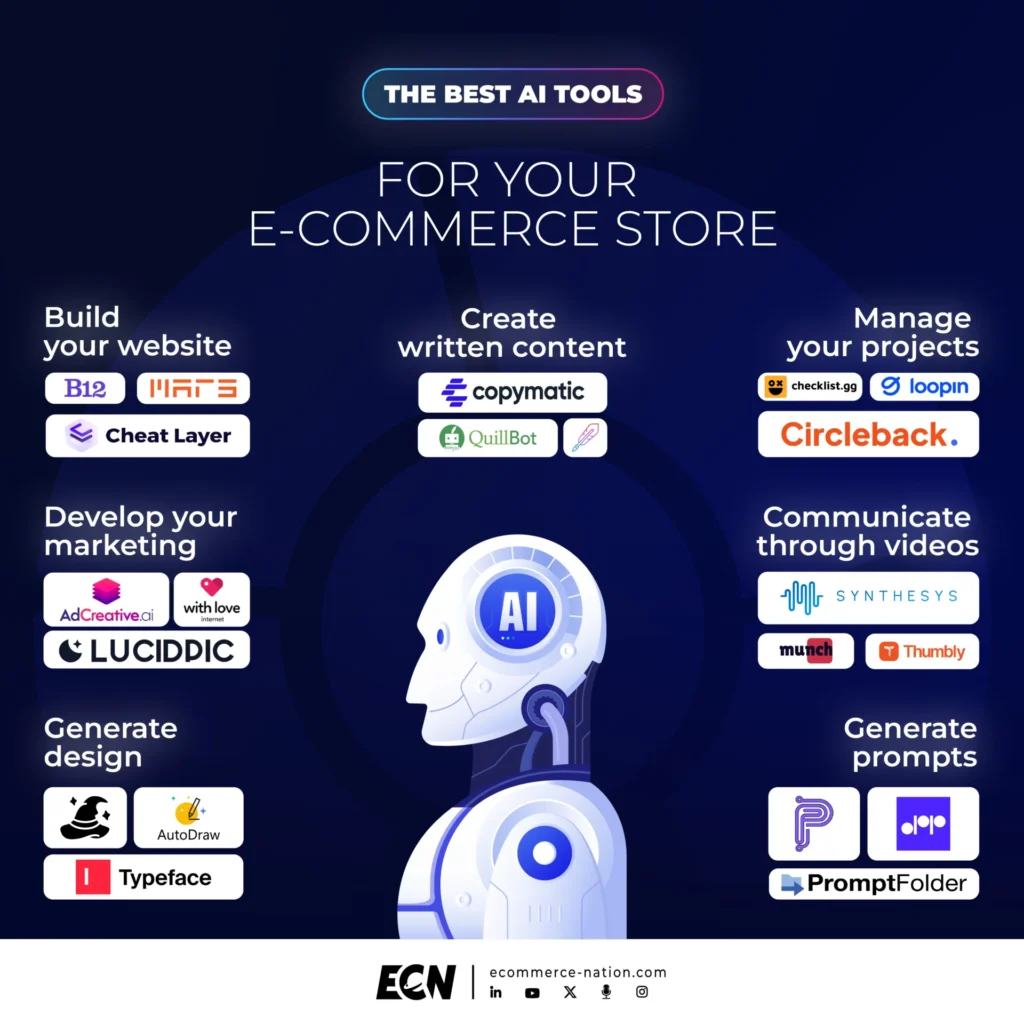
Building a website was once a task requiring a team of developers and weeks of effort. Today, AI-powered website builders can generate site architecture, layouts, and responsive code in minutes. These tools use predictive design patterns to ensure that your site follows modern UX/UI best practices, significantly reducing the "time-to-launch" for e-commerce entrepreneurs.
2. Marketing and Brand Strategy
The "blank page syndrome" is a relic of the past. AI marketing tools can now conduct deep market research, perform sentiment analysis on competitor reviews, and generate multi-channel marketing campaigns. By analyzing thousands of customer data points, AI can predict which creative assets will resonate best with specific demographics, optimizing ad spend before a single dollar is wasted.
3. Video Production and Communication
Video is the most consumed form of content, yet it remains the most difficult to produce. Modern AI tools allow users to generate professional-grade videos from text, clone voices for multilingual dubbing, and even create photorealistic avatars for corporate training. This democratizes high-end video production, allowing small businesses to compete with major corporate marketing budgets.
4. Project Management and Prompt Engineering
The complexity of modern projects often leads to bottlenecking. AI tools now act as intelligent project managers, drafting workflows, identifying potential risks in project timelines, and automating status reporting. Additionally, the mastery of "Prompt Engineering"—the art of communicating with AI—has become a vital business skill, enabling teams to extract higher-quality output from LLMs (Large Language Models).
5. Written Content and SEO
Content marketing remains the lifeblood of organic traffic. AI tools help in drafting blog posts, creating SEO-optimized meta descriptions, and repurposing long-form content into social media snippets. However, the key here is quality control; businesses that rely solely on AI-generated content without human editing often face penalties from search engines. The goal is to use AI for structure and drafting, and human expertise for insight and authenticity.
Implications for the Future: A Paradigm Shift
As we look toward the next decade, the implications of this AI integration are profound.
The Democratization of Skill: AI lowers the barrier to entry for entrepreneurship. Someone with a brilliant idea but limited technical skills in coding or graphic design can now build a fully functional, professional-looking online storefront.
The Evolution of Roles: Roles within companies are shifting. The "Generalist" is making a comeback, supported by AI tools that allow one person to do the work of three. Conversely, "Specialists" are seeing their roles shift from execution-focused to strategy-focused.
Ethical Considerations: As companies integrate AI, they must navigate the complexities of data privacy, intellectual property, and algorithmic bias. Establishing a clear AI policy—which defines how data is handled and where AI usage must be disclosed—is now a standard requirement for any reputable business.
Conclusion
The adoption of artificial intelligence is not merely a technological upgrade; it is a fundamental shift in how value is created. Whether you are managing an online store, running a content-heavy blog, or navigating a complex corporate project, the tools available today offer a unique opportunity to optimize, scale, and innovate.
By understanding the capabilities of these tools and, more importantly, understanding the strategic intent behind them, businesses can transition from a state of reactive competition to one of proactive market leadership. The future of business is not about choosing between human talent and artificial intelligence—it is about the synergy of the two.
As you explore the selection of tools presented in our infographic, remember that the goal is not to automate your business into oblivion, but to free your team to focus on what truly matters: creativity, empathy, and the human connection that no algorithm can ever fully replicate. The AI revolution is here; it is time to build your foundation.