The Architecture of Failure: Why Tool Design, Not Model Capability, Derails AI Agents
In the rapidly evolving landscape of generative AI, the industry has spent the better part of two years fixated on the "reasoning" capabilities of Large Language Models (LLMs). We obsess over parameter counts, chain-of-thought prompting, and context window sizes. However, as AI agents move from experimental sandboxes into production enterprise environments, a recurring, systemic problem has emerged: agents are failing—not because they aren’t "smart" enough, but because they are being fed poorly designed interfaces.
In this article, we dissect the root cause of most AI agent failures, explore the design patterns that transform fragile prototypes into resilient autonomous systems, and examine why the interface between a model and its tools is the single most important design decision in the current AI stack.
Main Facts: The Interface is the Intelligence
Most AI agent failures are misdiagnosed as "hallucinations" or model incompetence. When an agent chooses the wrong tool, passes a malformed argument, or enters an infinite loop of retries, developers often blame the LLM.
In practice, the model is simply a prisoner of the interface it is given. An AI agent reasons based on four primary data points: the tool’s name, its docstring description, the parameter schema, and the parameter descriptions. If these inputs are vague, contradictory, or structurally loose, the model is effectively being asked to perform a high-stakes task with a blindfold on. When the tool design is unclear, failures move from being statistical outliers to being predictable, recurring events.
Chronology of Agentic Evolution and Failure
The lifecycle of agent development typically follows a distinct, often painful, trajectory:
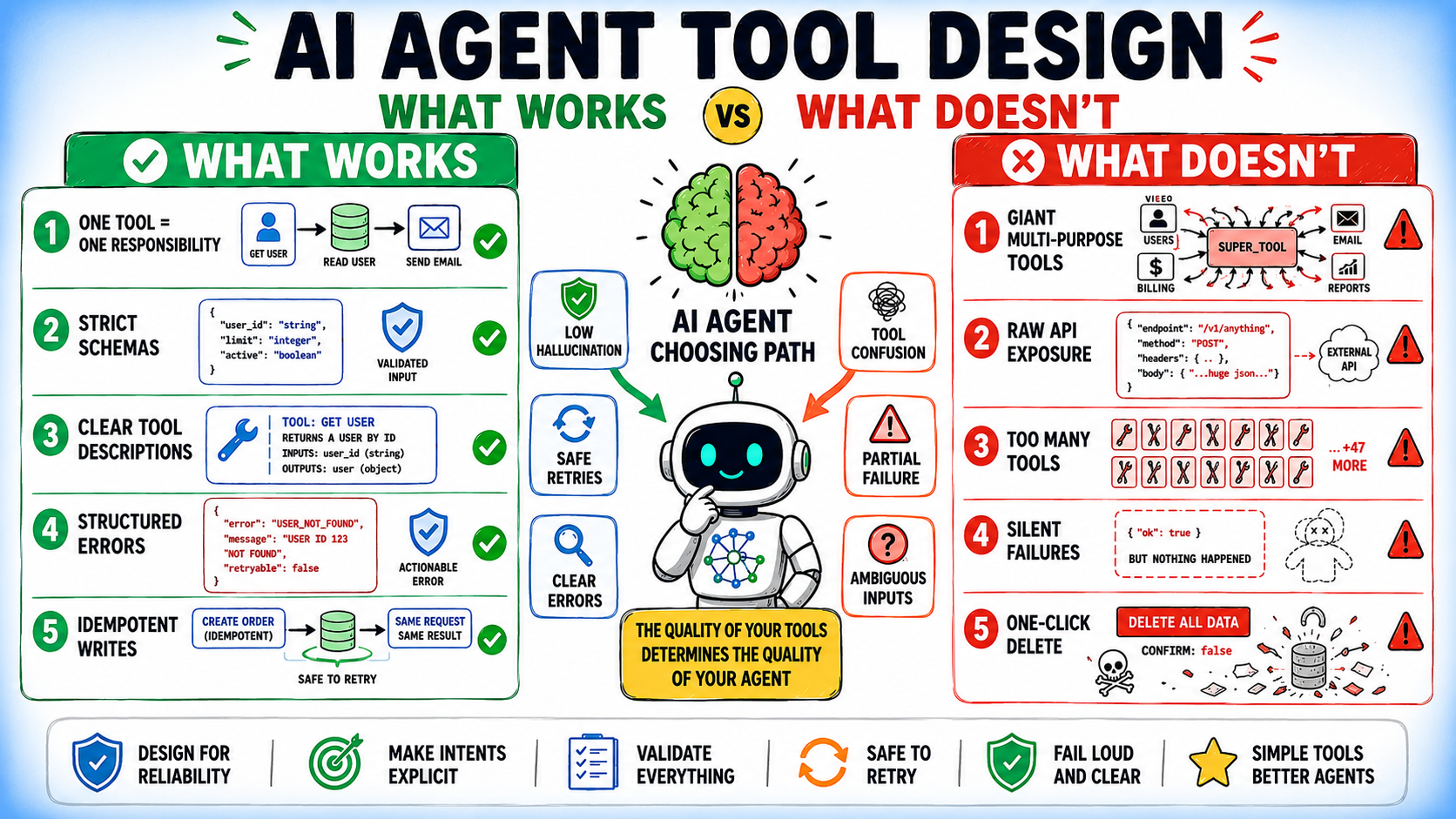
- The "API Wrapper" Phase: Developers begin by mapping existing REST APIs directly to agent tools. This phase is characterized by high initial success but immediate, catastrophic failures when handling complex data structures or unexpected API errors.
- The "Prompt Engineering" Phase: When failures occur, developers attempt to "fix" the problem by adding instructions to the system prompt (e.g., "Always make sure to use X before Y"). This leads to "prompt bloat," where the system prompt becomes so long that the model loses focus on the primary task.
- The "Interface Design" Phase: Mature teams realize that the problem is structural. They shift from prompting the model to engineering the tools the model consumes. This is the transition from "AI as an improviser" to "AI as a software engineer working with a well-documented API."
Supporting Data and Design Patterns
Stronger models—like the latest releases from OpenAI, Anthropic, or Google—can reduce the frequency of mistakes, but they cannot compensate for a fundamentally flawed interface. To build resilient agents, developers must adopt specific, battle-tested design patterns.
One Tool, One Responsibility
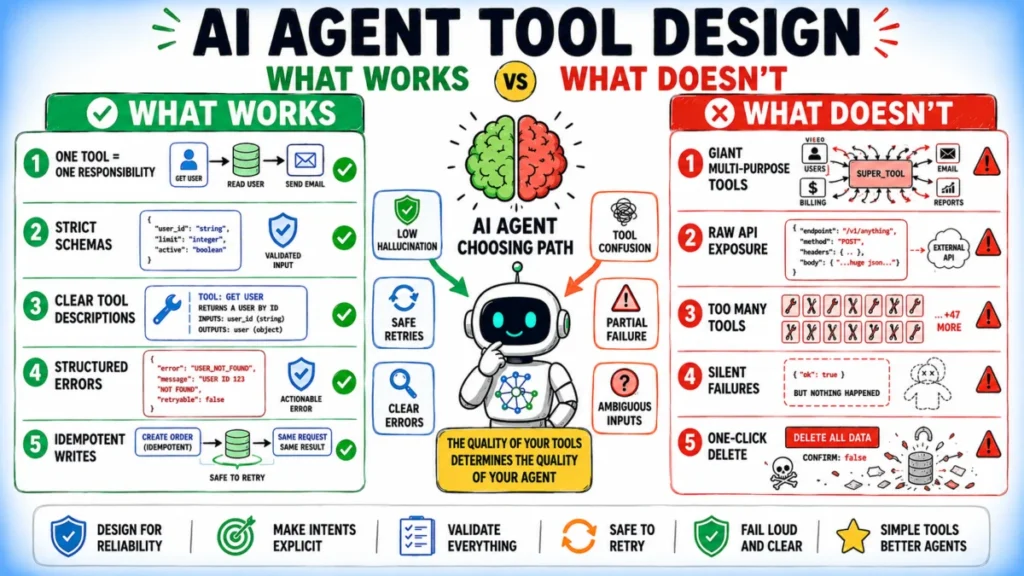
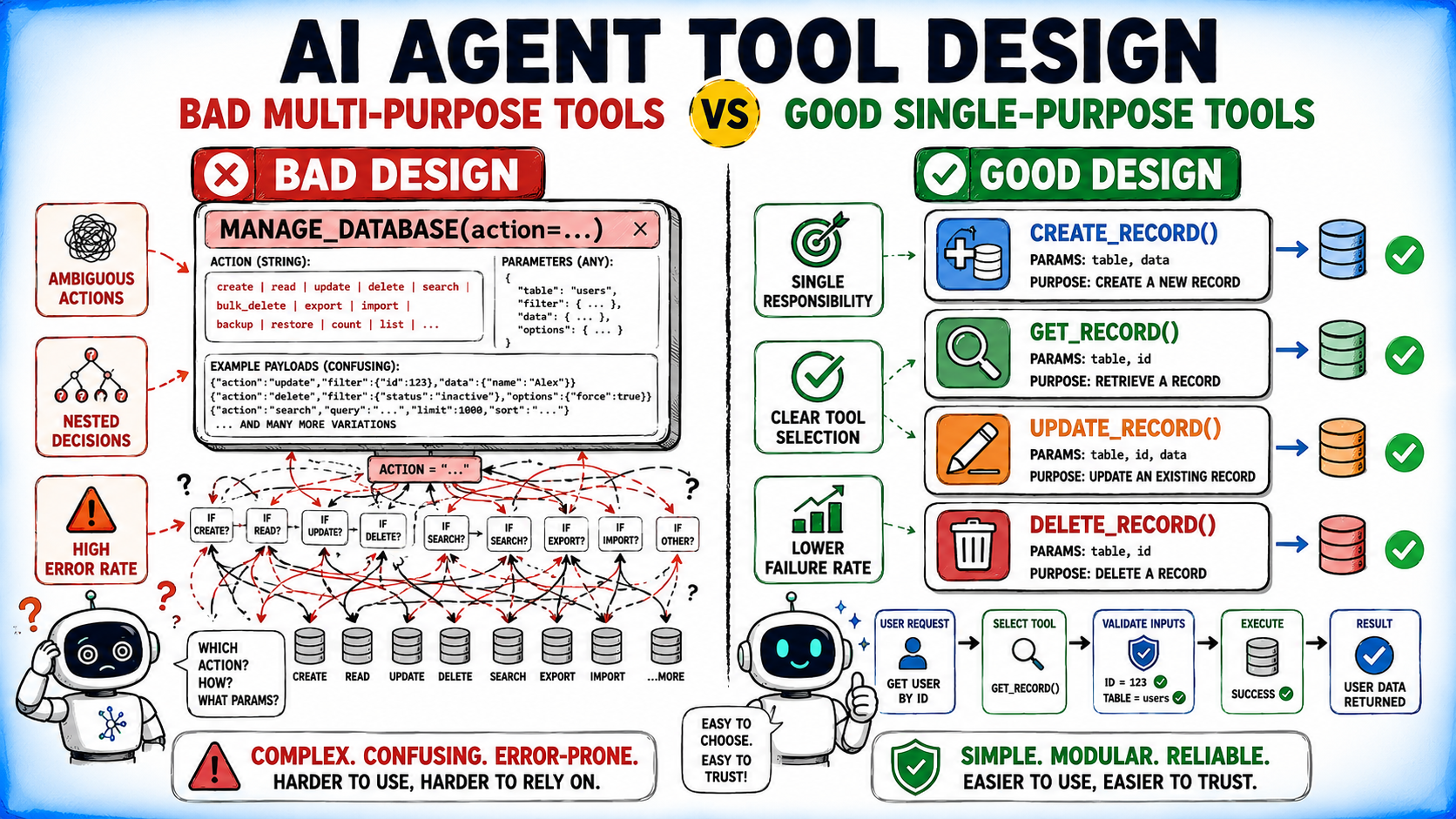
The Single Responsibility Principle (SRP) is a pillar of software engineering, and it is arguably more critical for AI agents than for human developers. When a tool attempts to handle multiple behaviors (e.g., a manage_customer tool that handles creation, deletion, and updates based on an action string), the model must first "guess" the intended mode of operation.
Instead, prefer dedicated, single-purpose tools. By creating create_customer, get_customer, and suspend_customer as distinct functions, you eliminate the ambiguity of the "action" parameter. This creates cleaner logs, more granular observability, and vastly higher success rates in tool selection.
Schemas as Guardrails
Models construct tool calls by reasoning from your schema. If your schema is loose—for example, using raw strings for dates or status codes—the model will eventually output an invalid format.
Using Pydantic models or JSON Schema with strict enums and field constraints (like min_length, pattern, and default) creates a "hard boundary." When the model attempts to generate an invalid argument, the validation fails at the boundary layer before the tool is even executed. This forces the model to correct its logic in the next turn, rather than crashing the downstream system with a runtime error.
Descriptions that Define Scope
Most developers write descriptions that explain what a tool does. To build robust agents, you must explain when not to use the tool. A strong description acts as a "Usage Contract." For instance, a search tool should explicitly state: "Do NOT use this for real-time data; use get_live_data() instead." By explicitly defining the scope boundaries, you prevent the agent from selecting a tool that is functionally relevant but contextually inappropriate.
Official Industry Perspectives on Tool Reliability
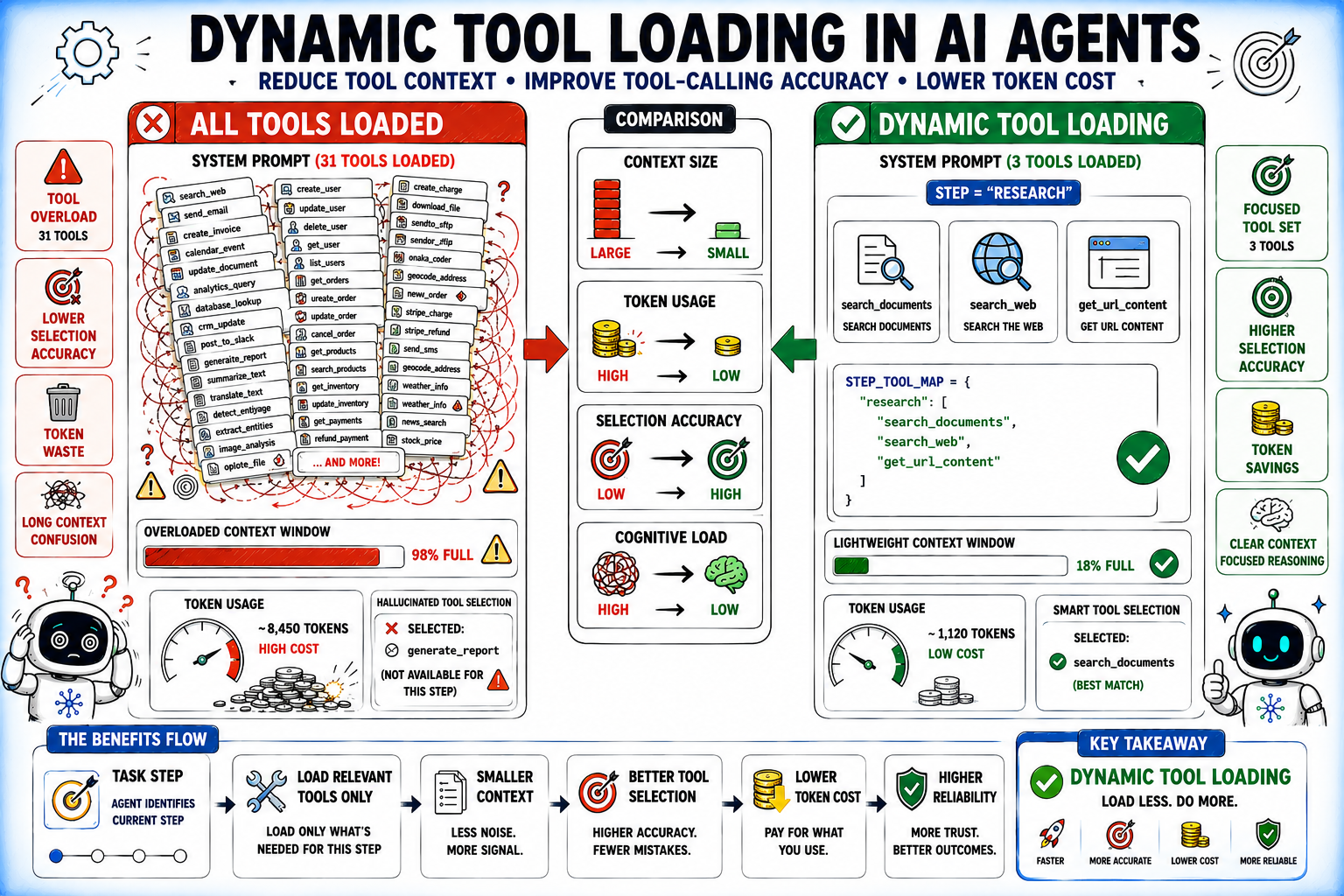
Leading AI research labs, including Anthropic and IBM, have emphasized that the "agent loop" is only as reliable as its weakest link. In their documentation on tool-calling, industry leaders note that agents often suffer from "Contextual Drift." As the number of tools in an agent’s catalog increases, the model’s ability to select the correct tool declines.
Research from the LongFuncEval study (2025) highlights that even with massive context windows, agent performance drops as the catalog grows. This has led to the industry-wide adoption of Dynamic Tool Loading. Rather than exposing all 50+ available tools in every prompt, sophisticated agents now use a "router" or a "pre-step" to determine which subset of tools is relevant to the current task. By limiting the search space, you reduce token costs and significantly improve selection accuracy.
Implications: The Future of Agentic Workflows
The Death of "Silent Failure"
One of the most dangerous patterns in current agent design is "silent partial success." This occurs when a batch operation (like creating ten tasks) fails on three items but returns a success message for the seven that worked. The agent, seeing a "success" message, proceeds as if the entire job is done.
Future-proof agents require Structured Error Returns. A tool should return a result object that explicitly separates successful operations from failed ones, providing the agent with a partial_success flag and a suggested_action. This gives the agent the agency to decide whether to retry the failed items, inform the human user, or stop the execution entirely.
Idempotency as a Safety Standard
In a distributed system, network timeouts are inevitable. If an agent calls a send_email tool and the connection drops before a response is received, the agent may attempt to retry. Without idempotency, the recipient receives two emails. By requiring an idempotency_key for all state-changing operations, developers ensure that even if a tool is called multiple times due to network flakiness, the side effect only occurs once.
The Rise of the "Human-in-the-Loop" Gate
Finally, we must address the issue of destructive actions. No model, no matter how sophisticated, should be granted unilateral power to delete data or execute financial transactions. The "two-step confirmation" pattern—where an agent must first call a stage_deletion tool and then a confirm_deletion tool—introduces a vital pause. This is not just a safety feature; it is a structural requirement for any agent operating in a production environment.
Conclusion: A New Discipline
The transition from simple chatbot to autonomous agent requires a shift in mindset. We are no longer just writing code; we are designing interfaces for a non-deterministic, probabilistic engine.
As summarized in our design matrix, the difference between a failing agent and a high-performing one comes down to discipline:
- Move from "action-based multi-behavior" to "single responsibility."
- Move from "loose strings" to "strict enums and schemas."
- Move from "silent failure" to "explicit partial success reporting."
The agents of tomorrow will not be defined by the scale of their underlying parameters, but by the elegance, clarity, and safety of the tools we provide them. By treating tool design as a first-class engineering discipline, we can finally move past the era of fragile, unreliable AI and toward a future of robust, task-oriented automation.