The Architecture of Reliability: A Comprehensive Roadmap to Mastering LLMOps in 2026
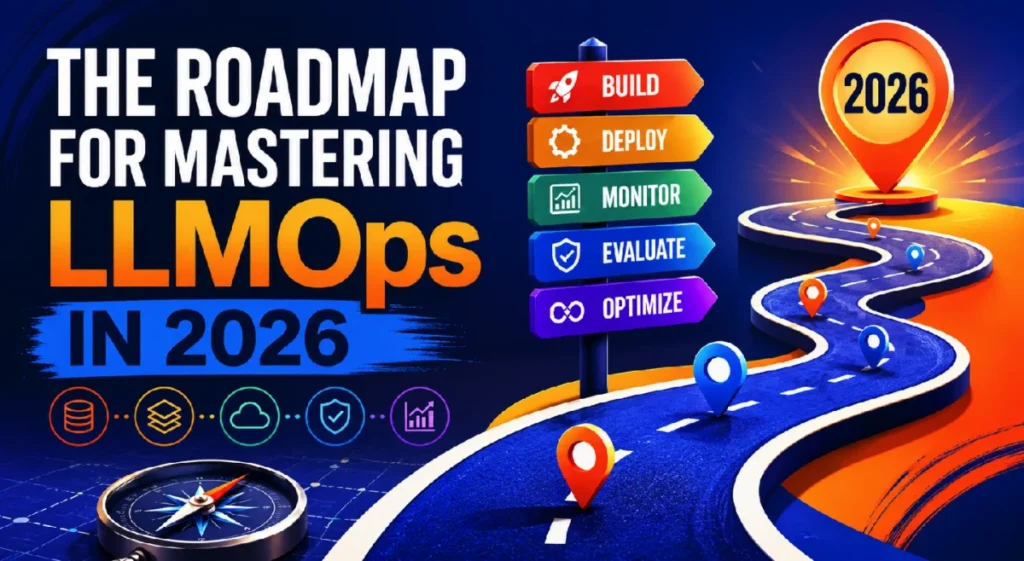
The artificial intelligence landscape has shifted from a "demo-first" culture to one of rigorous industrial application. As the LLMOps market accelerates toward a projected $4.9 billion valuation by 2028, enterprises are moving past the initial excitement of generative AI and confronting the harsh reality of production: unreliable outputs, ballooning API costs, and the difficulty of maintaining non-deterministic systems.
For engineers and CTOs alike, the question is no longer whether to adopt LLMs, but how to manage them with the same operational discipline as traditional software. LLMOps—the engineering practice of building, monitoring, and scaling LLM-based systems—is the bridge between an experimental notebook and a mission-critical production environment.
The Evolution of Operational Discipline: LLMOps vs. MLOps
To understand the necessity of LLMOps, one must first distinguish it from traditional MLOps. In the legacy MLOps paradigm, the primary focus is the model artifact: training, hyperparameter tuning, and monitoring for statistical drift. Once a model is deployed, its behavior is largely predictable given specific input features.
LLMOps presents a fundamentally different challenge. In modern LLM systems, the model weights are often static, provided by third-party APIs like Anthropic or OpenAI. The "code" that changes most frequently is the prompt. Furthermore, LLM outputs are inherently non-deterministic. A minor tweak to a system prompt can cause cascading changes in downstream performance, often in ways that are difficult to predict.
This necessitates a shift from binary "correct/incorrect" testing to continuous, evaluation-based pipelines. In this new world, token usage is not merely a technical detail; it is a P&L metric. As inference costs scale linearly with user growth, treating cost management as an afterthought is a recipe for budget volatility.
Phase 1: Foundations – The Art of Instrumented Execution
Before implementing complex orchestration, teams must master the baseline: observability. A production system without comprehensive logging is essentially a black box. The goal of the first phase is to ensure that every LLM interaction is traceable, auditable, and cost-aware.
Establishing the "Production-First" Mindset
An application is only "production-ready" if it can be debugged at 2:00 AM. This requires a robust instrumentation layer. By using tools like Langfuse, developers can capture:
- Input/Output Tracing: Recording every prompt and response to understand how the model interprets intent.
- Token Attribution: Calculating the exact cost per turn, allowing for granular visibility into API spending.
- Latency Monitoring: Identifying bottlenecks in the request-response cycle.
Practical Implementation
The following code snippet demonstrates how to wrap a standard LLM call with tracing functionality, ensuring that developers have full visibility into the lifecycle of every request.
# Instrumented LLM Call Wrapper
import os
from langfuse import Langfuse
from anthropic import Anthropic

# Initialize clients using environment variables
langfuse_client = Langfuse()
anthropic_client = Anthropic()

def call_llm_with_tracing(user_message, session_id):
    trace = langfuse_client.trace(name="customer-support-call", session_id=session_id)
    generation = trace.generation(name="claude-completion", model="claude-sonnet-4")

    # Execution logic with automated cost calculation and logging
    # ... (Implementation details for tracing)

    return response_text
Phase 2: RAG Pipelines and the Evaluation Crisis
Retrieval-Augmented Generation (RAG) has become the standard architectural pattern for grounding LLMs in proprietary data. However, RAG systems are notorious for "silent failures"—where the model answers confidently but incorrectly, or fails to retrieve the relevant context entirely.
Measuring Success with RAGAS
Evaluation is the bedrock of RAG reliability. The RAGAS framework has emerged as the industry standard for measuring four critical failure modes:
- Faithfulness: Does the answer derive strictly from the retrieved context, or is the model hallucinating?
- Answer Relevancy: Does the response address the specific user query?
- Context Precision: Is the retrieved information actually useful?
- Context Recall: Did the retriever find all the necessary data points?
By maintaining a "golden dataset"—a collection of 50 to 100 high-quality question-answer pairs—teams can run automated regressions before every deployment, blocking the release of any update that degrades these metrics.
Phase 3: Guardrails and Economic Optimization
As systems scale, they encounter two primary enemies: malicious inputs and inefficient compute usage.
Guardrails: The Digital Bouncer
Input and output guardrails act as an essential security layer. They scrub for PII (Personally Identifiable Information), detect prompt injection attacks, and verify that the output adheres to expected formats. Whether using the flexible, code-first approach of Guardrails AI or the conversational flow-control of NVIDIA’s NeMo Guardrails, these tools ensure that the system remains safe for end-users.
Strategic Cost Control
Cost management in 2026 is no longer about just choosing a cheaper model; it is about intelligent routing. By implementing a "Router" pattern—using tools like LiteLLM—teams can route simple, low-stakes queries to lightweight models (e.g., Claude Haiku) while reserving frontier models (e.g., Claude Sonnet) for complex, high-reasoning tasks. This tiered approach can reduce total inference costs by 30–50% without compromising user experience.
Phase 4: The Agentic Frontier
The transition from RAG to Agents represents the next great leap in LLMOps. Agentic systems, where models autonomously determine which tools to call and in what order, introduce a higher level of complexity.
Scoring Trajectories
Evaluating an agent is fundamentally different from evaluating a RAG pipeline. You are no longer scoring a single response; you are scoring a trajectory. If an agent takes seven steps to solve a problem and fails on step six, the evaluation must capture that entire sequence.
The industry is currently coalescing around a three-tiered evaluation strategy:
- Heuristic Evals: Run on 100% of production traffic for basic checks (e.g., loop limits, tool-call format).
- LLM-as-a-Judge: Run on a 10–20% sample to analyze semantic success.
- Human-in-the-Loop: Periodic manual reviews to update the "golden dataset" and keep the automated judges calibrated.
Implications for the Future of AI Engineering
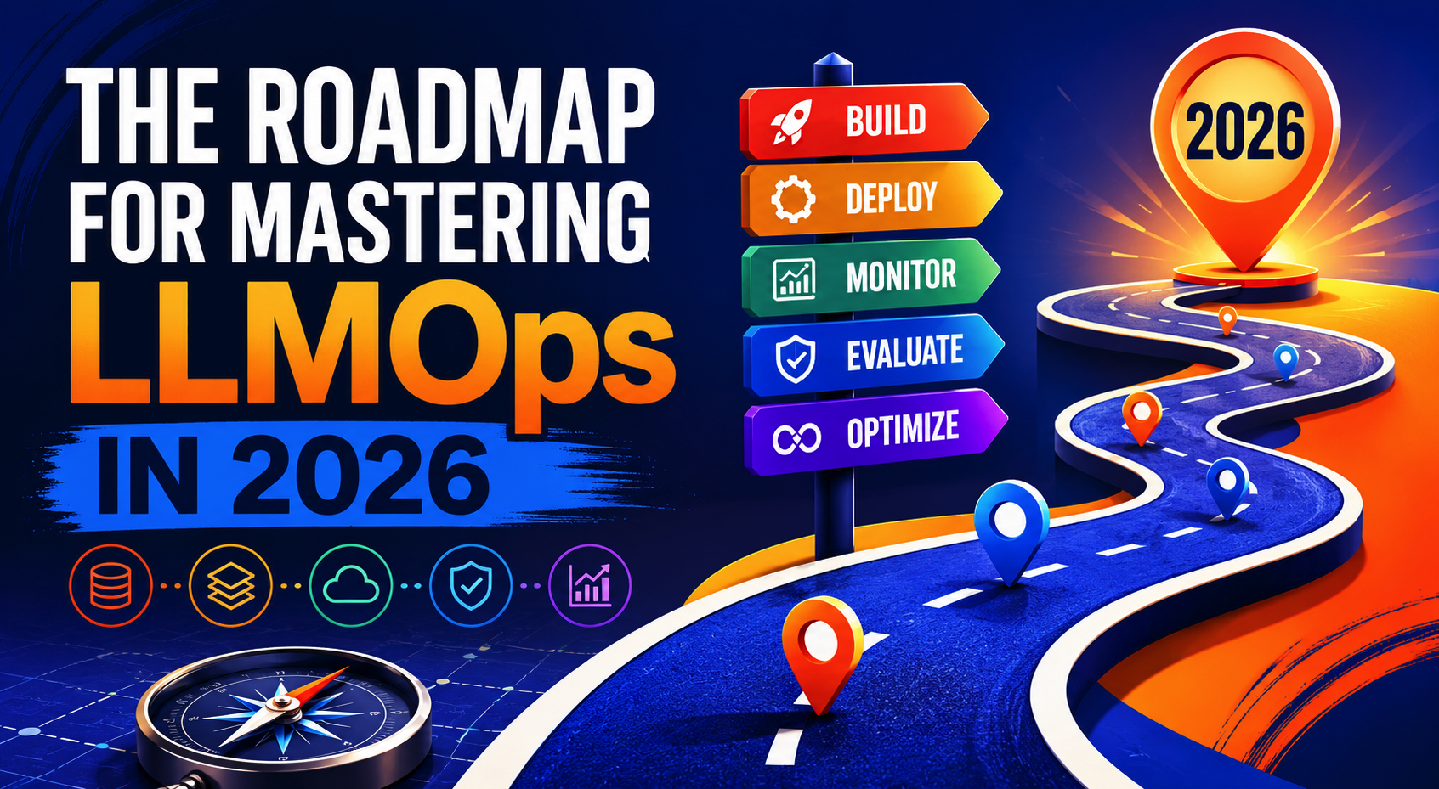
The "production stack" for 2026 is becoming remarkably consistent. While individual preferences for tools like LangSmith, Langfuse, or Arize Phoenix may vary, the architecture remains stable: Observability → Evaluation → Guardrails → Routing.
For teams building at scale, the implications are clear: The era of the "unmonitored LLM" is over.
The successful AI engineer of the future is not just someone who can craft an elegant prompt. They are a systems architect who understands how to build durable, cost-effective, and safe pipelines. By following this roadmap, organizations can transform their experimental prototypes into reliable, production-grade systems that deliver consistent value.
Summary Checklist for Engineering Teams
- Foundations: Ensure every call is traced and cost-logged.
- Evaluation: Build a golden dataset and automate RAGAS metrics.
- Optimization: Implement LiteLLM routing to balance cost and performance.
- Security: Deploy input/output guardrails as a non-negotiable standard.
- Orchestration: Use LangGraph for durable, stateful agent workflows.
In conclusion, LLMOps is not a "side project" or a set of optional tools. It is the core engineering discipline that separates AI systems that merely function from those that thrive in the real world. By treating operations as a first-class citizen, teams can navigate the complexities of 2026 and build the next generation of intelligent software.