In an era dominated by instant communication, rapid technological breakthroughs, and live-streamed rocket launches, public attention is naturally captured by the climactic moments of space exploration. We watch in awe as rocket boosters fire, capsules splash down in the ocean, and astronauts step onto foreign surfaces. Yet, this high-profile theater of spaceflight often obscures the grueling, years-long journey that makes these missions possible.
Behind every successful mission lies a highly complex, multi-disciplinary, and physically punishing process known simply as astronaut training. Going to space is not merely a matter of boarding a highly automated vehicle; it requires human beings to undergo a profound physical and psychological transformation. To survive the vacuum of space, extreme gravitational forces, and the psychological toll of isolation, candidates must be systematically rebuilt into adaptable, resilient, and highly specialized operators.
From deep-water diving in Texas to hunting for volcanic rocks in Hawaii and surviving the sub-zero forests of Siberia, astronaut training is a global endeavor. As space agencies prepare to return to the Moon and push onward to Mars, the methodologies of training are evolving, combining legacy survival tactics with cutting-edge virtual reality and planetary analogs.
Main Facts: The Pillars of Modern Astronaut Training
Astronaut training is designed to mitigate the extreme risks of spaceflight by exposing candidates to high-fidelity simulations of the hazards they will encounter. These hazards include microgravity, high G-forces, physiological deterioration, equipment malfunctions, and extreme environmental isolation. To prepare for these challenges, international space agencies—including NASA, the European Space Agency (ESA), Roscosmos, and JAXA—rely on five core pillars of preparation.
1. Extra-Vehicular Activity (EVA) and Neutral Buoyancy
An Extra-Vehicular Activity (EVA), commonly known as a spacewalk, is among the most physically demanding and dangerous tasks an astronaut can perform. Working outside the protective hull of a spacecraft or station requires operating in a pressurized suit that resists movement, making even basic tasks like turning a bolt exhausting.
To prepare for this, astronauts train extensively in neutral buoyancy pools. By balancing weights and flotation devices, divers achieve "neutral buoyancy"—a state in which they neither sink nor float. While this does not eliminate inertia, it closely mimics the sensation of microgravity.
Key Facility: NASA’s Neutral Buoyancy Laboratory (NBL) at the Johnson Space Center in Houston, Texas, contains 6.2 million gallons of water and houses full-scale mockups of International Space Station (ISS) modules.
Training Protocol: For every hour an astronaut is scheduled to spend on an EVA in space, they spend approximately six to ten hours training underwater. Here, they practice using specialized EVA tools, managing tether lines, and communicating under high stress.
2. Geological and Field Analog Training
With the focus of global space exploration shifting from Low Earth Orbit (LEO) back to planetary surfaces (the Moon and eventually Mars), geology has re-emerged as a vital discipline. Astronauts are not just pilots; they are field scientists who must identify, document, and collect valuable geological samples.
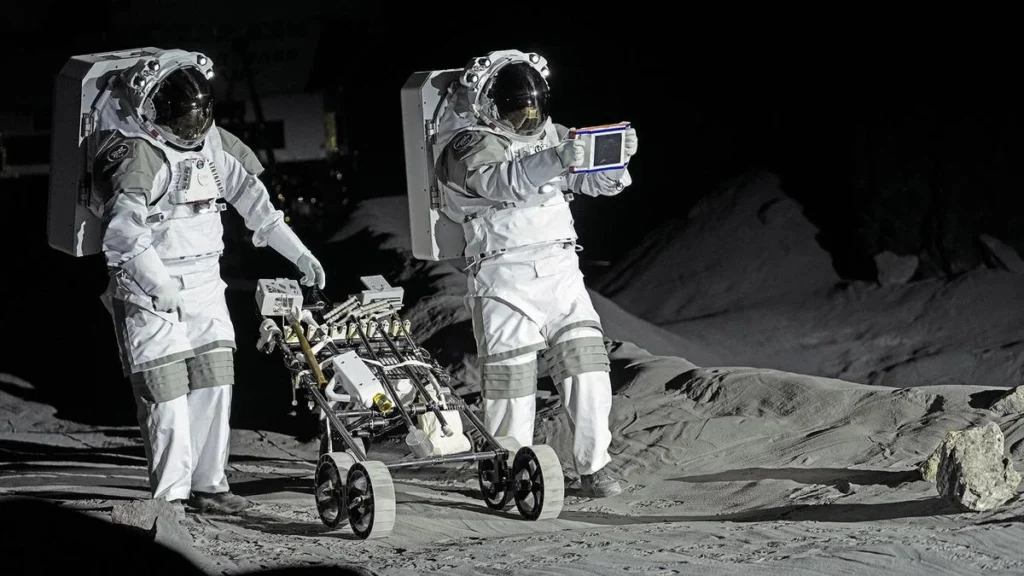
To build these skills, space agencies utilize Earth-based "analogs"—regions with geological features, volcanic landscapes, or extreme climates that resemble lunar or Martian terrain.
Volcanic Fields and Craters: Astronauts practice identifying volcanic rocks, basaltic formations, and impact craters in regions like the Grand Canyon, the volcanic fields of Hawaii, the Canary Islands, and Iceland.
LUNA Facility: Located at the European Astronaut Centre (EAC) in Cologne, Germany, the newly established LUNA facility simulates the lunar surface, complete with 700 square meters of simulated moon dust (regolith) and specialized lighting to mimic the harsh, low-angle sunlight of the lunar south pole.
3. Survival and Wilderness Training
Spaceflight operations do not always go according to plan. During re-entry, emergency aborts or atmospheric anomalies can cause a spacecraft to land thousands of kilometers off-target. If a capsule lands in the open ocean, a dense jungle, or a freezing mountain range, the crew must survive until search-and-rescue teams arrive.
Survival training strips astronauts of their high-tech support systems and forces them to rely on basic bushcraft and emergency capsule equipment.
Water Survival: Astronauts practice escaping from submerged capsule mockups, deploying life rafts, and signaling rescue helicopters in rough open waters.
Winter and Wilderness Survival: Conducted in locations like the forests near Star City, Russia, or the wilderness of Canada, candidates spend days in sub-zero temperatures, learning to build shelters from pine branches, start fires, hunt, and prevent hypothermia using only the contents of their emergency landing kits.
4. High-Fidelity Simulators and Virtual Reality
To master the complex flight systems of vehicles like the SpaceX Crew Dragon, Boeing Starliner, and Russia’s Soyuz, astronauts spend thousands of hours in motion-based and virtual simulators.
Centrifuges: To prepare for the intense gravitational forces (G-forces) experienced during launch and re-entry—which can exceed 4 to 8 times Earth’s gravity (Gs)—astronauts are spun in giant centrifuges. This training teaches them specialized breathing techniques to prevent G-induced loss of consciousness (G-LOC).
Virtual Reality (VR): Modern VR laboratories allow astronauts to practice operating robotic arms, navigating the exterior of the ISS, and practicing emergency evacuation procedures in a fully immersive, 3D digital environment.
5. Medical and Psychological Resilience
Living in a confined space for six months or longer with a small crew can lead to profound psychological strain. Astronauts undergo intensive psychological conditioning to manage stress, resolve interpersonal conflicts, and cope with isolation. Furthermore, because there are no hospitals in orbit, all crew members must acquire basic medical skills, including wound suturing, administering intravenous fluids, and performing emergency dental work.
Chronology: The Evolution of Astronaut Preparation
[1959–1972: The Pioneer Era]
   └── Focus: Extreme physical endurance, military flight testing, and basic survival.
       └── Key Milestone: Apollo astronauts train in Hawaii and the Grand Canyon for lunar geology.

[1981–2011: The Space Shuttle Era]
   └── Focus: Payload deployment, robotic arm operations, and short-duration microgravity tasks.
       └── Key Milestone: Construction of the Neutral Buoyancy Laboratory (NBL) in Houston.

[2000–Present: The ISS & Long-Duration Era]
   └── Focus: International collaboration, systems maintenance, and extreme isolation management.
       └── Key Milestone: Cooperative training across NASA, Roscosmos, ESA, and JAXA.

[2020s and Beyond: The Artemis & Deep-Space Era]
   └── Focus: Return to planetary surfaces, lunar regolith handling, and autonomous operations.
       └── Key Milestone: Opening of the LUNA facility in Cologne; preparation for Mars analog missions.
The Pioneer Era (1959–1972)
In the early days of the Space Race, the physiological effects of spaceflight were largely unknown. Medical experts feared that microgravity could cause cardiovascular collapse or psychological madness. Consequently, the first astronaut cohorts (such as the Mercury Seven) were selected exclusively from the ranks of military test pilots who had already proven their ability to survive high-stress, high-G environments.
Training during this era was characterized by raw physical endurance testing. Astronauts were subjected to extreme heat chambers, sensory deprivation tanks, and primitive multi-axis gimbals that spun them in multiple directions simultaneously to test their resistance to disorientation.
As the Apollo program matured, the focus shifted toward planetary science. In December 1970, the crew of Apollo 15 trained on the volcanic Big Island of Hawaii, riding prototype lunar rovers and learning to distinguish between different types of volcanic basalt. This geological foundation proved vital when astronaut Harrison Schmitt, a professional geologist, walked on the Moon during Apollo 17.
The Space Shuttle and ISS Era (1981–Present)
With the advent of the Space Shuttle, spaceflight was no longer the exclusive domain of military daredevils. Space agencies began recruiting "Payload Specialists" and "Mission Specialists"—scientists, engineers, and physicians who required a different style of preparation. Training shifted away from raw physical endurance toward systems management, payload deployment, and complex robotic operations.
The construction of the International Space Station (ISS) in 1998 ushered in an era of unprecedented international cooperation. For the first time, astronauts had to learn multiple languages (specifically Russian and English), train on diverse international hardware, and adapt to long-duration stays of six months or more in orbit.
The Artemis and Deep-Space Era (2020s and Beyond)
Today, the landscape of astronaut training is shifting once again. NASA’s Artemis program aims to establish a sustainable human presence on the Moon, requiring a fusion of ISS-era systems training and Apollo-era geological field skills.
Modern training incorporates advanced virtual reality, artificial intelligence flight simulators, and sophisticated planetary analog environments. Astronauts Thomas Pesquet of France and Matthias Maurer of Germany, for example, have pioneered new training techniques at the European Astronaut Centre, practicing lunar dust mitigation and lunar gravity locomotion using specialized suspension rigs that offset five-sixths of their body weight.
Supporting Data: The Metrics of Human Optimization
The rigorous nature of astronaut preparation can be quantified through the demanding metrics and parameters set by global space agencies:
Metric / Parameter
Value / Description
Significance
Average Training Duration
2 Years (Basic) + 2 Years (Mission-Specific)
Ensures absolute mastery of basic survival, language, and spacecraft systems before launch.
NBL Water Volume
6.2 Million Gallons (23.5 Million Liters)
Large enough to hold full-scale mockups of the ISS, allowing realistic EVA routing.
EVA Training Ratio
6 to 10 Hours Underwater per 1 Hour in Space
Builds muscle memory and stamina required to operate in a pressurized spacesuit.
G-Force Simulation Limits
Up to 9 Gs (Centrifuge Training)
Prepares the cardiovascular system for the extreme decelerations of ballistic re-entries.
Parabolic Flight Duration
20 to 25 Seconds of Microgravity per Parabola
Allows astronauts to experience short bursts of weightlessness to practice basic movement.
Regolith Simulant at LUNA
700 Square Meters of Volcanic Dust
Recreates the physical, abrasive, and electrostatic properties of lunar soil.
Institutional Perspectives and Official Responses
Space agency officials and veteran astronauts frequently emphasize that training is not merely about learning how to fly a spacecraft, but about developing a specific mental framework.
Following the extended orbital stay of astronauts Sunita Williams and Butch Wilmore aboard the ISS—necessitated by technical issues with their transport spacecraft—NASA leadership highlighted the critical role of adaptive training.
"Our astronauts are trained to expect the unexpected. We do not train them for a single, perfect mission profile; we train them to be problem solvers, system experts, and resilient survivors. When a mission schedule changes or a technical anomaly occurs, their years of rigorous, multi-faceted preparation are what ensure their safety and the mission’s ultimate success."
— NASA Operations Directorate Statement
The European Space Agency (ESA) has also underscored the importance of collaborative, multi-agency training as humanity prepares to venture deeper into the solar system. During the inauguration of the LUNA analog facility, ESA representatives stressed that international standardization is the key to deep-space exploration.
"LUNA represents a significant leap forward in our preparation for the Moon. By simulating the physical, optical, and geological conditions of the lunar south pole here on Earth, we are giving our international crews the exact tools and experience they need to conduct high-value science. Space is a collaborative frontier, and our training facilities must reflect that unity."
— European Astronaut Centre (EAC) Leadership
Implications: Preparing for the Next Giant Leap
As humanity stands on the precipice of a new space age, the evolution of astronaut training has profound implications for the future of exploration, science, and commercial enterprise.
1. The Commercial Spaceflight Revolution
The rise of commercial space companies like SpaceX, Blue Origin, and Axiom Space is democratizing access to orbit. Private citizens, researchers, and commercial astronauts are now traveling to space with significantly less training than their government counterparts.
This shift is forcing a re-evaluation of what "essential" astronaut training entails. While a professional NASA astronaut requires years of deep systems knowledge to maintain a multi-billion-dollar space station, a commercial space tourist may only need a few weeks of safety, egress, and G-force acclimation training. This bifurcation of training protocols will accelerate the commercialization of Low Earth Orbit.
2. Autonomous Operations on Mars
For future missions to Mars, astronauts will face a communication delay of up to 20 minutes each way with Earth. This delay makes real-time mission control support impossible during an emergency.
Consequently, training programs must shift from teaching astronauts to follow step-by-step instructions from ground control to cultivating absolute autonomy. Future Martian explorers will need to be master diagnosticians, capable of repairing complex life-support systems, conducting advanced scientific research, and managing medical emergencies entirely on their own.
3. Planetary Stewardship and Scientific Return
The rigorous geological and scientific training given to modern astronauts ensures that when humanity returns to the Moon, we will not simply be leaving footprints. By training astronauts to be elite field geologists, space agencies are maximizing the scientific return of every gram of lunar or Martian soil returned to Earth. These samples could hold the key to understanding the history of our solar system and discovering signs of past life on other worlds.
Ultimately, the rigorous, exhausting, and meticulous process of astronaut training is what bridges the gap between science fiction and human reality. It is the silent, unseen foundation upon which the grandest adventures of our species are built.