The Future of Digital Engagement: Navigating the Top Marketing Trends Shaping 2024 and Beyond
Marketing, much like the e-commerce landscape it serves, is in a state of perpetual metamorphosis. Every year, industry leaders, innovative agencies, and disruptive brands introduce new methodologies that challenge the status quo, forcing businesses to rethink how they connect with consumers. In recent years, this evolution has been characterized by a profound shift toward social interaction, hyper-connectivity, and the integration of advanced technologies.
As marketing budgets swell and the competition for consumer attention intensifies, the necessity for precision has never been greater. Whether through organic content or paid acquisition, the cost of customer acquisition—both in time and capital—is climbing. To remain competitive, brands must navigate a complex ecosystem where reaching the right consumer, on the right channel, at the precise moment of intent is the ultimate goal. This article examines the critical trends defining the current marketing era and explores the implications for businesses striving to stay ahead of the curve.
The Core Pillars of Modern Marketing
To understand the trajectory of the industry, we must look at the convergence of ethical technology, sustainability, and human-centric content.
1. The Rise of Responsible Artificial Intelligence
Artificial Intelligence (AI) is no longer a futuristic concept; it is the engine room of modern marketing. However, 2024 marks a transition toward "Responsible AI." This movement prioritizes ethics, transparency, and social accountability in the deployment of machine learning algorithms.
- Algorithmic Transparency: Brands are increasingly under pressure to disclose when content is AI-generated, ensuring that consumers are aware of the nature of their interactions.
- Data Privacy: With the deprecation of third-party cookies, Responsible AI focuses on utilizing first-party data in ways that respect user privacy, moving away from invasive surveillance marketing.
- Bias Mitigation: Companies are auditing their AI tools to ensure that automated recommendations and targeting do not perpetuate social biases, ensuring a more equitable digital marketplace.
2. Sustainability as a Competitive Advantage
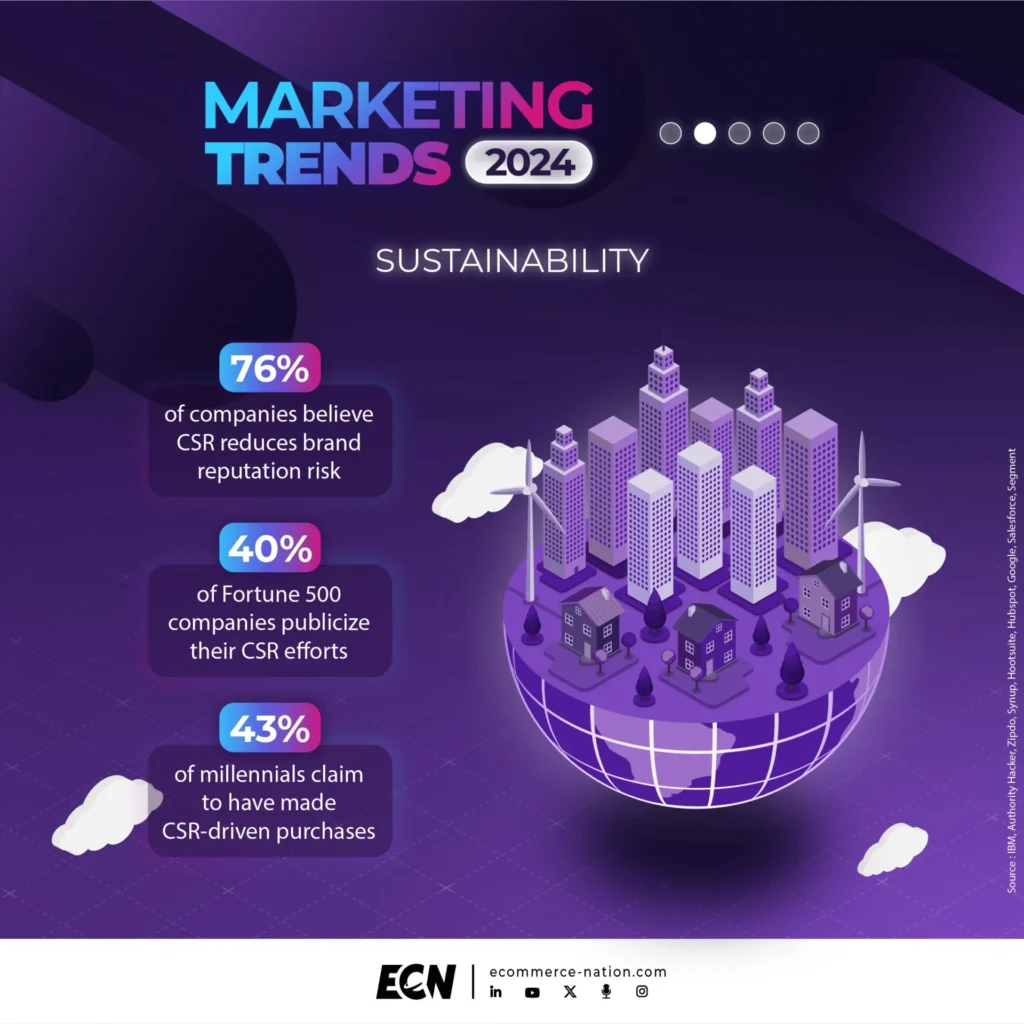
Sustainability has evolved from a corporate social responsibility (CSR) checkbox into a central pillar of brand identity. Today’s consumers—particularly Gen Z and Millennials—demand transparency regarding the environmental impact of the products they purchase.
- Showcasing the Green Value Chain: Through social media, blogs, and video campaigns, brands are shifting their narrative to focus on the lifecycle of a product. By highlighting sustainable materials and ethical labor practices, companies are building deeper, value-based relationships with their audiences.
- Influencer Partnerships: The role of the influencer has pivoted. "Greenfluencers"—creators who specialize in sustainable living—are now among the most trusted voices in the market, helping brands validate their eco-credentials.
- Technological Traceability: Tools like blockchain are becoming essential for verifying claims. When a consumer can scan a QR code to view the entire journey of a garment, from fiber to storefront, trust is inherently strengthened.
Chronology of the Digital Shift
The trajectory of these trends didn’t happen overnight. It is the result of a decade of rapid technological acceleration:
- 2015–2018 (The Social Era): Marketing was defined by the dominance of social media feeds and the explosion of influencer marketing as a primary discovery channel.
- 2019–2021 (The Pandemic Pivot): Digital transformation was forced into high gear. Businesses that weren’t "digitally native" scrambled to adopt e-commerce, leading to the early integration of AR and virtual shopping.
- 2022–2023 (The AI Explosion): The release of generative AI tools democratized content creation, allowing small brands to produce enterprise-level marketing assets, while simultaneously creating a "noise" problem.
- 2024 and Beyond (The Era of Authenticity): With AI-generated content flooding the web, the current trend is a return to human connection, ethical responsibility, and hyper-personalized, high-value experiences.
Supporting Data and Market Implications
Recent industry reports indicate that businesses utilizing hyper-personalized content strategies see, on average, a 15–20% increase in conversion rates. Furthermore, companies that explicitly communicate their sustainable practices experience a 30% higher customer retention rate compared to competitors that remain silent on environmental issues.
The implication is clear: The "spray and pray" method of digital advertising is dead. The future belongs to brands that use AI to facilitate—not replace—human connection.

Conversational Search: The New SEO Frontier
As AI assistants like Siri, Google Assistant, and Alexa become more integrated into our daily lives, search behavior is changing. Users are moving away from fragmented keyword strings toward full-sentence, natural-language queries.
Adapting to Semantic Search
Marketing teams must pivot their SEO strategies toward semantic search. This means:
- Addressing Intent: Rather than just ranking for a term like "running shoes," content must answer the user’s intent: "What are the best running shoes for flat feet?"
- Structuring Data: Using schema markup to help AI algorithms interpret the context of your content.
- Conversational Tone: Writing copy that mirrors the way humans speak, ensuring that your brand is the "answer" provided by the smart assistant.
The Dominance of Short-Form and Immersive Content
The human attention span is shrinking, and content strategies have adjusted accordingly.
Short-Form Video
Platforms like TikTok, Instagram Reels, and YouTube Shorts have conditioned the global consumer to digest information in 15-to-60-second bursts. For marketers, the challenge is "The Three-Second Rule": if you haven’t captured the viewer’s interest within the first three seconds, the sale is lost. Storytelling, quick cuts, and humor are no longer optional—they are the baseline for entry.

The Immersive Experience
Beyond the short-form video, there is a surge in interactive media. Augmented Reality (AR) has transformed the e-commerce experience. Whether it is "trying on" sunglasses through a phone camera or visualizing furniture in a living room, these tools reduce purchase anxiety and decrease return rates. By allowing customers to "interact" with a product before it ever touches their doorstep, brands are effectively bridging the gap between physical and digital retail.
Hyper-Personalization: The End of Generalization
The final, and perhaps most potent, trend is hyper-personalization. In a world of infinite choice, the "one-size-fits-all" message is ignored.
Hyper-personalization uses machine learning to analyze granular data points—purchase history, abandoned cart behavior, time of engagement, and even weather patterns in the user’s location—to create a bespoke experience.
- Dynamic Email Marketing: No two customers receive the same newsletter. Each email is curated based on the individual’s specific browsing history.
- Predictive Analytics: Using AI to anticipate a customer’s needs before they even search for a product. If a data model predicts a customer will need a refill on a consumable product in 30 days, the brand can trigger a reminder just in time, securing the loyalty.
Official Industry Responses and Future Outlook
Industry leaders from global marketing agencies have noted that the biggest threat to growth in 2024 is not a lack of technology, but a lack of trust.

"Technology gives us the tools to reach everyone, but ethics give us the permission to reach the right people," stated a representative from a leading global digital agency. The industry consensus is that while AI and automation will continue to dominate, the brands that win will be those that use these tools to build transparency and authentic human relationships.
The Path Forward
To capitalize on these trends, companies must:
- Invest in Data Hygiene: You cannot have hyper-personalization without clean, actionable first-party data.
- Prioritize Video Production: If your brand isn’t investing in high-quality short-form video, you are effectively invisible to the under-40 demographic.
- Adopt an Ethical Stance: Sustainability is no longer a luxury; it is a fundamental expectation of the modern consumer.
In conclusion, the marketing landscape is evolving from a transactional model to a relational one. By leveraging responsible AI, embracing sustainability, optimizing for conversational search, and focusing on hyper-personalized, immersive experiences, brands can navigate the complexities of the current market and build a sustainable, future-proof strategy. The challenge is immense, but for those who adapt, the potential for growth and deep-rooted customer loyalty has never been greater.