The Future of Digital Inclusion: How AudioEye is Redefining Web Accessibility in the AI Era
In an era where the digital landscape serves as the primary gateway to commerce, healthcare, education, and civic life, the inability to navigate the web is no longer just a technical inconvenience—it is a profound systemic failure. With over 1.3 billion people worldwide living with some form of disability, the internet remains largely inaccessible.
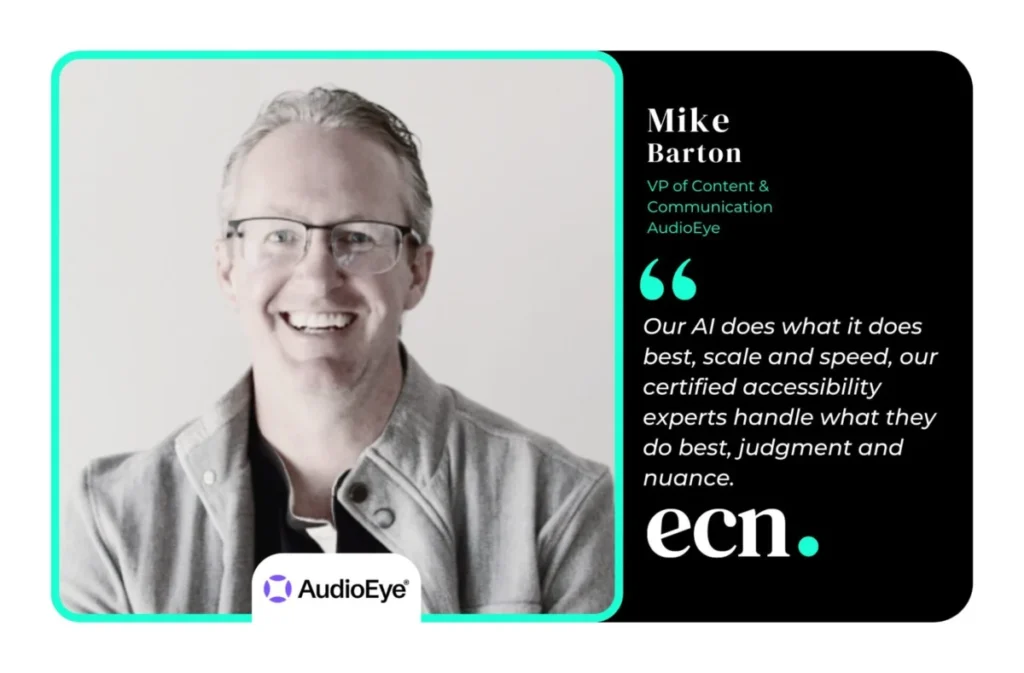
Mike Barton, Vice President at AudioEye, views this not as an insurmountable hurdle, but as a critical mission. "Our vision is a digital world where accessibility isn’t an afterthought or a legal scramble, but the default," says Barton. As the company continues to refine its platform, it is positioning itself at the vanguard of a movement that combines high-speed AI automation with the nuanced judgment of human experts to bridge the digital divide.
The Evolution of a Digital Necessity
For nearly two decades, AudioEye has been a central player in the digital accessibility space. When the company was founded, accessibility was widely viewed as a niche concern—a "checkbox" activity for compliance officers rather than a core component of user experience (UX) or business strategy.
"What’s changed is that the stakes have caught up to the principle," explains Barton. Over the last five years, the environment has shifted dramatically. Legal pressures have intensified, with U.S. accessibility-related lawsuits doubling. Global regulatory frameworks, such as the European Accessibility Act (EAA), have begun to demand a higher standard of digital inclusion across international borders.
AudioEye’s evolution has mirrored this shift. The company has moved from being a provider of basic monitoring tools to a comprehensive platform that addresses the "gray areas" of web accessibility. By doubling down on a hybrid model—utilizing AI for massive-scale detection and human experts for complex remediation—AudioEye has managed to scale its solutions to support over 127,000 organizations.
The Business Case for Inclusivity
While many businesses approach accessibility through the lens of risk mitigation, the economic arguments for digital inclusion are increasingly compelling.
Global Spending Power
People with disabilities represent a massive $18 trillion in global spending power. Despite this, they are often underserved by major digital platforms. Research indicates that 83% of users with disabilities will limit their shopping to websites they know are functional and accessible. When a site presents barriers—such as missing alt text, poor keyboard navigation, or inaccessible form fields—these users do not simply "try again later"; they move to competitors.
The Conversion Lever
For e-commerce brands, accessibility is a direct conversion lever. By removing technical barriers, businesses see lower bounce rates and higher engagement across the board. Furthermore, accessibility is increasingly tied to the "discoverability" of a brand. As AI-powered agents and search algorithms begin to crawl the web to answer user queries, they rely heavily on the site’s "accessibility tree" (the underlying structure of the site). A site that is optimized for accessibility is essentially optimized for the new wave of AI-driven search, making it more visible to both human users and digital assistants.
The Mechanics of Accessibility: The AudioEye Approach
To understand the efficacy of AudioEye, one must look at how its technology integrates into the modern web stack.
Real-Time Remediation
AudioEye’s platform functions via a single line of JavaScript, similar to the deployment of a cookie banner or a chat widget. This allows for seamless integration across CMS platforms, headless setups, and custom builds. Once active, the platform monitors user sessions 24/7.
"Our AI scans the rendered page against the Web Content Accessibility Guidelines (WCAG) standard, detecting up to 2.5 times more issues than competing tools," Barton notes. Roughly half of these issues are resolved automatically in real-time.
The Human-in-the-Loop Advantage
However, the company maintains that automation is not a panacea. The most significant barriers to access often reside in the context and intent of a digital interface. "The barriers that put real users and real revenue at risk often live in the gray areas: context, intent, and how a site actually feels to someone navigating with a screen reader," says Barton.
To address this, AudioEye employs certified accessibility specialists—including professionals with lived experience of disabilities—to conduct audits. These experts deploy custom code fixes through the platform, ensuring that approximately 97% of issues are resolved without requiring a single pull request from the client’s internal engineering team.
Navigating the Legal Landscape
Legal risk remains a primary driver for investment in accessibility. With the rise of litigation in the U.S. and new mandates in the EU, companies are looking for more than just a scan; they are looking for a defense.
AudioEye differentiates itself by offering what it calls a "real legal guarantee." Unlike software-only widgets that often offer hollow warranties, AudioEye provides documentation and support that includes expert debunking reports and, in some cases, direct collaboration with legal counsel. The company reports that its hybrid approach provides three to four times the legal protection compared to automation-only solutions, providing a level of security that aligns with the rigor of modern regulatory requirements.
Implications for the Future: AI as a Double-Edged Sword
Looking toward the future, AudioEye is bracing for a shifting technological tide. The rise of generative AI in web development presents both an opportunity and a threat.
The Challenge of AI-Generated Content
General-purpose AI coding tools are currently generating vast amounts of new web content at unprecedented speeds. Because these models are trained on a web that is historically inaccessible, they often perpetuate—or even worsen—accessibility flaws. "Solving that gap is one of the most important problems in our industry," says Barton.
A Globalized Regulatory Future
As the European Accessibility Act continues to force companies to standardize their digital offerings globally, the "American-only" focus of many legacy companies is becoming obsolete. AudioEye plans to leverage its scale to help multinational corporations navigate these disparate regional requirements, turning compliance into a standardized, automated byproduct of their digital operations.
Conclusion: The Road Ahead
The ultimate goal for AudioEye is to reach a point where accessibility is no longer a "specialized" service but an inherent quality of the internet. As AI agents evolve to become the primary interface through which humans interact with the web, the "accessibility tree" will determine the success of every digital storefront.
By prioritizing the combination of machine speed and human empathy, AudioEye is setting a new standard. For the 1.3 billion people living with disabilities, this means a more navigable, inclusive, and fair digital future. For businesses, it represents the next frontier of growth, risk management, and ethical leadership in a globalized digital economy.
"The internet should work for everyone who uses it," concludes Barton. "Our job is to make sure it does."