The Indian Startup Ecosystem: A Mid-Year Pulse Check and the New Vanguard of Innovation
June 2026 served as a definitive turning point for India’s startup ecosystem, the world’s third-largest. As the mid-year mark approached, the industry witnessed a complex dance of high-profile executive departures, massive corporate investments, and a robust, if nuanced, funding landscape. While the macro-economic environment remains cautious, the undercurrents of innovation—driven by deep-tech, artificial intelligence, and indigenous manufacturing—remain stronger than ever.

The State of Funding: H1 2026 in Review
The first half of 2026 has been a period of recalibration. According to industry data, Indian startups raised $5.2 Bn in the first six months of the year. While this represents a 9% decline compared to the $5.7 Bn raised during the same period in 2025, the narrative is not one of stagnation. Notably, the deal count rose by 7% year-on-year to 501, suggesting that capital is being distributed more broadly, albeit in smaller, more surgical tranches.

The ecosystem was anchored by several blockbuster moves. Meta’s acquisition of a 20% stake in fintech giant CRED for a staggering $900 Mn was arguably the defining financial headline of the month. This, paired with AI powerhouse Sarvam securing $234 Mn from HCLTech at a billion-dollar valuation—making it India’s second AI unicorn—provided a much-needed shot of confidence to the venture capital community. Shortly thereafter, the proptech sector saw its own milestone as Square Yards raised $95 Mn, cementing its status as India’s 131st unicorn.

Executive Shifts and Market Dynamics
June was also defined by a significant changing of the guard. The departure of Kunal Shah from his role at CRED to lead global operations at Meta’s WhatsApp sent shockwaves through the industry, signaling a broader trend of Indian founders taking the helm of global tech operations.

Simultaneously, secondary market activity surged. As public market conditions improved, long-term investors—including Sofina, Alpha Wave Ventures, and Elevation Capital—capitalized on the liquidity window to trim their exposure in established players like Pine Labs, Delhivery, and Honasa Consumer. While the public markets themselves saw a tepid start with Turtlemint’s muted IPO debut, the pipeline is burgeoning. Industry giants such as Reliance Jio Infocomm have filed draft IPO papers, while unicorns like Zepto and the OYO-parent PRISM are readying for major public offerings in the latter half of the year.

30 Startups to Watch: The 72nd Edition
Against this backdrop of transition, Inc42 is proud to unveil the 72nd edition of the 30 Startups to Watch series. Powered by Peak XV, this list highlights the emerging early-stage companies that are not just participating in the market, but actively steering it toward new, high-growth frontiers.

Artificial Intelligence & Marketing Tech
- Aigenc.ai: Founded by the visionaries behind Momspresso, this AI-driven martech platform helps brands forecast campaign performance by analyzing historical ad data. As the AI-in-marketing market nears an $82 Bn opportunity by 2030, Aigenc is positioning itself as an essential tool for digital ad optimization.
- Gigacatalyst: Addressing the "SaaS bloat" problem, this Y Combinator-backed startup allows non-technical teams to build custom features atop existing B2B SaaS stacks. With a 90% repeat usage rate, it is tapping into the $71 Bn enterprise AI market.
- ProactAI: By developing "Bhaskara," a vertical vision foundational model, ProactAI is enabling existing CCTV networks to perform person re-identification and object tracking with 98% accuracy, a critical step toward securing India’s data sovereignty.
SpaceTech and Advanced Engineering
- AnduraX: With the reusable space vehicle market projected to hit $32 Bn by 2034, AnduraX is building the "ARES" spaceplane, designed for routine return missions. Their recent successful drop test at 250 km marks a significant milestone in indigenous aerospace capability.
- Astrobase Space: Partnering with ISRO scientists, Astrobase is building full-flow staged combustion engines using large-scale additive manufacturing. Their goal is to overcome the bottleneck in India’s heavy-lift launch capacity, contributing to the country’s $44 Bn space economy target.
- Khageshvara Aviation: Focusing on the high-payload eVTOL segment, this Jaipur-based startup is developing drones capable of carrying up to 400 kg, bridging the gap in disaster response and critical defence logistics.
- ZeroDrag: By focusing on the avionics stack—flight controllers and GPS modules—rather than just the airframe, ZeroDrag is helping Indian drone manufacturers reduce their 90% reliance on imported components.
Industrial IoT and Deep Tech
- Control One: Bringing "Physical AI" to warehouses, this startup retrofits existing forklifts and pallet trucks with vision AI, automating material handling without the need for total infrastructure overhauls.
- Ubiqedge: Their AIoT platform, featuring the "KLEON" hardware, has already digitized over 23,000 borewells. By enabling real-time monitoring, they are reducing industrial operational inefficiencies by over 80%.
- Beijan: Digitizing legacy military hardware, Beijan provides plug-and-play modules that grant autonomy to traditional artillery and ground stations, a vital upgrade as autonomous warfare becomes the norm.
- CeraTattva Innotech: Transitioning academic research to industry, they are producing advanced ceramic materials and coatings that withstand extreme temperatures, vital for the future of Indian aerospace and automotive manufacturing.
Consumer Goods and Services
- Arta AI Commerce: Streamlining the fragmented D2C process, Arta provides a single operating system for sourcing, marketing, and fulfillment, helping brands launch in under a week.
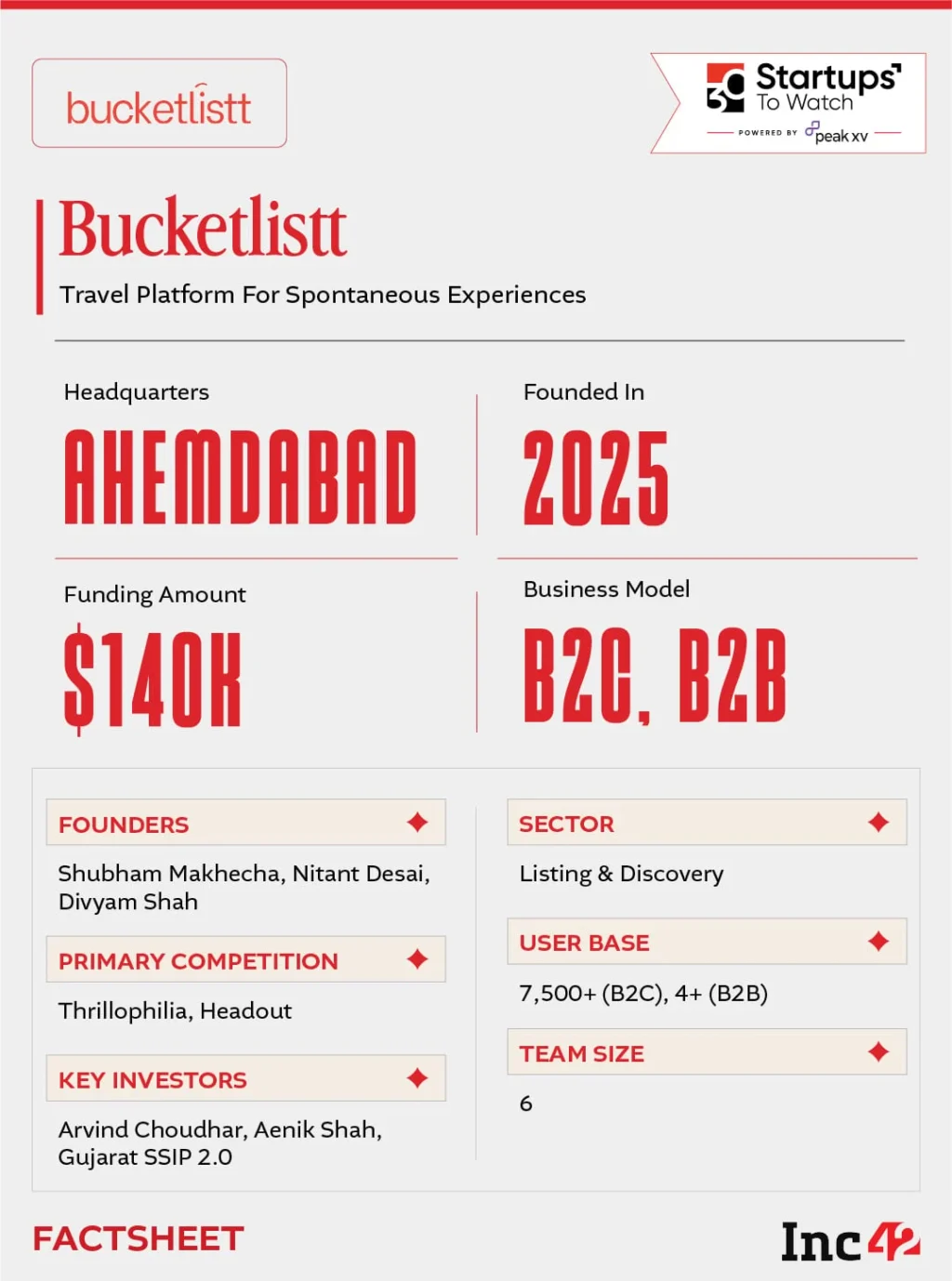
- Bucketlistt: By digitizing the travel experience for both the user and the local vendor, this OTA platform is carving a niche in the $56 Bn Indian online travel market.
- Eazzy: Addressing the post-sales service vacuum, Eazzy offers a circular economy model that includes appliance servicing, maintenance, and buybacks, targeting the $100 Bn home services market.
- Eternz: A curated marketplace for premium jewelry, their "Tinder for Jewellery" discovery engine is helping the D2C segment reach a $10 Bn valuation by 2030.
- Gimi Michi: By focusing on authentic Korean ramen—a high-growth culinary trend—this brand has scaled revenue through quick-commerce platforms like Zepto, hitting a 60% month-on-month growth rate.
- Kroslo: Revolutionizing the traditional cast-iron pan with their "TriForge" technology, Kroslo is making heritage cooking tools lighter and rust-resistant for the modern kitchen.
- LiLLBUD: With BIS-certified Montessori toys for toddlers, they are tackling the $5 Bn early childhood education market with a focus on safety and cognitive development.
- Omli: By training speech recognition models specifically for children aged 3-8, Omli is setting a new standard for voice-first learning apps.
- The Sweet Change: Removing the bitter aftertaste of traditional sweeteners, their monk fruit and allulose-based products are catering to the growing health-conscious demographic in the $650 Mn sugar-substitute market.
- Xtovia: Utilizing "TriLayerX" technology, this startup is redefining premium haircare, backed by over 1,500 formulation iterations and extensive clinical validation.
CleanTech and Agriculture
- FermBox Bio: Using synthetic biology to engineer bio-based enzymes and fragrances, FermBox is helping industries transition away from volatile petrochemical inputs.
- Gudlyf Mobility: Developing type IV and V high-pressure composite cylinders, they are solving the logistics crisis in India’s hydrogen storage market.
- Pehle Jaisa: By decentralizing the production of organic fertilizers, they are enabling village-level circular economies, reducing farmer dependence on chemical inputs.
- Speedioo: Organizing the fragmented used two-wheeler market, this full-stack platform has already achieved profitability and is scaling its franchise-led retail model.
- Tringbox: Their AI-powered background music platform for commercial spaces is dynamically adapting to venue footfall and ambience, changing how retail stores engage with customers.
- VoltSeal: By deploying modular LFP battery systems, they are enabling industrial facilities to store solar power for peak-hour discharge, directly competing with diesel generators.
- Rovia: Providing a wealth management solution for employees with international equity compensation (RSUs/ESOPs), Rovia is tapping into the needs of India’s growing globalized workforce.
- IINDEPRO Dynamics: By manufacturing high-performance BLDC motors locally, they are tackling the supply chain vulnerabilities in the Indian drone propulsion system market.
Implications and The Path Forward
The common thread linking these 30 startups is a pivot from consumer-facing "copycat" models to deep-tech innovation and indigenous capacity building. Whether it is space-grade ceramics, AI-driven surveillance, or synthetic biology, these companies are addressing systemic bottlenecks in the Indian economy.

As the second half of 2026 begins, the focus for these founders will shift from "survival" to "sustainability." With capital markets tightening, the emphasis on profitability—seen already in companies like Speedioo and Omli—is becoming the new benchmark for success. India’s startup ecosystem is no longer just chasing growth at any cost; it is maturing into a resilient, sophisticated engine of global-scale industrial transformation.

Disclaimer: The list above is presented alphabetically and does not constitute a ranking.