The PayPal Honey Fallout: Major Network Crackdowns Signal a Turning Point for Affiliate Marketing Ethics

By Global Business & Technology Desk
Published: January 2026
Main Facts
In a seismic development that has sent shockwaves through the digital marketing ecosystem, PayPal Honey—the ubiquitous browser extension and coupon-finding tool acquired by fintech giant PayPal for $4 billion six years ago—has been ousted from major U.S. affiliate marketing networks. Following a high-profile investigative video by content creator MegaLag and a meticulous technical examination by digital marketing expert Ben Edelman, both Rakuten Advertising and impact.com took decisive punitive action against the multi-billion-dollar platform.
The core issue driving these disciplinary measures centers on attribution manipulation, specifically intentional violations of "stand-down" rules. These industry-standard protocols dictate that browser-based shopping assistants must step down and refrain from injecting affiliate tracking cookies if a consumer has already interacted with another publisher earlier in the digital clickstream. By bypassing these rules, Honey allegedly hijacked affiliate links to wrongfully claim credit—and commissions—for transactions driven by other creators, undermining the foundational trust of the partnership economy.
The timing of the crackdown could not have been more striking. The initial enforcement actions coincided precisely with the opening day of Affiliate Summit West, the largest annual gathering of digital marketers in the United States. While networks and brand managers grapple with the fallout, industry veterans are viewing the incident as a watershed moment for compliance, highlighting structural flaws in how attribution is managed across global affiliate ecosystems.
Chronology of Events
The unraveling of PayPal Honey’s standing within premier affiliate networks unfolded rapidly over a single week in January 2026, driven by mounting public pressure and independent technical exposés:
- Early January 2026: Investigative reports from independent researcher Ben Edelman and tech creator MegaLag expose systemic vulnerabilities regarding how certain browser extensions handle clickstream data and manipulate last-touch attribution models.
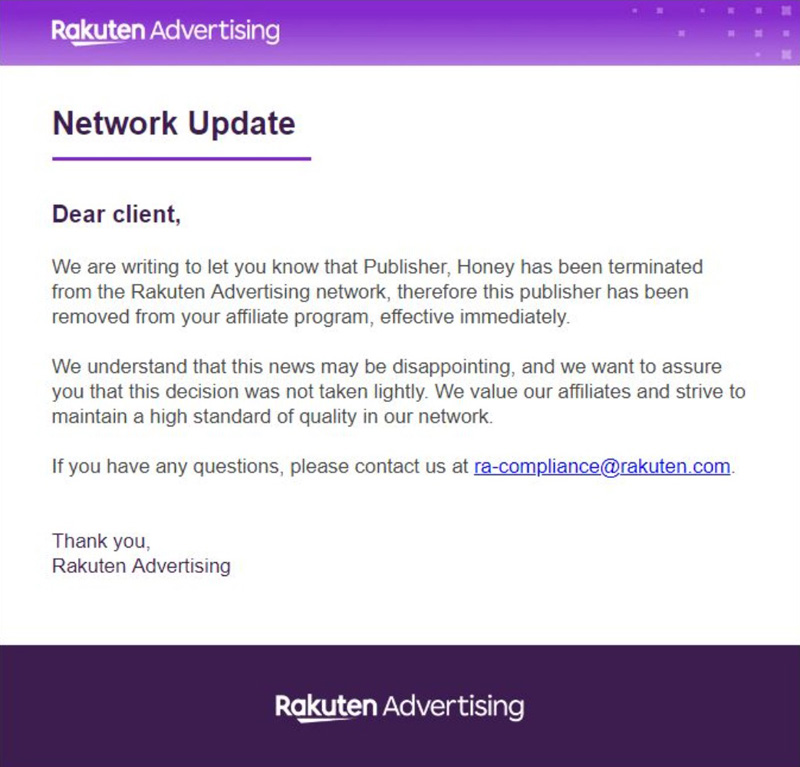
- Monday, January 12, 2026: On the opening morning of Affiliate Summit West, Rakuten Advertising publicly announces that PayPal Honey has been "terminated from the network." Rakuten frames the drastic step as a necessary measure to maintain high standards of quality and protect the integrity of its merchant and publisher base. The announcement immediately dominates conversations at the conference and across social media platforms.
- Friday, January 16, 2026: Competitor network impact.com follows suit, revealing that Honey was found to be "out of compliance" with its platform policies. impact.com removes the extension from its Discovery Marketplace, though legal and structural distinctions classify this initial action as a temporary suspension rather than an outright permanent ban.
Supporting Data and Industry Context
The implications of the PayPal Honey disciplinary actions extend far beyond a single corporate dispute, drawing heavily on recent industry audits and academic research into affiliate attribution models.
The Last-Touch Dilemma
The vast majority of modern affiliate programs operate on a "last-touch-wins-all" compensation structure. Under this rule, 100% of the commission for a verified transaction goes to the final affiliate whose tracking cookie is registered before checkout. While efficient for simple transactions, this model creates an aggressive incentive for downloadable software publishers (DSPs) and browser extensions to aggressively overwrite prior touchpoints—often referred to in the industry as "cookie stuffing" or link hijacking.

The APMA Independent Audit
To understand the technical complexity of these disputes, industry analysts frequently point to a comprehensive 24-page audit conducted by the UK’s Affiliate & Partner Marketing Association (APMA). Titled Independent Audit of Attribution Rules in the UK Affiliate & Partner Marketing Industry, the study evaluated thirty brands across ten affiliate networks and three distinct publisher categories.
The APMA audit highlighted the nuanced differences between traditional "soft click" mechanisms and rigid "stand-down" rules. Crucially, it demonstrated that attribution discrepancies are widespread, prompting the association to issue seven key recommendations for industry-wide reform.
Furthermore, resources such as the Performance Marketing Association’s Affiliate Network DSP Policies Comparison provide foundational guidelines for brands attempting to navigate the complex behavioral rules governing software-based publishers.
Official Responses and Network Statements
The leadership of the major affiliate networks did not mince words when addressing the violations. Their official statements emphasize the protection of merchant ROI and the preservation of a fair playing field for content creators and niche publishers.
- Rakuten Advertising Statement: In its January 12 notice, Rakuten underscored that terminating high-volume publishers is never taken lightly, but that upholding ecosystem quality supersedes gross merchandise value (GMV). The network noted that strict compliance enforcement is essential to "maintain a high standard of quality" across all managed campaigns.
- impact.com Leadership: Highlighting the broader philosophical damage caused by such infractions, impact.com’s executive team explicitly cited "attribution manipulation" as the catalyst for Honey’s suspension. Leadership framed the action as a defense of the broader "partnership economy," stressing that behavior undermining cross-publisher trust cannot be tolerated under modern platform policies.
Implications for Affiliate Managers and Brand Strategies
For brand managers, affiliate directors, and agency operators, the PayPal Honey suspension serves as an urgent wake-up call. Industry experts suggest five core strategic takeaways to insulate affiliate programs from similar disruptions:
1. The "Bad Apple" Effect on Recruitment
When a program harbors aggressive rule-breakers who manipulate last-touch attribution, sophisticated, high-value content publishers take notice. Utilizing the same policing tools employed by network auditors, reputable affiliates will frequently refuse to partner with brands that harbor predatory DSPs. Consequently, tolerating one non-compliant partner often alienates dozens of ethical ones, degrading the overall quality of the program’s publisher mix.
2. Proactive Program-Level Policing
Relying solely on affiliate networks to police compliance is a dangerous gamble. Network compliance teams primarily monitor violations of network-wide rules, and historical precedent shows that network bureaucracies can sometimes be slow to act. Brand managers must explicitly define compliance standards within their individual program Terms and Conditions (T&Cs), maintain active internal monitoring, and retain the autonomy to pause or ban bad actors at the program level immediately.
3. Deep Technical Literacy
Affiliate managers cannot effectively regulate what they do not understand. DSP mechanics, clickstream behavior, cookie-dropping mechanisms, and the distinction between soft-click protocols and mandatory stand-down rules require continuous education. Reviewing benchmarking tools—such as the APMA audit and PMA comparisons—is critical for modern program administration.
4. Avoiding Dangerous Generalizations
A common trap for inexperienced managers is reactionary overcorrection. Following high-profile controversies, some brands enact blanket bans against entire classes of publishers—such as automatically blacklisting all browser extensions, loyalty platforms, or closed-user-group (CUG) solutions. Experts advise against sweeping generalizations, urging instead that every affiliate be evaluated on an individual, performance- and behavior-driven basis.
5. Aggressive Affiliate Diversification
Perhaps the most critical lesson of the PayPal Honey crisis is the danger of revenue concentration. Programs that witness a catastrophic drop in sales following the removal of a single browser extension suffer from a fatal structural flaw: putting all their eggs in one basket.
To build resilient programs, managers should actively recruit across a diverse spectrum of publisher models. Modern affiliate strategies should look beyond basic coupon and cashback sites to incorporate a robust mix of categories, including:
- Affinity groups and charitable fundraisers
- Card-linked offers and Connected TV (CTV) integrations
- Content producers, podcasters, and video marketers
- Educational resources, domainers, and consultants
- Niche online communities, forums, and sub-affiliate networks
- Paid search publishers, retargeting agents, and post-checkout solutions
- Social media influencers and brand advocates
Conclusion
The swift removal of PayPal Honey from Rakuten Advertising and impact.com marks the end of an era where dominant tech tools could operate with near-impunity regarding attribution rules. As digital marketing enters a new phase of accountability, brands and affiliate managers must step up their oversight, prioritize rigorous compliance enforcement, and cultivate diversified ecosystems. By doing so, the industry can restore fairness, protect brand equity, and ensure a sustainable foundation for the partnership economy for years to come.