The Logistics Backbone: How Spring GDS is Redefining Cross-Border E-Commerce
In the hyper-competitive world of modern e-commerce, the difference between a satisfied customer and a lost sale often comes down to one critical factor: logistics. As consumer expectations for speed, transparency, and sustainability reach unprecedented heights, online retailers are increasingly seeking partners who can navigate the complexities of international trade. Enter Spring GDS, an international logistics powerhouse that has positioned itself as the essential bridge between local merchants and global markets.
The Pillars of Success: Backed by a Market Leader
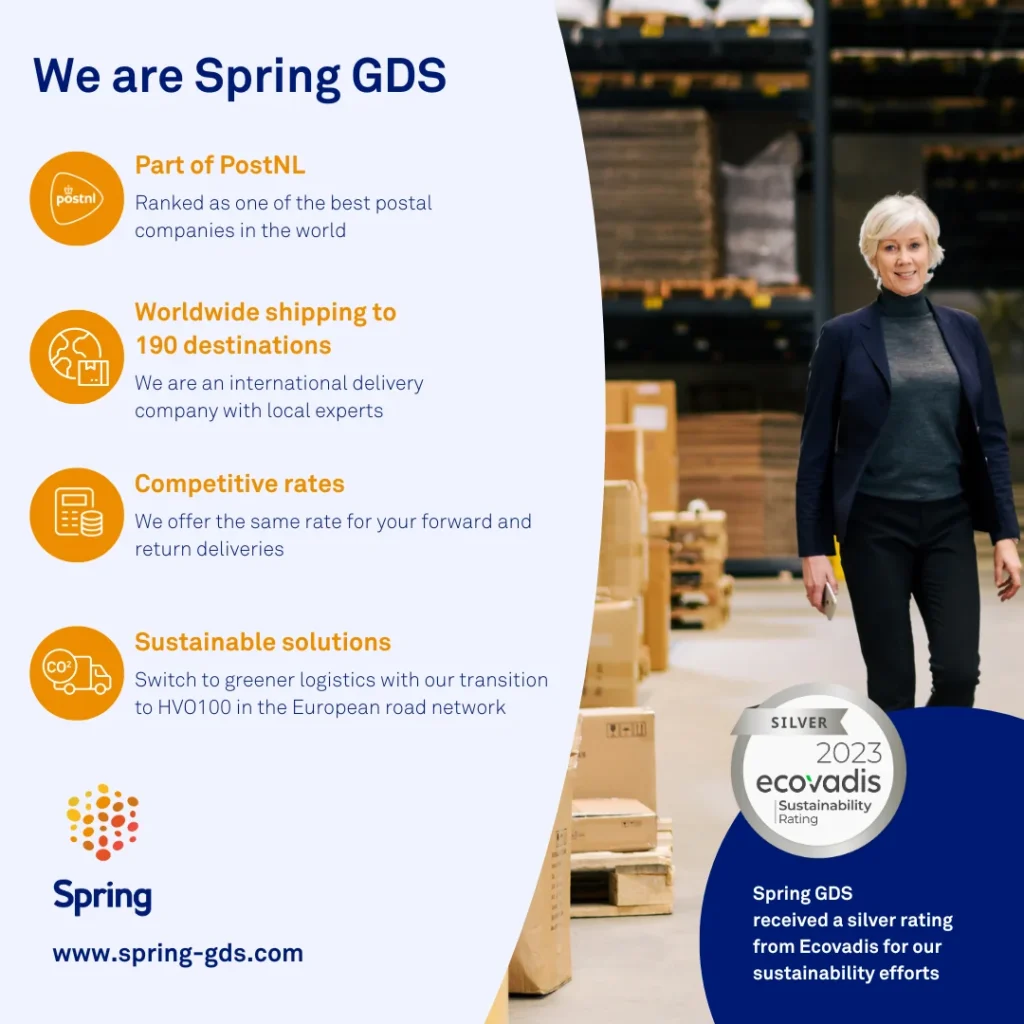
The reliability of a logistics provider is often measured by its lineage and infrastructure. Spring GDS stands on the shoulders of giants as the international subsidiary of PostNL, the prestigious Dutch mail and parcel corporation. Listed on the Euronext Amsterdam, PostNL is not merely a regional carrier; it is a globally recognized institution.
The Universal Postal Union (UPU) consistently ranks PostNL among the top ten postal organizations in the world. Beyond operational efficiency, the parent company has earned accolades for its corporate responsibility, frequently appearing on the Dow Jones Sustainability Index (DJSI) as a leader in the transportation sector. This institutional backing provides Spring GDS with a level of stability and trust that is rare in the volatile landscape of international shipping. For an e-commerce merchant, partnering with Spring GDS means inheriting decades of postal expertise and a robust network that has been battle-tested across borders.
Chronology and Evolution: From Postal Legacy to E-Commerce Specialist
The evolution of Spring GDS mirrors the meteoric rise of the global e-commerce industry. While its roots are firmly planted in the traditional postal services of the Netherlands, the organization recognized early on that the digital shift required a specialized approach.
- Foundational Years: Leveraging the infrastructure of PostNL, the service began by optimizing cross-border mail flows.
- Expansion Phase: Recognizing the unique needs of online retailers—who require tracking, returns management, and customs clearance—Spring GDS expanded its footprint.
- The Modern Era: Today, the organization operates 18 dedicated logistics centers across three continents, creating a seamless "local-to-global" pipeline.
- The Sustainability Milestone: In 2023, the company hit a major benchmark by receiving a silver medal from EcoVadis, marking a turning point in their commitment to environmental, social, and ethical (ESG) performance.
This strategic evolution has allowed Spring GDS to transition from a traditional postal carrier to a high-tech logistics partner capable of managing the complexities of modern, omni-channel retail.
Local Expertise with a Global Vision
One of the most significant challenges for e-commerce brands is the "last mile" problem—the final leg of a delivery that is often the most expensive and complex. Spring GDS addresses this through a massive collaborative network, partnering with over 230 international logistics entities. This alliance grants merchants access to 190 destinations worldwide.
The beauty of this model lies in its agility. By maintaining 18 operation centers across three continents, Spring GDS remains physically close to the merchant’s point of origin and the customer’s point of receipt. This proximity allows for a nuanced understanding of local customs, delivery preferences, and regulatory requirements, ensuring that a package shipped from Europe to Asia, or the Americas to the Middle East, is handled with local expertise at every stage of the journey.
The Sustainability Mandate: A Greener Path Forward
In an era where consumers are increasingly conscious of their carbon footprint, logistics providers are under intense scrutiny. Spring GDS has proactively embedded sustainability into its organizational DNA, viewing it not as a regulatory burden but as a competitive advantage.
The company’s commitment to a greener future is built on three core pillars:
- Circular Resource Management: By replacing single-use materials—such as traditional wooden pallets and carton boxes—with circular, reusable packaging solutions, Spring GDS is actively reducing waste in the supply chain.
- Strategic Emission Reduction: The company has set a rigorous goal to achieve net-zero emissions by 2040. This timeline is specifically aligned with the 1.5°C threshold established in the 2015 Paris Climate Agreement, signaling a commitment to scientific climate targets rather than mere "greenwashing."
- Third-Party Validation: The 2023 EcoVadis silver medal serves as a critical indicator of transparency. It assures stakeholders that the company’s environmental performance is being measured against rigorous, globally accepted benchmarks.
For e-commerce retailers, partnering with a provider that prioritizes sustainability is a value-add that can be passed on to their own customers, strengthening brand loyalty in a market that increasingly favors ethical consumption.
Innovative IT Integration: The XBS Platform
Logistics is as much about data as it is about moving physical goods. The complexity of international shipping—customs duties, label generation, real-time tracking, and returns management—requires a sophisticated digital interface.
Spring GDS addresses this with the Cross Border Shipping (XBS) platform. This IT solution is designed to act as the "central nervous system" for a retailer’s international operations. Key features of the XBS platform include:
- Automated Customs Documentation: Streamlining the often-daunting process of international clearance, reducing the likelihood of border delays.
- Real-time Visibility: Providing merchants and their customers with accurate, granular tracking data, which is essential for maintaining high levels of customer satisfaction.
- Seamless Integration: The platform is designed to plug into existing e-commerce ecosystems, allowing merchants to manage shipments directly from their dashboards without switching between multiple software interfaces.
By reducing the manual labor associated with shipping, XBS allows business owners to focus on what they do best: developing products and building their brand.
Supporting Data and The "Spring Advantage"
Why do top-tier retailers choose Spring GDS? The advantages are rooted in a combination of scale, technology, and service. When analyzing the current logistics landscape, several key differentiators emerge:
- Risk Mitigation: By utilizing a vast, vetted network of partners, Spring GDS offers built-in redundancy. If one route is blocked, their logistics architecture is designed to reroute, ensuring business continuity.
- Cost Efficiency: The ability to leverage PostNL’s existing volume and infrastructure allows for economies of scale, providing merchants with competitive rates that are often inaccessible to independent shippers.
- Customized Solutions: Recognizing that a fashion retailer has different logistical needs than a consumer electronics brand, Spring GDS focuses on tailor-made solutions rather than "one-size-fits-all" shipping boxes.
Official Stance and Implications
In official statements, leadership at Spring GDS has emphasized that their role is that of a "facilitator of global commerce." By removing the friction from international shipping, they empower local businesses to reach a global audience.
The implications of this are profound. As the barrier to entry for international trade lowers, we are witnessing a democratization of e-commerce. Small and medium-sized enterprises (SMEs) are no longer confined to their domestic markets; they are competing on a global stage, provided they have the right logistics partner to handle the complexity.
For the modern retailer, the choice of a logistics partner is a strategic decision that affects the bottom line, the customer experience, and the brand’s environmental credentials. Spring GDS represents a new breed of logistics provider: one that acknowledges the legacy of traditional postal services while embracing the digital-first, sustainable, and highly connected future of global trade.
Conclusion: The Future of E-Logistics
The narrative of e-commerce is constantly being rewritten, but one theme remains constant: the need for efficient, transparent, and sustainable logistics. As Spring GDS continues to expand its reach and refine its IT capabilities, it remains a critical partner for any business aiming to scale internationally.
By aligning themselves with a provider that understands the interplay between local regulatory requirements, global shipping infrastructure, and the urgent need for environmental responsibility, e-commerce retailers can position themselves for long-term success. In a world that is becoming smaller through connectivity, Spring GDS ensures that the physical distance between a seller and a buyer is never a barrier to a seamless experience.
As we look toward the 2040 net-zero goals and the continued integration of AI and machine learning into logistics platforms, the importance of these foundational partnerships will only grow. For the merchant, the lesson is clear: logistics is not just a cost center—it is the engine of growth, and choosing the right partner is the most important delivery of all.