The "Undo" Button for Infrastructure: AWS Revolutionizes Kubernetes Stability with EKS Version Rollbacks
For nearly a decade, the Kubernetes community has operated under a sobering technical reality: upgrading a control plane is a "one-way door." Once a cluster is migrated to a new minor version, there is no native path for reversal. This architectural constraint has forced organizations—from agile startups to heavily regulated financial institutions—to implement rigid, often exhausting, "compensating mechanisms." From lengthy bake periods and staged rollouts to months-long internal certification cycles, the fear of an unrecoverable upgrade has frequently led to "upgrade paralysis."
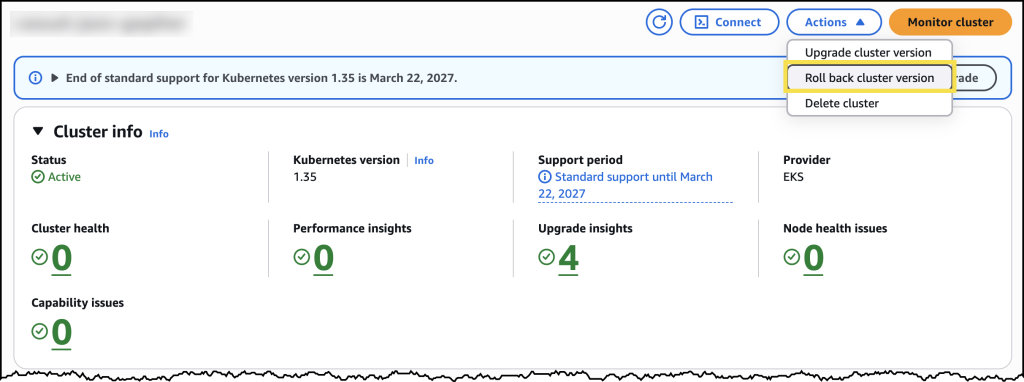
Today, Amazon Web Services (AWS) has fundamentally changed that calculus. The company has announced the immediate availability of version rollbacks for Amazon Elastic Kubernetes Service (Amazon EKS), providing cluster administrators with a long-awaited safety net. This feature allows teams to revert an EKS cluster to its previous, fully functional version within a seven-day window, effectively acting as an "undo" button for one of the most stressful tasks in cloud infrastructure management.
The Evolution of the Kubernetes Upgrade Dilemma
To understand the magnitude of this announcement, one must look at the historical friction surrounding Kubernetes lifecycle management. Open-source Kubernetes, while incredibly powerful, does not natively support control plane rollbacks. While the Kubernetes community has made strides—most notably through KEP-4330, which explores "emulated versions"—these solutions often keep clusters in a transitional, somewhat artificial state.
In production environments, "emulation" is rarely enough. Organizations need the certainty that their infrastructure is running on a proven, stable version. Because the Kubernetes project releases three minor versions annually, the pressure to keep clusters current is constant. However, for teams managing hundreds of clusters, the risk of a "day-two" failure—where an application breaks due to a hidden API deprecation or a compatibility drift—often outweighs the benefits of the latest features.
As a result, many enterprises have found themselves stuck on aging versions, missing critical security patches, and eventually drifting into "extended support" territory, which carries additional costs and increased operational risk. AWS’s new rollback functionality is designed to break this cycle of fear.
How EKS Version Rollbacks Function: A Technical Deep Dive
The new rollback capability in Amazon EKS is not an emulation; it is a restoration of a previously validated production state. If a cluster is upgraded from Kubernetes 1.34 to 1.35 and an administrator encounters a critical compatibility issue, they can initiate a rollback within seven days to return the cluster to the exact configuration of 1.34.
The Mechanism of Safety
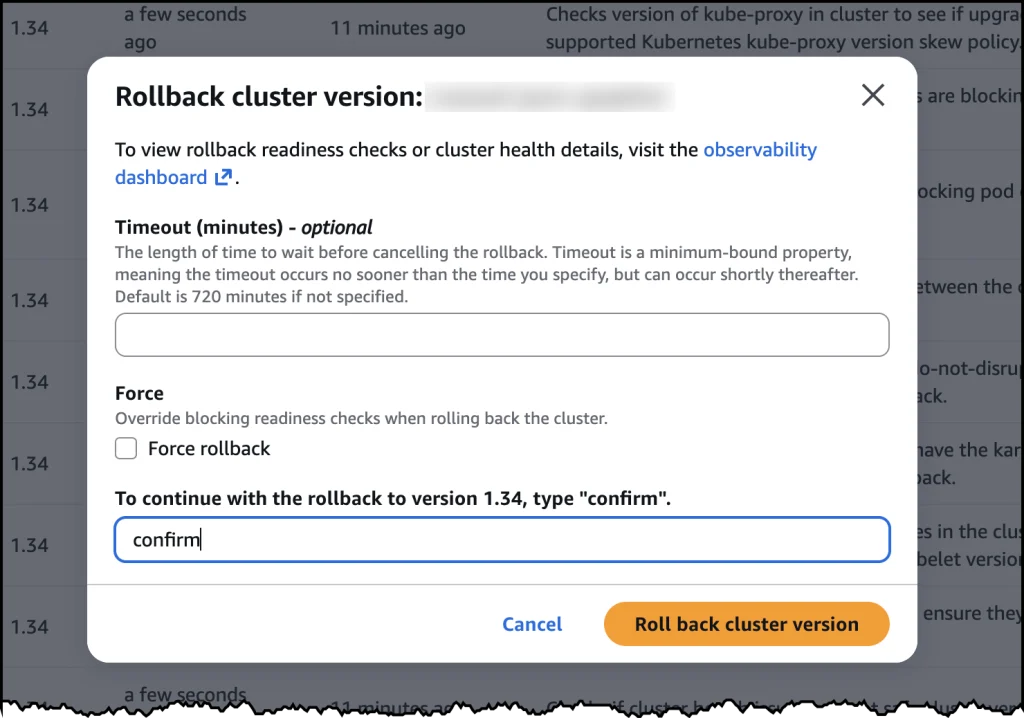
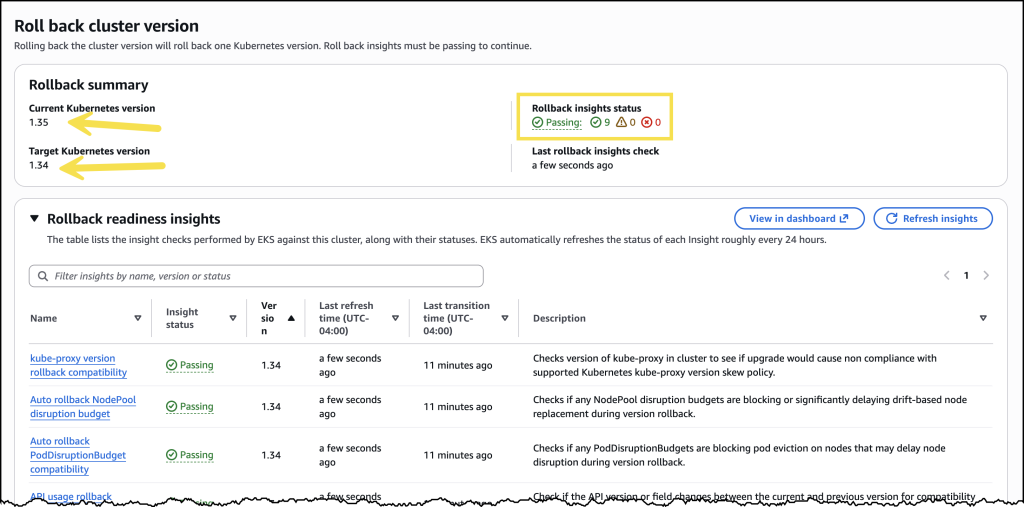
The process is designed to be as incremental and controlled as the upgrade itself, supporting one minor version rollback at a time. To ensure success, AWS has integrated the feature with "Cluster Insights." Before a rollback begins, EKS automatically evaluates the cluster’s readiness, flagging potential conflicts such as incompatible node versions or add-on dependencies.
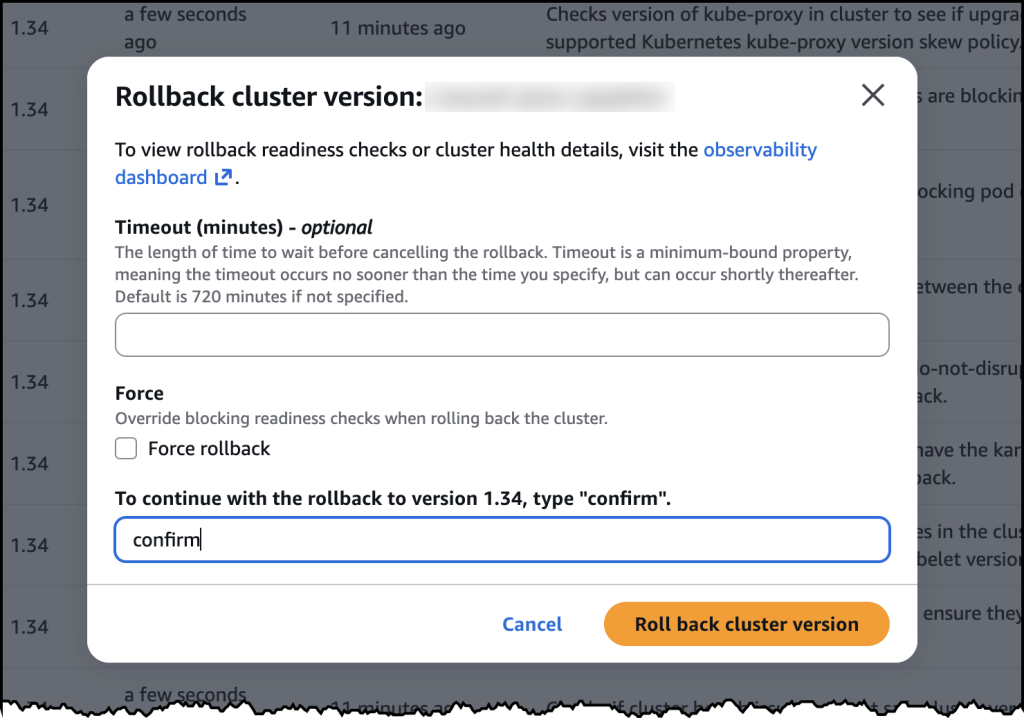
For administrators who have already performed their own rigorous pre-flight checks and need to act with extreme urgency, AWS provides a --force flag. This bypasses the automated readiness checks, granting experienced operators the autonomy to move as quickly as their internal processes allow.

The "Auto Mode" Advantage
While the rollback feature is available for all EKS clusters, it reaches its full potential in EKS Auto Mode. Introduced to simplify the deployment of production-ready clusters by automating compute, networking, and storage, EKS Auto Mode requires a synchronized rollback of both the control plane and managed nodes.
Because node rollbacks must strictly adhere to configured Pod Disruption Budgets (PDBs), the process is inherently cautious. Recognizing that time is often of the essence during a recovery event, AWS has introduced a dedicated Cancel API. This allows administrators to halt a node rollback in progress if they determine that the process is moving too slowly or if they need to adjust their PDBs to prioritize speed over workload graceful-termination during the recovery.
Chronology of the Release and User Experience
The rollout of this feature follows a strategic progression of AWS’s commitment to "opinionated" infrastructure management.
- The Planning Phase: AWS observed the industry-wide struggle with upgrade cycles and the subsequent technical debt accumulated by teams afraid to move forward.
- The Development Phase: Engineering teams focused on creating a non-destructive restoration process that respects the complex interplay between the control plane and the underlying compute resources.
- The Validation Phase: Through the EKS Console, administrators can now view the "rollback window," a seven-day grace period that clearly defines the available timeframe for a reversal.
- The Execution Phase: Upon selecting a rollback, the system provides real-time insights into node status and dependencies, ensuring that the administrator has full visibility before the automated process begins.
In practice, the experience is designed to be seamless. During a standard control plane rollback, the cluster remains functional. The process generally takes approximately 20 minutes—a timeframe that mirrors a standard upgrade, providing a predictable expectation for the duration of the downtime or performance impact.
Implications for Regulated Industries and Cloud Strategy
The introduction of version rollbacks has profound implications for how organizations approach their "Cloud Center of Excellence" (CCoE) policies.
1. Accelerating Modernization
By removing the "one-way" risk, AWS is essentially lowering the barrier to entry for the latest Kubernetes versions. Teams that were previously waiting six months to adopt a new release may now feel confident enough to upgrade within weeks, as the cost of failure has been effectively mitigated.
2. Simplifying Compliance
For companies in highly regulated sectors like banking, healthcare, and government, the ability to document and execute a "revert" procedure is often a core audit requirement. Providing a native, AWS-supported rollback mechanism simplifies the compliance documentation process significantly, as organizations no longer need to rely on complex, home-grown scripts to attempt to restore a previous cluster state.
3. Shift in Operational Culture
The "undo" button encourages a culture of experimentation. When the penalty for an unsuccessful upgrade is the total reconstruction of a cluster, engineers become risk-averse. When the penalty is a simple, automated rollback, engineers are more likely to participate in testing new Kubernetes features and performance improvements. This shift could lead to a faster pace of innovation across the entire AWS ecosystem.
Official Stance and Cost Structure
AWS has confirmed that version rollbacks are available at no additional cost. Users are only responsible for the standard EKS and compute costs they would otherwise incur. This "no-extra-charge" model is a clear signal that AWS views cluster stability and lifecycle management as core value propositions for the EKS platform, rather than premium add-on services.
The feature supports all commercial AWS Regions and covers clusters running on versions currently available under standard and extended support. By including this in the baseline offering, AWS is setting a new industry standard for managed Kubernetes services.
Conclusion: The New Standard for Kubernetes Operations
The Kubernetes ecosystem has long struggled with the tension between rapid innovation and operational stability. By introducing version rollbacks for Amazon EKS, AWS has effectively resolved one of the most persistent anxieties in modern cloud computing.
This is more than just a new API or a console button; it is a validation of the "Infrastructure as Code" paradigm. It acknowledges that even with the best planning and the most robust CI/CD pipelines, production environments are inherently unpredictable. By providing a secure, automated path back to a known "good" state, AWS is enabling administrators to manage their clusters with the confidence that they are no longer walking a tightrope without a net.
For organizations currently debating their upgrade schedules, this announcement may be the catalyst needed to modernize. As the industry moves toward more frequent, automated updates, the ability to pivot—and to reverse that pivot—will become the hallmark of truly resilient, cloud-native enterprises.