The Web of Peril: Kochi’s Ongoing Struggle with Dangerous Overhead Cabling
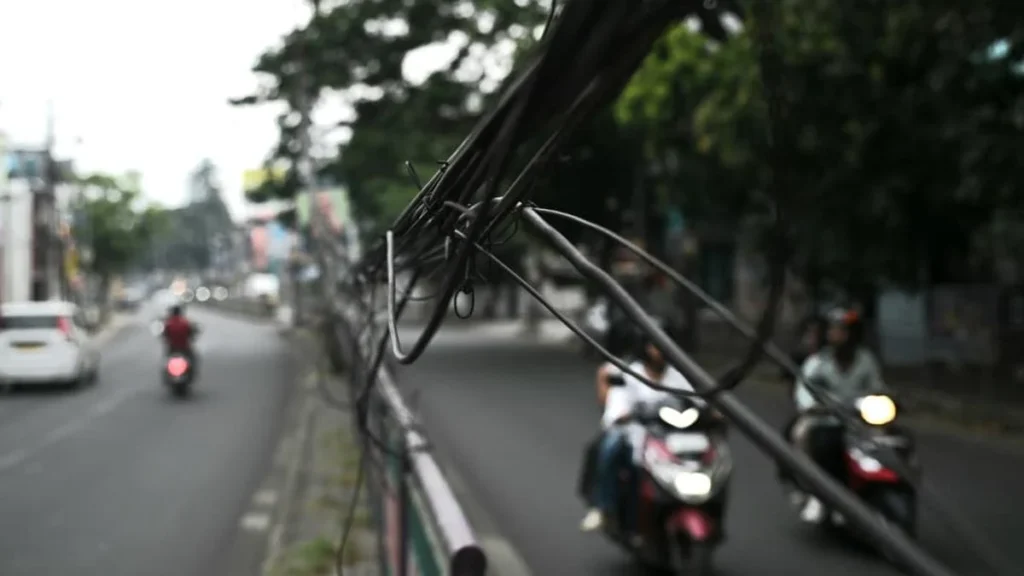
KOCHI, September 21, 2026 — For the residents of Kochi, the city’s skyline is defined not just by its historic architecture or the sprawling growth of its commercial districts, but by a suffocating web of black wires. These cables—a tangled, chaotic network of internet, telephone, and cable television lines—drape across streets like unkempt cobwebs, hanging dangerously low over the Kaloor-Kadavanthra road and countless other arterial routes.
What began as a necessity for the digital age has transformed into a persistent, life-threatening hazard. Following years of public outcry and stern directives from the Kerala High Court, the Kochi Corporation has once again pledged to launch a rigorous enforcement drive to purge the city of these dangerous, untagged, and low-hanging overhead wires. However, as the city prepares for yet another cleanup, experts and officials remain locked in a cycle of blame, questioning whether this latest initiative will finally break the pattern of recurring neglect.
The Core Issue: A Tangled Crisis
The core of the problem lies in the sheer volume of redundant infrastructure. As technology has evolved from copper-based telephone lines to high-speed fiber optics, companies have frequently opted to lay new cables rather than decommission the old ones. The result is a dense, heavy accumulation of "ghost wires" that strain utility poles, droop into the path of heavy vehicles, and frequently ensnare unsuspecting motorcyclists and pedestrians.
The legal and safety implications are severe. The Kerala High Court has, on multiple occasions, intervened, directing the Kochi Corporation and the Kerala State Electricity Board Limited (KSEBL) to identify and excise these hazards. The court’s mandate was sparked by a series of preventable accidents, some of which have resulted in fatalities, underscoring the urgency of a situation that has remained largely stagnant despite repeated judicial warnings.
Chronology: A Cycle of Enforcement and Neglect
The history of this issue in Kochi is one of sporadic action followed by quick regression.
- Pre-2024: Initial complaints regarding "cable clutter" began as a nuisance issue, primarily focusing on aesthetics.
- 2024–2025: As the number of accidents involving entanglement increased, the issue shifted from a matter of urban beautification to a public safety crisis. The High Court issued its first set of formal directives, compelling the Corporation to begin mapping cable ownership.
- Late 2025: A massive, city-wide drive was initiated but was abruptly suspended to accommodate the logistical requirements of the football World Cup, which brought significant traffic and public movement to the city.
- September 2026: Following a renewed surge in public complaints and safety assessments, Mayor V.K. Minimol has announced the resumption of the drive, signaling a shift in policy: the Corporation will now perform the removal work and recover the costs directly from the offending operators.
The recurring nature of these drives highlights a fundamental flaw in urban planning. The Corporation clears a stretch, the cables are removed, and within months, new, unregulated lines are strung up under the cover of night or during periods of lax enforcement, returning the area to its previous state of disarray.
Official Responses and Administrative Hurdles
The administrative response to the crisis has been hampered by a lack of coordination between the Corporation and the KSEBL.
Mayor V.K. Minimol, speaking on the upcoming enforcement strategy, emphasized that the Town Planning Committee has been given a clear mandate: "The committee has been asked to initiate the drive at the earliest. We are not just removing the cables; we are recovering the expenses from the operators. Furthermore, the agency tasked with managing master boards in the city will now take on the responsibility of maintaining clean cable corridors in their designated zones."
The Mayor’s statement highlights a critical administrative gap: only three companies are currently licensed by the Kochi Corporation to draw overhead cables. Yet, the city’s poles are teeming with wires belonging to dozens of other providers. These companies have bypassed the Corporation’s regulatory framework by negotiating directly with the KSEBL for pole usage, creating a fragmented system where accountability is easily evaded.

P.M. Naseema, chairperson of the Town Planning Committee, confirmed that the next phase of the operation would be decentralized. "We are moving away from top-down enforcement to a zonal-level approach," she explained. "By involving division councillors in these meetings, we can ensure that local-level monitoring is more effective. We intend to restore order, and we are prepared to cut any cable that does not meet safety standards or lacks proper identification."
The Operator’s Perspective: A Plea for Structural Reform
While the Corporation views the issue through the lens of enforcement and cost-recovery, industry stakeholders argue that the problem is rooted in the absence of a standardized, modern infrastructure.
E. Jayadevan, president of the Kerala Cable Television Federation, contends that the current approach is a "band-aid solution" that fails to address the underlying architectural failure of the utility grid. According to Jayadevan, the industry is aware of the "ghost cable" problem but lacks a unified mandate to rectify it.
"The authorities have never looked for a permanent solution," Jayadevan stated. "Operators are often blamed, but the system is built to encourage clutter. If KSEBL mandated a universal clamp system on every pole, and forced every company to run their wires through that single, tagged conduit, the mess would vanish overnight. Instead, we have a ‘wild west’ approach where every provider drills their own path."
Jayadevan further advocates for an ambitious shift toward underground ducting. "In the long term, we must move toward a universal duct system. As long as we rely on overhead poles, we are at the mercy of every storm, every passing truck, and every company that decides to leave behind dead weight."
Implications: The High Cost of Inaction
The implications of failing to resolve the cable crisis are far-reaching:
- Public Safety: The most immediate danger is to motorists. Low-hanging wires, particularly those that have frayed or snapped, act as tripwires. In a city like Kochi, where two-wheelers are the primary mode of transport, the threat of serious injury is a constant reality.
- Fire Hazards: Cluttered utility poles are fire magnets. A short circuit in one line can rapidly spread through the dense, flammable insulation of dozens of adjacent, unused cables, leading to catastrophic urban fires.
- Economic Disruption: The constant need for maintenance and the periodic, forced cutting of cables by the Corporation leads to frequent, unannounced internet and television outages for businesses and residents, hampering the city’s digital economy.
- Urban Aesthetics: The "spaghetti effect" of wires ruins the architectural heritage and visual appeal of the city, undermining Kochi’s standing as a major tourism hub.
Conclusion: A Turning Point?
As the Kochi Corporation prepares to resume its cleanup, the stakes have never been higher. The move to hold operators financially liable for the removal of their own junk infrastructure is a bold step, but it must be paired with the structural reforms suggested by the industry—specifically, the implementation of a mandatory clamping system and a transition to underground ducting.
For the residents of Kochi, the sight of municipal workers cutting wires will provide temporary relief. However, true success will only be measured by the long-term stability of the city’s infrastructure. Without a permanent, technological shift in how utility cables are managed, the city remains trapped in a cycle where the wires are cut today, only to be re-strung tomorrow. The High Court’s directives provide the legal backbone, but it is the Corporation’s resolve and its ability to modernize the infrastructure that will determine if Kochi can finally shed its status as a city under siege by its own cables.