Two Decades in the Cloud: How Amazon EC2 Rewrote the Rules of Global Computing
Main Facts
Twenty years ago, a modest blog post authored by Jeff Barr quietly altered the trajectory of the technology industry. It introduced the Amazon Elastic Compute Cloud (Amazon EC2) Beta. At its inception, the service offered a single virtual server type—the m1.small instance—running Linux, deployed within a single AWS Region (US East), and billed strictly by the hour. It was a minimal, highly pragmatic offering that allowed developers to spin up resizable compute capacity without ordering physical hardware, racking servers, or waiting weeks for provisioning.
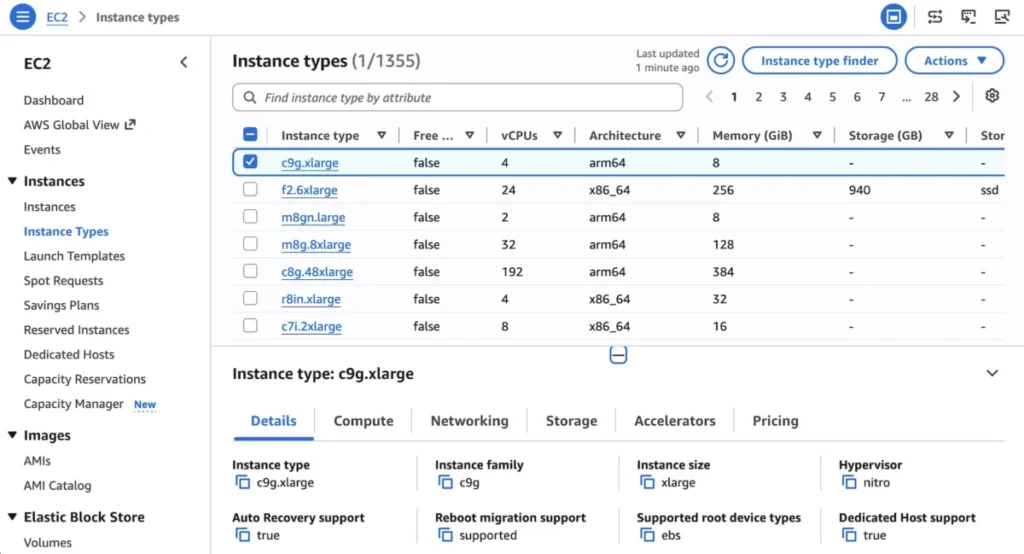
Today, that single-region experiment has matured into the undisputed backbone of modern cloud computing. Amazon EC2 has expanded into a global infrastructure giant boasting over 1,200 distinct instance types spanning general-purpose, compute-optimized, memory-optimized, storage-optimized, accelerated computing, and high-performance computing (HPC) families. Spanning 39 AWS Regions worldwide, EC2 handles everything from simple startup web applications to massive, trillion-parameter artificial intelligence model training clusters.
Despite two decades of staggering scale and architectural evolution, the core value proposition of Amazon EC2 remains remarkably consistent with Barr’s 2006 vision:
- Secure, resizable compute capacity available in minutes.
- A pay-as-you-go consumption model eliminating long-term hardware commitments.
- On-demand elasticity that allows infrastructure to scale fluidly with business demands.
Crucially, EC2 is not just a standalone product; it serves as the foundational compute engine for almost every major service AWS offers today. Container platforms like Amazon ECS and Amazon EKS, serverless architectures like AWS Lambda and AWS Fargate, data processing frameworks like Amazon EMR, and cutting-edge generative AI services like Amazon SageMaker AI and Amazon Bedrock all ultimately rely on EC2 capacity.
Chronology: The Evolution of a Cloud Titan
The trajectory of Amazon EC2 over the past 20 years is a masterclass in rapid iteration, customer-driven engineering, and foundational architectural foresight.
Phase 1: Laying the Infrastructure Bedrock (2006–2009)
- August 2006: Jeff Barr launches the Amazon EC2 Beta, bringing on-demand Linux virtual servers to the public.
- 2008: The introduction of Amazon Elastic Block Store (EBS) solves a critical persistence hurdle, giving instances reliable, low-latency block-level storage volumes that could persist independently of the virtual server lifespan.
- 2009: AWS rolls out Elastic Load Balancing (ELB), Auto Scaling, and Amazon CloudWatch. This trifecta transforms EC2 from static virtual machines into dynamic, fault-tolerant, self-healing application environments.
- 2009: Amazon Virtual Private Cloud (VPC) launches, allowing enterprises to provision logically isolated, secure virtual networks within the AWS cloud—a vital step in convincing risk-averse corporate IT departments to migrate.
Phase 2: Silicon Innovation and Network Redefinition (2017–2019)
- 2017: The AWS Nitro System makes its debut. By offloading virtualization functions from the host CPU to dedicated AWS-designed hardware and software accelerators, Nitro delivers near-bare-metal performance, enhanced security, and rapid instance innovation.
- 2018: AWS shatters the Intel/AMD duopoly in cloud compute by launching AWS Graviton processors, custom-built ARM-based chips engineered specifically to deliver superior price-performance for scale-out workloads.
- 2018–2019: AWS breaks the physical boundaries of centralized cloud regions. AWS Outposts (2018) brings native AWS infrastructure directly into on-premises data centers. AWS Local Zones (2019) places compute resources closer to large metropolitan populations, while AWS Wavelength (2019) embeds EC2 computing inside global 5G telecommunications carrier networks for ultra-low-latency edge applications.
Phase 3: The AI Era and Modern Scale (2020–Present)
- Over the last five years, AWS has pushed the boundaries of specialized silicon, introducing successive generations of Graviton processors alongside purpose-built AI training and inference chips (such as AWS Trainium and Inferentia).
- EC2 has evolved to support massive accelerated computing clusters capable of handling the astronomical computational demands of modern Large Language Models (LLMs) and generative AI workloads—a scale that was completely unimaginable when the service debuted in 2006.
Supporting Data & Infrastructure Metrics
To understand the sheer magnitude of Amazon EC2’s expansion, one must look at the quantitative metrics of its global footprint over the last 20 years:
- Instance Variety: Expanded from 1 single instance type (
m1.small) to over 1,200 distinct instance types optimized for every conceivable workload profile. - Geographic Reach: Scaled from 1 initial Region (US East) to a sprawling global network of 39 AWS Regions worldwide.
- Deployment Form Factors: Evolved from centralized data centers to a hybrid and edge portfolio including AWS Outposts, Local Zones, and Wavelength zones embedded directly within 5G telecom networks.
- Ecosystem Integration: Functions as the bedrock computational layer for foundational AWS ecosystem components, including:
- Container orchestrators (Amazon ECS, Amazon EKS)
- Serverless execution environments (AWS Lambda, AWS Fargate)
- Big data and analytics engines (Amazon EMR, AWS Batch)
- AI and Machine Learning platforms (Amazon SageMaker AI, Amazon Bedrock)
Official Responses and Perspectives
Reflecting on the milestone, AWS leadership and long-standing figures within the cloud community have emphasized the philosophy that allowed EC2 to survive and dominate for two decades.
Channy Yun, writing for the AWS News Blog, underscored the enduring validity of AWS’s initial product strategy: "We made strong foundational decisions in 2006, and we left room for the service to grow. Twenty years later, that strategy of creating services that are minimal-yet-useful, launching quickly, and iterating rapidly in response to your feedback continues to guide how we build."

Jeff Barr, who penned the original 2006 announcement and subsequent milestone reflections, has frequently noted that the primary goal of early cloud engineering was simply to remove undifferentiated heavy lifting from developers’ plates. By focusing relentlessly on customer feedback, AWS engineers were able to pivot from basic virtual machine hosting to complex, hardware-accelerated, globally distributed computing fabrics without breaking backward compatibility or diluting core reliability.
Industry analysts point out that EC2’s secret weapon has always been the AWS Nitro System. By decoupling the hypervisor tasks from the main CPU, AWS not only secured a performance advantage over rival cloud providers but also insulated its customers from hypervisor overhead—a technical gamble that paid off massively as workloads grew increasingly dense and data-intensive.
Implications for the Future of Cloud Computing
The twentieth anniversary of Amazon EC2 offers more than just a moment for corporate nostalgia; it serves as a lens through which to view the next era of enterprise technology.
1. The Undisputed King of the Compute Stack
As software architectures evolve through microservices, containers, serverless functions, and agentic AI workflows, the underlying debate often centers on abstraction layers. However, EC2’s ubiquity proves that higher-level abstractions do not eliminate the need for foundational infrastructure—they merely build upon it. Whether a developer interacts with raw virtual machines, Kubernetes pods, or a fully managed generative AI API via Amazon Bedrock, somewhere down the stack, an EC2 instance is executing the instructions.
2. Custom Silicon as a Competitive Imperative
The success of AWS Graviton and specialized AI chips highlights a major industry shift: general-purpose cloud computing is no longer enough. Cloud providers must vertically integrate hardware and software design. The next decade of EC2 development will undoubtedly be defined by silicon optimization, where performance-per-watt and specialized tensor processing capabilities dictate market leadership.
3. Edge, Hybrid, and Ultra-Low Latency
The traditional model of routing all cloud traffic back to massive, centralized regional data centers is increasingly insufficient for modern use cases like autonomous vehicles, industrial IoT, and real-time multiplayer gaming. By pushing EC2 out to Local Zones, Wavelength 5G networks, and customer-owned data centers via Outposts, AWS has redefined the cloud as an omnipresent fabric rather than a remote destination.
Conclusion
As Channy Yun observed in his anniversary commentary, "The next twenty years of cloud computing will demand capabilities we have not yet imagined." Yet, as long as enterprises, startups, and researchers require secure, scalable, and flexible computing power on demand, Amazon EC2 will remain the anvil upon which the future of digital innovation is forged.