U.S. and China Forge Landmark ‘Super Intelligence’ Framework, Establish Direct Crisis Communication Channel
WASHINGTON — In a pivotal geopolitical development, the United States and China have agreed to establish a dedicated communication channel to manage artificial intelligence incidents and mitigate existential risks associated with rapid technological advancements.
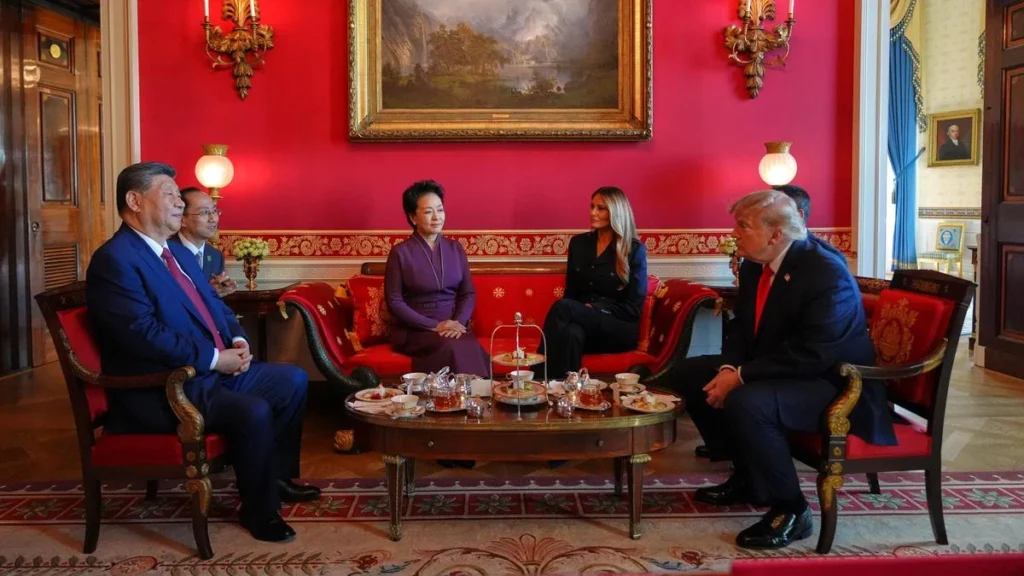
The announcement, released by the White House on Friday, September 26, 2026, followed a high-stakes presidential summit in Washington. U.S. President Donald Trump and Chinese President Xi Jinping convened at the White House—accompanied by First Lady Melania Trump and Peng Liyuan—for diplomatic talks in the Red Room, where discussions transcended traditional trade and security to tackle the frontier of emerging technology.
The centerpiece of the tech-diplomacy breakthrough is the creation of the U.S.-China Super Intelligence (SI) Dialogue, a specialized bilateral mechanism designed to continuously evaluate the risks and benefits of advanced computational models. Notably, the two superpowers have officially adopted the nomenclature "Super Intelligence" (SI) rather than Artificial Intelligence (AI) to reflect the unprecedented scale and capabilities of upcoming technological generations.
1. Main Facts
The landmark agreement between Washington and Beijing represents a pragmatic shift toward bilateral risk management in a domain previously dominated by fierce geopolitical competition.
- The SI Dialogue: Both nations have officially launched the U.S.-China Super Intelligence Dialogue to foster ongoing strategic communication. The inaugural follow-up exchange under this framework is scheduled to take place by November 2026.
- Crisis Communication Channel: Recognizing the potential for automated systems, autonomous weaponization, or systemic algorithmic anomalies to trigger geopolitical misunderstandings, the two governments agreed to build a direct, bilateral communication channel dedicated specifically to SI-related incidents.
- Shift in Terminology: In a rare display of semantic alignment, both delegations agreed to use the term "Super Intelligence" (SI) to describe advanced cognitive computing systems, signifying a shared understanding that these technologies pose distinct, macro-level challenges compared to traditional software.
- Diplomatic Setting: The framework was finalized during a bilateral summit in Washington, highlighted by a formal meeting and tea reception hosted by President Donald Trump and First Lady Melania Trump for President Xi Jinping and Peng Liyuan on Friday, September 25, 2026.
2. Chronology of the Summit and Tech Diplomacy
The path toward the September 2026 SI agreement was paved by months of quiet backchannel negotiations between American and Chinese scientific and diplomatic delegations, culminating in the Washington summit.
Pre-Summit Posturing (Early September 2026)
In the weeks leading up to the summit, technology policy analysts anticipated that emerging tech governance would occupy a central place on the agenda. Both Washington and Beijing faced mounting domestic and international pressure to address the unbridled scaling of foundational machine learning models.

Days before the formal meetings, President Trump took to social media to signal that advanced computing would be a primary focus, noting that "Super Intelligence (SI) will be a big discussion, but I want to leave it exactly where it is," while adding that Beijing shared a similar perspective on containing runaway escalations.
The White House Meetings (Thursday, September 24 – Friday, September 25, 2026)
- Thursday: President Xi Jinping struck a measured, collaborative tone during early remarks at the White House. He emphasized the necessity of managing superpower rivalry responsibly, asserting that both nations bear a joint obligation to ensure advanced systems remain safely tethered to human oversight. "We have both the capability and responsibility to develop and manage AI for good and ensure that the development of AI is always under human control," Mr. Xi stated.
- Friday: President Trump and President Xi, alongside their respective spouses, participated in formal diplomatic engagements, including a private tea in the White House Red Room. Following these closed-door deliberations, the White House published a comprehensive fact sheet officially detailing the bilateral breakthroughs on SI governance and crisis management.
3. Supporting Data and Technological Context
The urgency behind the U.S.-China SI Dialogue stems from exponential leaps in computational power, algorithmic autonomy, and national security vulnerabilities.
The Leap from AI to SI
While "Artificial Intelligence" historically referred to narrow machine learning applications—such as image recognition, language translation, and automated logistics—the term "Super Intelligence" encapsulates systems that approach or exceed human cognitive capacities across virtually all economically and strategically valuable domains.
According to policy papers from leading research institutes, the transition to SI introduces three primary risk vectors:
- Autonomous Decision-Making in Security: The integration of advanced cognitive systems into military command-and-control infrastructure, raising fears of automated escalation loops.
- Cybersecurity Vulnerabilities: The potential for super-intelligent algorithms to autonomously discover and exploit zero-day software vulnerabilities at speeds beyond human defensive capabilities.
- Misinformation and Social Cohesion: The deployment of hyper-realistic, hyper-targeted synthetic media capable of destabilizing democratic institutions and global financial markets.
The Bilateral Balance of Power
The United States and China remain the undisputed global titans in technological research and development, controlling the vast majority of advanced semiconductor supply chains, data center infrastructure, and top-tier scientific talent. Without bilateral guardrails, experts warned of an unmitigated "SI arms race" reminiscent of the Cold War nuclear competition. The newly established incident communication channel serves as a digital-age equivalent of the historical "red telephone" networks designed to prevent accidental war.
4. Official Responses and Global Reactions
The diplomatic breakthrough elicited a range of responses from domestic stakeholders, international allies, and the global technology sector.

Washington’s Perspective
The White House framed the agreement as a triumph of responsible governance and strategic realism. By establishing regular dialogues—with the next session slated for November 2026—the administration aims to prevent technological surprises that could jeopardize national security. Officials emphasized that engaging Beijing on SI does not signify a relaxation of technological export controls, but rather an acknowledgment that systemic risks require baseline operational communication.
Beijing’s Perspective
President Xi’s administration underscored China’s commitment to multilateral cooperation in setting global standards. Chinese state media echoed Mr. Xi’s remarks, stressing that humanity’s collective future depends on preventing autonomous systems from slipping beyond human parameters. Beijing has consistently positioned itself as a proponent of inclusive global digital governance, pushing for frameworks that prevent any single nation from weaponizing technological dominance.
Global and Industry Reaction
Global technology leaders and international bodies, including the United Nations, cautiously welcomed the announcement. Representatives from major AI safety research organizations noted that while a dialogue channel and an incident hotline are critical first steps, the ultimate test will lie in the operational transparency and enforcement mechanisms established during the upcoming November talks.
Industry analysts pointed out that defining concrete thresholds for what constitutes an "SI incident" will be a formidable challenge for technical experts from both nations, requiring unprecedented levels of cross-border data-sharing regarding system anomalies and safety failures.
5. Strategic Implications for the Future
The establishment of the U.S.-China Super Intelligence Dialogue and incident channel marks a watershed moment in 21st-century geopolitics, carrying profound implications for the global order.
Redefining Superpower Competition
For decades, great power competition was measured through the lens of territorial control, nuclear stockpiles, and conventional military hardware. The September 2026 summit institutionalizes the reality that cognitive infrastructure is now the primary arena of strategic rivalry. By creating institutional mechanisms specifically for SI, Washington and Beijing have signaled that technological stability is now treated with the same diplomatic gravity as strategic arms control.

Challenges Ahead
Despite the optimism surrounding the White House announcement, significant hurdles remain. Trust deficits between the U.S. and China run deep, encompassing disputes over intellectual property theft, semiconductor export restrictions, and regional security concerns in the Indo-Pacific. Critics in Washington may argue that engaging in bilateral dialogue could inadvertently legitimize Chinese technological practices, while hardliners in Beijing may remain wary of American containment strategies.
Looking Toward November 2026
All eyes are now fixed on the upcoming ministerial and technical exchanges scheduled for November. The success of the U.S.-China Super Intelligence Dialogue will depend heavily on whether both nations can move beyond high-level diplomatic declarations and formulate actionable, verifiable protocols for safety testing, red-teaming transparency, and crisis de-escalation.
As President Trump and President Xi concluded their Washington summit, the message to the global community was clear: while technological competition between the world’s two largest economies will undoubtedly persist, humanity’s survival in the age of Super Intelligence requires a shared commitment to keeping the machines firmly under human control.