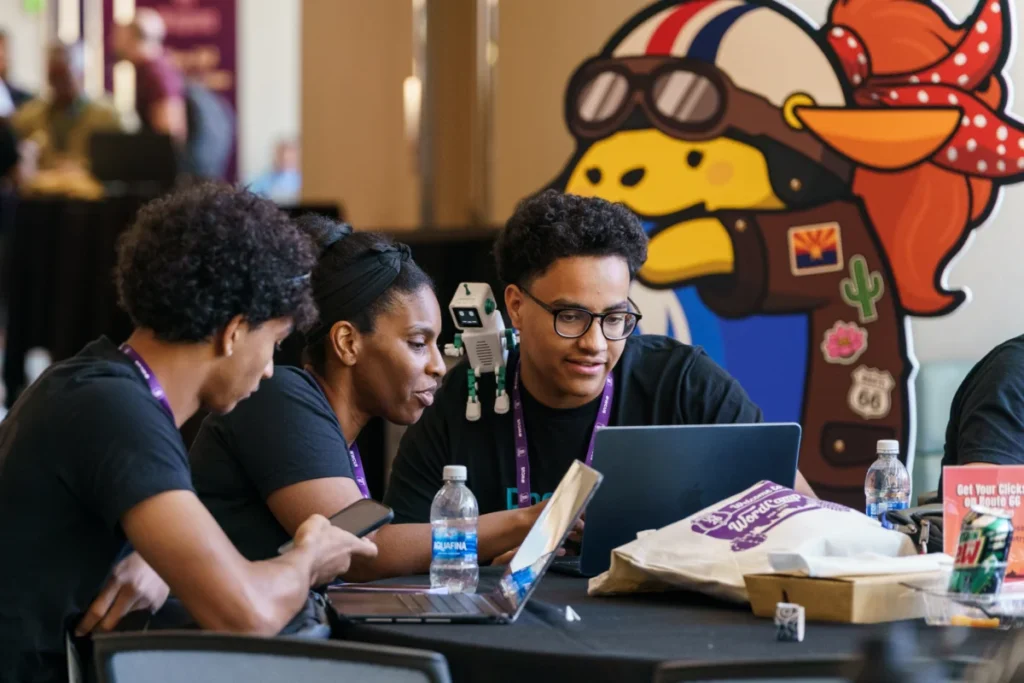
PHOENIX, ARIZONA — Against the backdrop of a scorching 111°F (44°C) desert summer, the global WordPress community converged on the Phoenix Convention Center for WordCamp US (WCUS) 2026. Over four action-packed days, more than 1,100 registered attendees—accompanied by thousands more tuning in via livestreams from across the globe—gathered to debate the future of the open web.
From high-stakes enterprise migrations and the rapid integration of artificial intelligence to co-founder Matt Mullenweg’s radical vision for software simplicity, WCUS 2026 proved to be a watershed moment for the world’s most popular Content Management System (CMS).
Main Facts: WCUS 2026 by the Numbers
WordCamp US 2026 pushed the boundaries of what a community-driven tech conference can achieve. The four-day event was structured around specialized programming:
The Schedule: Kicking off with dedicated Contributor and Showcase days, the event transitioned into two primary conference days featuring over 50 speaker-led sessions spanning four distinct tracks, alongside hands-on workshops and beginner labs.
Attendance: Over 1,100 in-person attendees utilized air-conditioned golf-cart shuttles bridging the Sheraton Phoenix Downtown and the convention center, while a massive digital audience participated remotely.
Key Announcements: The event played host to the official release of WordPress 7.1 ("Mary Lou"), which notched hundreds of thousands of downloads within hours, alongside major ecosystem rollouts like shortened WordPress.org profile links (w.org/@username).
Civic Recognition: Highlighting the economic footprint of the platform, Phoenix’s inaugural Chief Innovation Officer, Michael Hammett, presented a mayoral proclamation from Mayor Kate Gallego declaring August 19 as Phoenix WordPress Day.
Chronology: A Four-Day Journey Through the Open Web
Day One: Contributor Day and the "Real Artists Ship" Ethos
Under the battle cry "Real artists ship," Contributor Day brought together 425 participants—including 29 first-time contributors—divided into 26 distinct, task-oriented teams. Eschewing sprawling, indefinite projects, the day focused heavily on tangible deliverables that could cross the finish line before nightfall.
The methodology yielded immediate results. Teams closed tickets, pushed code updates, and reviewed themes for accessibility compliance. Highlights included:
The creation of specialized description-list blocks tailored for glossaries and product attributes.
Enhancements to core email settings, automated testing tools, and account recovery verification workflows.
The development of a dedicated Photo Directory importer and updates to the WordPress dashboard Notes and Multisite documentation.
The formalization of new contribution pathways converted into dedicated courses on Learn WordPress for remote developers.
Day Two: Showcase Day Highlighting Enterprise Scale
Monday’s Showcase Day shifted focus from core development to production-grade resilience, highlighting how major organizations rely on WordPress to handle staggering volumes of traffic and data.
Civic tech took center stage as Manny Costa detailed how public-sector websites utilize WordPress to deliver critical citizen services, manage emergency communications, and process citizen-reported grievances. Crucially, Costa emphasized that in municipal tech, accessibility and editorial workflows are core public services, not afterthought checkboxes.
The spotlight then turned to massive publishing migrations:
The Ankler: Nicola Catton detailed the publication’s high-stakes migration of 15 newsletters away from Substack to a custom WordPress block theme. The move returned direct control of subscriber data, paywall monetization rules, and audience ownership back to the independent media outlet.
Daily Kos: Ben Greeley and Allison McHenry broke down the monumental migration of a community-driven political platform boasting 2.7 million users, 1.5 million posts, and 88 million comments. The transition relied on a public beta test involving over 500 active community members to ensure zero data loss at scale.
Days Three and Four: Keynotes, Advanced Workshops, and the Push for Simplicity
The core conference days offered deep dives into system architecture, design systems, and security. Speakers like K Adam White, Michelle Hunt, Nik McLaughlin, and Brian Coords unpacked the intersection of block themes, design tokens, and developer tooling.
The event culminated on Wednesday with high-profile keynotes, including a fireside chat featuring Amanda Ventura of Waymo and David Levine examining trust as a product practice. The conference officially closed with Matt Mullenweg’s keynote conversation alongside Robert Jacobi, capping off the week with the release of WordPress 7.1.
Supporting Data and Technical Innovations
While user-facing features dominated many session rooms, underlying architectural discussions signaled profound shifts in how WordPress applications will be built and deployed in the coming years.
Performance and File-Based Architecture: Mullenweg’s closing presentation introduced a provocative concept dubbed WordPress Piplets—a modern evolution of a 2007 experiment utilizing a single, self-modifying PHP file capable of storing its own data without requiring an external database or third-party packages. Capable of packing up to 25 megabytes (roughly four million words) into a single script with 50-millisecond load times, Piplets represent an extension of the technological trajectory that brought WordPress from MySQL to SQLite and WordPress Playground.
Five for the Future Re-evaluation: Mullenweg addressed the state of the Five for the Future initiative. While official statistics cite two million self-sponsored hours pledged weekly by 150,000 contributors, Mullenweg challenged the community to tie recognition directly to verifiable, on-chain metrics like code commits, closed tickets, and organized WordCamps rather than unverified pledges.
Security and Supply Chain Integrity: Core committer Jonathan Desrosiers and security expert Robert Abela led urgent conversations regarding software supply chain safety. As AI-assisted tools accelerate both vulnerability discovery and exploit generation, the WordPress ecosystem faces heightened pressure to institutionalize automated security checks and rigorous code reviews.
Official Responses and Perspectives
The Human Element in the Age of AI
A recurring theme across nearly every track was the integration—and limitation—of artificial intelligence. Far from viewing AI as a total job replacement, industry leaders emphasized that automation shifts human labor rather than eliminating it.
"AI doesn’t remove your work. It moves it."
— Bo English-Wiczling, Keynote Speaker
English-Wiczling and other speakers noted that while AI can generate a functional block of code or draft text in seconds, human judgment remains indispensable for ensuring semantic accessibility, preventing security vulnerabilities, and preserving design integrity.
This sentiment was echoed by Disney and Meta veteran Loyal Pyczynski, who stressed the value of iterative failure and structural ownership:
"We need to make sure that we make better mistakes tomorrow. Success is an iterative endeavor, and time is our most precious resource."
Bridging the Open-Source Divide
During the closing Q&A session, audience questions touched on inter-community friction and competitive fragmentation across open-source ecosystems. Mullenweg issued an explicit call to action, inviting leaders from competing open-source projects to speak at future WordCamps and encouraging cross-pollination.
"Copying good code between projects is the entire point of open source," Mullenweg remarked, advocating for radical collaboration over isolated competition.
Implications for the Future of WordPress
The announcements and debates at WordCamp US 2026 carry profound implications for developers, enterprise site owners, and everyday creators.
A Renewed Mandate for Simplicity: Amidst growing software bloat, Mullenweg’s explicit directive—"I want WordPress to be known for simplicity, not just complexity"—signals a strategic pivot. Future core updates are expected to prioritize lightweight configurations, streamlined developer experiences, and frictionless hosting models like Playground and experimental single-file architectures.
Enterprise Independence: The successful migrations executed by platforms like The Ankler and Daily Kos establish a clear blueprint for large-scale publishers looking to escape proprietary SaaS platforms. By reclaiming data ownership, subscriber monetization, and custom editorial workflows, enterprise brands are increasingly viewing WordPress not just as a blogging tool, but as a robust digital infrastructure.
Institutionalizing Trust: As automated translation, AI-driven content generation, and smart tooling mature, trust has evolved from a vague design philosophy into a hard product requirement. Whether through Waymo’s user-centric accessibility testing or Jonathan Desrosiers’ supply-chain security protocols, the WordPress ecosystem is rapidly standardizing practices that ensure human oversight remains tightly coupled with automated capabilities.
As the curtains close on Phoenix, the global community turns its eyes toward the upcoming State of the Word, followed by international gatherings on the horizon: WordCamp Asia 2027 in Penang, Malaysia, and WordCamp Europe 2027 in Málaga, Spain. For an open-source project entering its third decade, WCUS 2026 demonstrated that WordPress remains as fiercely adaptable, community-driven, and ambitious as ever.