Srinagar Interfaith Dialogue: L-G Manoj Sinha Emphasizes India’s Historical Legacy of Coexistence and Spiritual Pluralism
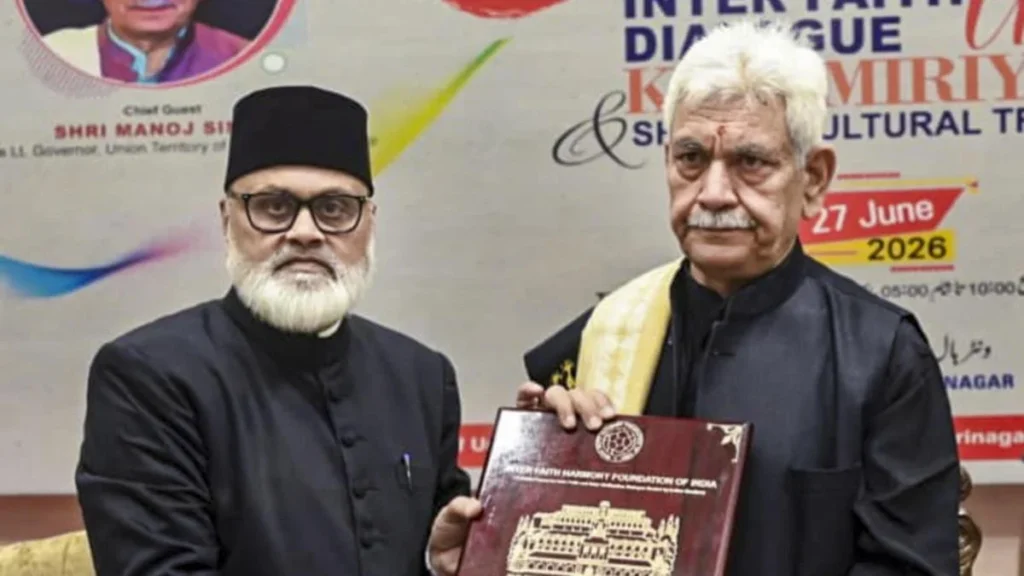
SRINAGAR – In a significant gathering aimed at fostering communal harmony and intellectual exchange, Jammu and Kashmir Lieutenant Governor Manoj Sinha addressed the ‘Interfaith Dialogue’ in Srinagar on Saturday, June 27, 2026. Organized by the National Council for Promotion of Urdu Language (NCPUL) in collaboration with the Inter-Faith Harmony Foundation of India (IFHFI), the event served as a platform for the L-G to articulate a vision of India rooted in the ancient wisdom of pluralism and the syncretic traditions that have shaped the subcontinent’s history.
The Core Message: A Synthesis of Faiths
Lieutenant Governor Sinha’s address centered on the historical trajectory of Islamic scholarship and Sufism in India, framing them not as foreign imports but as movements that integrated deeply with the indigenous spiritual landscape.
“Islam’s Sufis and scholars, who arrived in India during the 12th and 13th centuries, discovered a unique Indian culture rooted in love, spirituality, and equality,” Mr. Sinha remarked. He highlighted that these thinkers were profoundly influenced by the foundational texts of the Indian subcontinent, specifically citing the Vedas, the Upanishads, and the philosophical frameworks of Buddhism and Jainism. According to the L-G, these influences allowed Sufi saints to synthesize their own theological foundations with the Indian ideal of Sahastitva (co-existence).
Mr. Sinha further underscored the intellectual exchange between the East and the Middle East during the medieval period, noting that numerous Sanskrit repositories of knowledge were translated into Arabic. He invoked the timeless Sanskrit prayer, "Sarve Bhavantu Sukhinah, Sarve Santu Niramayah" (May all be happy, may all be free from illness), characterizing it as the definitive identity of India. "This prayer is not for one religion or sect; it is a universal invocation for the welfare of all humanity," he added.

Chronology of the Dialogue and Recent Developments
The discourse on interfaith harmony in Srinagar follows a series of significant cultural and religious events in the region.
- June 26, 2026: Srinagar observed the solemnity of Ashura processions, with the administration ensuring peace and logistical support for the participants.
- June 27, 2026: The Interfaith Dialogue was held, focusing on the shared heritage of Indian civilization and the role of Sufi traditions in bridging communal divides.
- June 28, 2026: Public discourse shifted toward the administrative and social preparations for the upcoming Amarnath Yatra, which remains a focal point for the region’s economic and social integration.
The L-G’s emphasis on the "living idea" of India—where diverse faiths such as Christianity, Islam, Judaism, and Zoroastrianism have historically flourished—was framed as a counter-narrative to the rising tide of global sectarian conflict.
Philosophical Implications: Sanatana Dharma as a Guiding Light
A significant portion of Mr. Sinha’s speech was dedicated to the concept of Sanatana Dharma and its role in modern governance and global peace. He argued that the world recognizes Hinduism not as a proselytizing force, but as an ancient framework that embraced diversity and rejected the imposition of belief.
"Ancient India built a foundation of respect," the L-G stated. "In a world increasingly fractured by religion, language, and race, the core spirit of Indian philosophy acts as a bridge. The young generation must be reminded that peace is not an abstract concept but a tangible outcome of mutual respect."

By positioning India as an "ancient civilization rooted in mutual respect," the L-G sought to project Jammu and Kashmir as a microcosm of this broader Indian ethos. He expressed his belief that the Indian thought process possesses the unique capacity to resolve modern-day polarizations, positioning the nation as a global moral leader in the 21st century.
Preparing for the Amarnath Yatra: A Test of Harmony
Transitioning from the theoretical to the practical, Mr. Sinha utilized the platform to rally support for the upcoming Amarnath Yatra, scheduled to commence on July 3 and conclude on August 28, 2026. He held extensive consultations with civil society groups, prominent business leaders, and religious heads to ensure that the pilgrimage proceeds smoothly.
The L-G characterized the Yatra as more than just a religious pilgrimage; he described it as a "true symbol of social harmony" and a testament to the collective strength of the diverse communities in Jammu and Kashmir.
Official Appeal for Collective Responsibility
Addressing the gathering, Mr. Sinha made a direct appeal to the residents of the Union Territory: "Let us unite across all sectors to make this year’s pilgrimage a beacon of faith, unity, and devotion. As pilgrims embark on the sacred journey to Baba Barfani’s cave, let us transform our devotion into compassionate action."

The L-G highlighted that the Yatra has historically transcended religious boundaries, serving as an occasion where Hindus, Muslims, Sikhs, and Christians come together in a spirit of insaniyat (humanity). He reminded the audience that the pilgrims bring with them the hopes and aspirations of the entire nation, and the hospitality provided by the local population remains a vital component of the state’s identity.
Socio-Economic and Political Implications
The implications of the L-G’s address are manifold:
- Reclaiming the Sufi Narrative: By emphasizing the intersection of Sufism and Vedic thought, the administration is actively promoting a narrative of "Kashmiriyat"—the traditional syncretic culture of the valley—to counter extremist ideologies.
- Stability and Tourism: The emphasis on the successful conduct of the Amarnath Yatra is closely tied to the region’s economic recovery. A peaceful, incident-free pilgrimage season is viewed by the administration as essential for sustaining the tourism sector and showcasing the "new normalcy" in the region.
- Diplomatic Soft Power: By positioning India as a global model for religious coexistence, the speech aligns with national efforts to project the country’s soft power, asserting that its internal model of pluralism is a valid solution to global instability.
- Civic Engagement: The active involvement of civil society and religious leaders in the Yatra preparations signals a shift toward a more participatory governance model, where religious leaders are viewed as partners in maintaining order and social cohesion.
Conclusion: A Vision for the Future
As the Amarnath Yatra approaches, the Lieutenant Governor’s focus on the synthesis of ancient philosophy and contemporary civic responsibility provides a roadmap for the coming months. The event in Srinagar was not merely a ceremonial dialogue but a strategic attempt to reinforce the social fabric of the Union Territory.
By grounding his message in the shared heritage of all faiths and calling for a unified effort to facilitate the pilgrimage, Mr. Sinha has set a clear agenda: to preserve the sanctity of Kashmir’s pluralistic past while ensuring the stability required for its future prosperity. As the world watches, the administration’s ability to turn these sentiments into reality during the 2026 Yatra will serve as a crucial metric for the success of its integration and harmony policies.