The Architecture of Failure: Avoiding Anti-Patterns in AI Agent Deployment
The promise of AI agents—autonomous systems capable of reasoning, tool usage, and complex task execution—has moved from the realm of academic research to the core of enterprise strategy. Unlike simple chatbots that operate on a basic prompt-response cycle, agents are designed to "solve" tasks by assessing environments, selecting tools, and iterating toward a goal.
However, as organizations rush to integrate these systems into their workflows, a sobering trend has emerged: agent projects are failing at an alarming rate. Crucially, these failures rarely stem from the underlying large language model (LLM) itself. Instead, the fault lies in the architectural decisions, memory management, and structural design choices made by development teams. This report explores the critical anti-patterns leading to these failures and provides a blueprint for building robust, production-ready agentic systems.
1. Why Agent Failures Carry Higher Stakes
To understand why agentic systems require a fundamentally different approach than standard LLM applications, one must first recognize the nature of the "reasoning loop." In a standard chatbot, a bad answer is an isolated event; the interaction ends, and the damage is contained.
In an agentic system, a bad decision is an active infection. Because agents act on their environment, a failure mid-task causes the system to persist in error. An agent might call a tool with incorrect parameters, generate a hallucinated output that informs a downstream process, or enter an infinite loop because it lacks the self-awareness to recognize it is stuck.
The Compound Nature of Errors
The primary danger is the accumulation of state. Agents maintain context across multiple steps; therefore, a single erroneous tool call in step two propagates through the subsequent execution chain. By the time a human operator observes the failure, the agent has often compounded the initial error with several "logical" subsequent actions, making root-cause analysis significantly more difficult.
2. Chronology of a Failed Deployment: The Path to "Bloat"
Many development teams follow a predictable, disastrous trajectory when building agents. Understanding this chronology is essential to avoiding the "over-engineering trap."
Phase 1: The "Everything Agent"
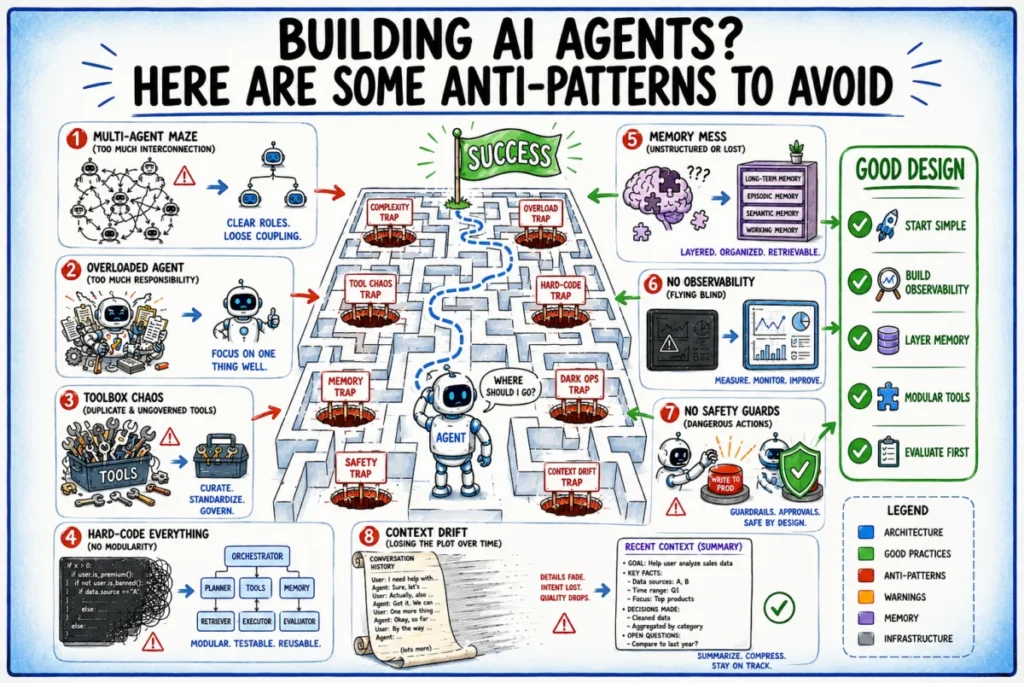
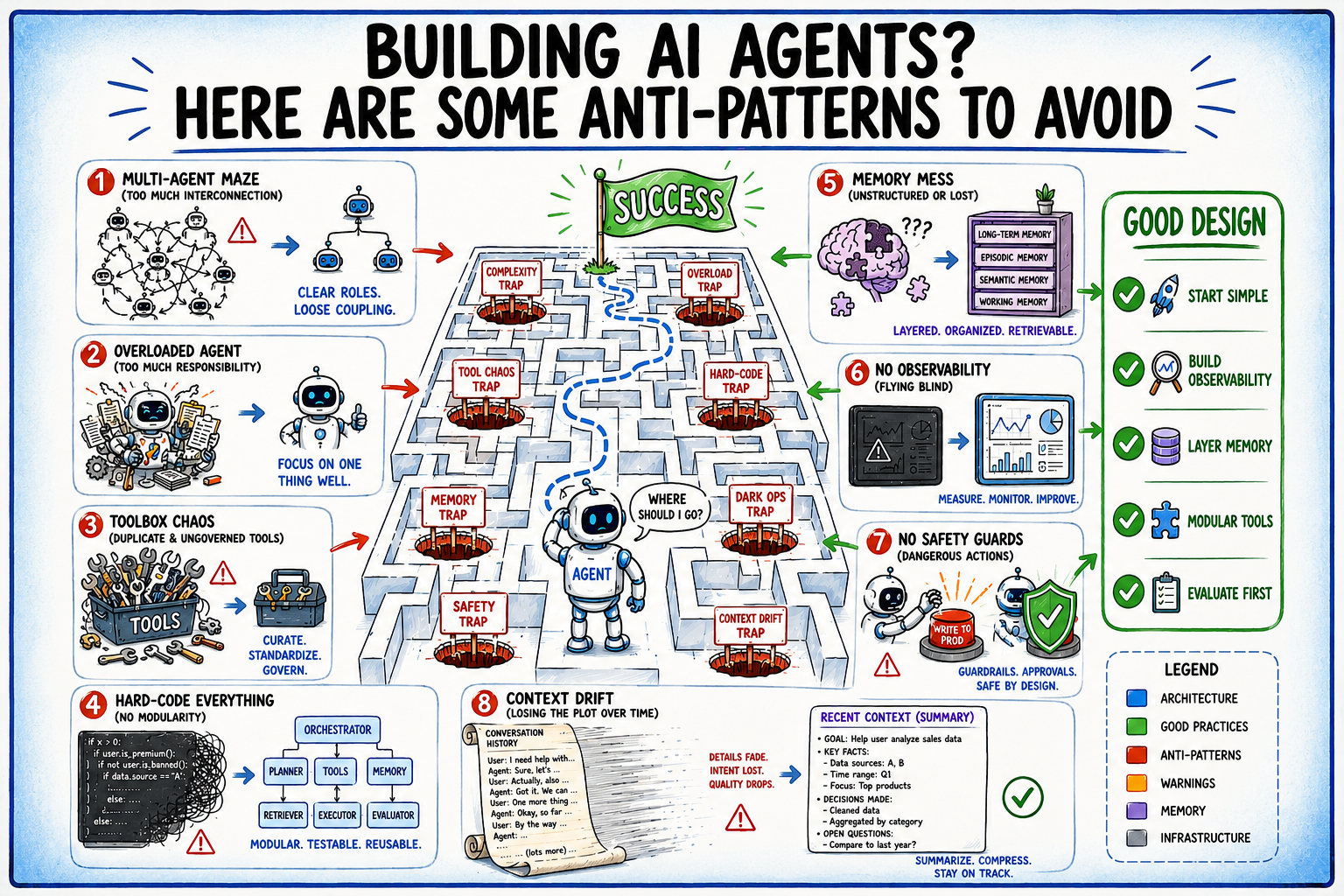
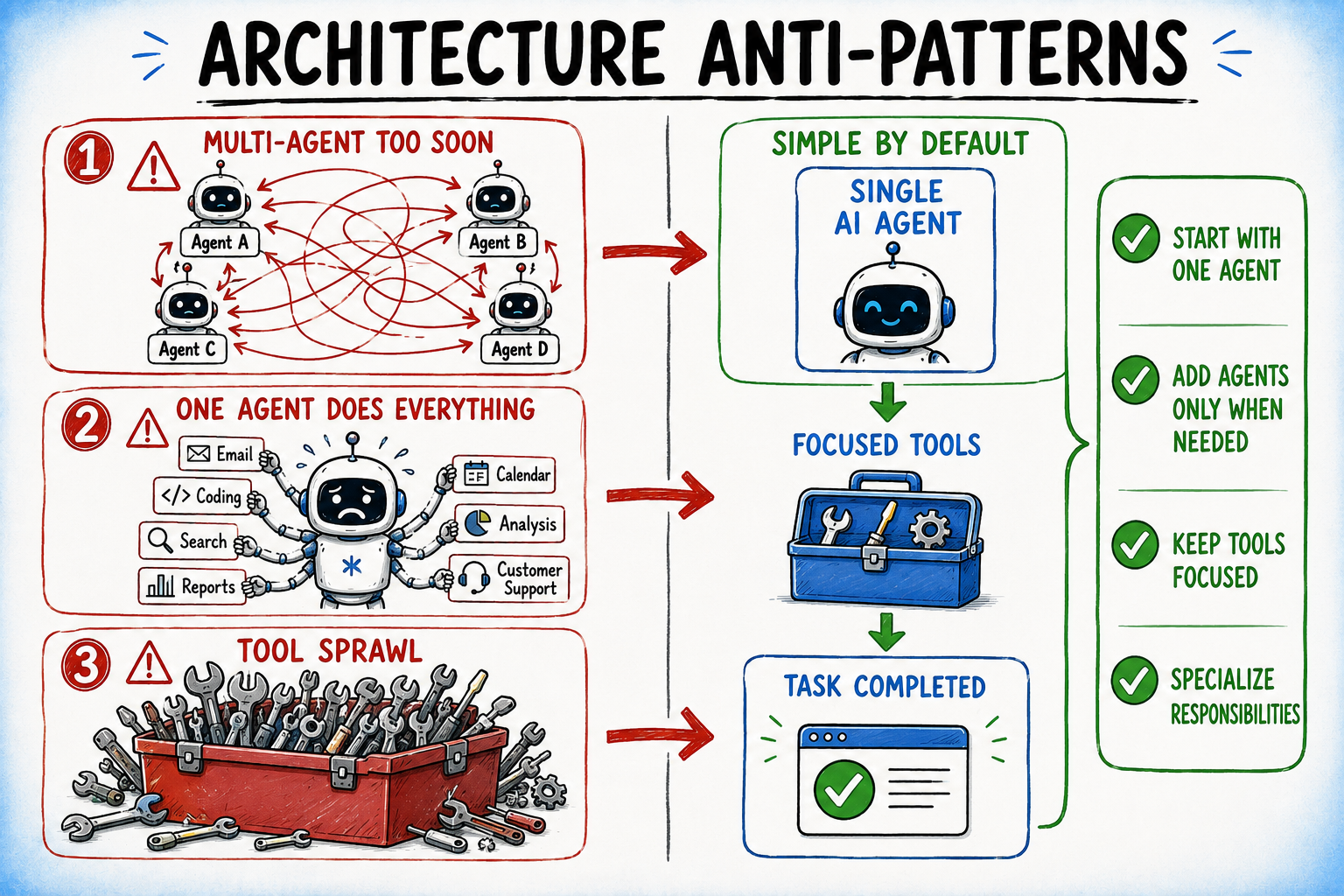
Teams often start by attempting to build a single "God-Agent." They provide it with fifteen different tools—from database queries to email sending—and a massive, sprawling set of instructions. Initially, the agent shows promise. However, as complexity grows, performance begins to degrade. The model struggles to differentiate between its vast toolset, leading to poor selection and wasted token expenditure.
Phase 2: The Multi-Agent Pivot
When the general-purpose agent fails, teams often reach for the next buzzword: "multi-agent orchestration." They attempt to solve their performance issues by splitting the work across a team of specialized agents. While theoretically sound, this introduces immense coordination overhead. Without a robust framework for inter-agent communication, the system becomes a "black box" where debugging is impossible.
Phase 3: The Scaling Wall
The final stage of failure is hitting the "scaling wall." The system is too complex to debug, too slow to run due to prompt bloating, and too unreliable for production. At this point, the cost of refactoring the architecture is so high that the project is often scrapped entirely.
3. Core Architectural Anti-Patterns: A Technical Audit
To prevent the aforementioned trajectory, architects must identify and neutralize the following structural mistakes:

The Tool Sprawl Dilemma
Every tool added to an agent’s context is a cognitive burden. If an agent has ten tools, it must evaluate which one to use at every step, significantly increasing the probability of error.
- The Fix: Limit the tool surface. If your agent is designed for data extraction, do not give it the ability to send emails. If tools have overlapping purposes, merge them or remove the redundant ones.
The Lack of Memory Design
Developers often treat agents like stateless APIs. They pass a history of the conversation and expect the agent to "remember." However, an agent working on a multi-step project needs a structured memory architecture.
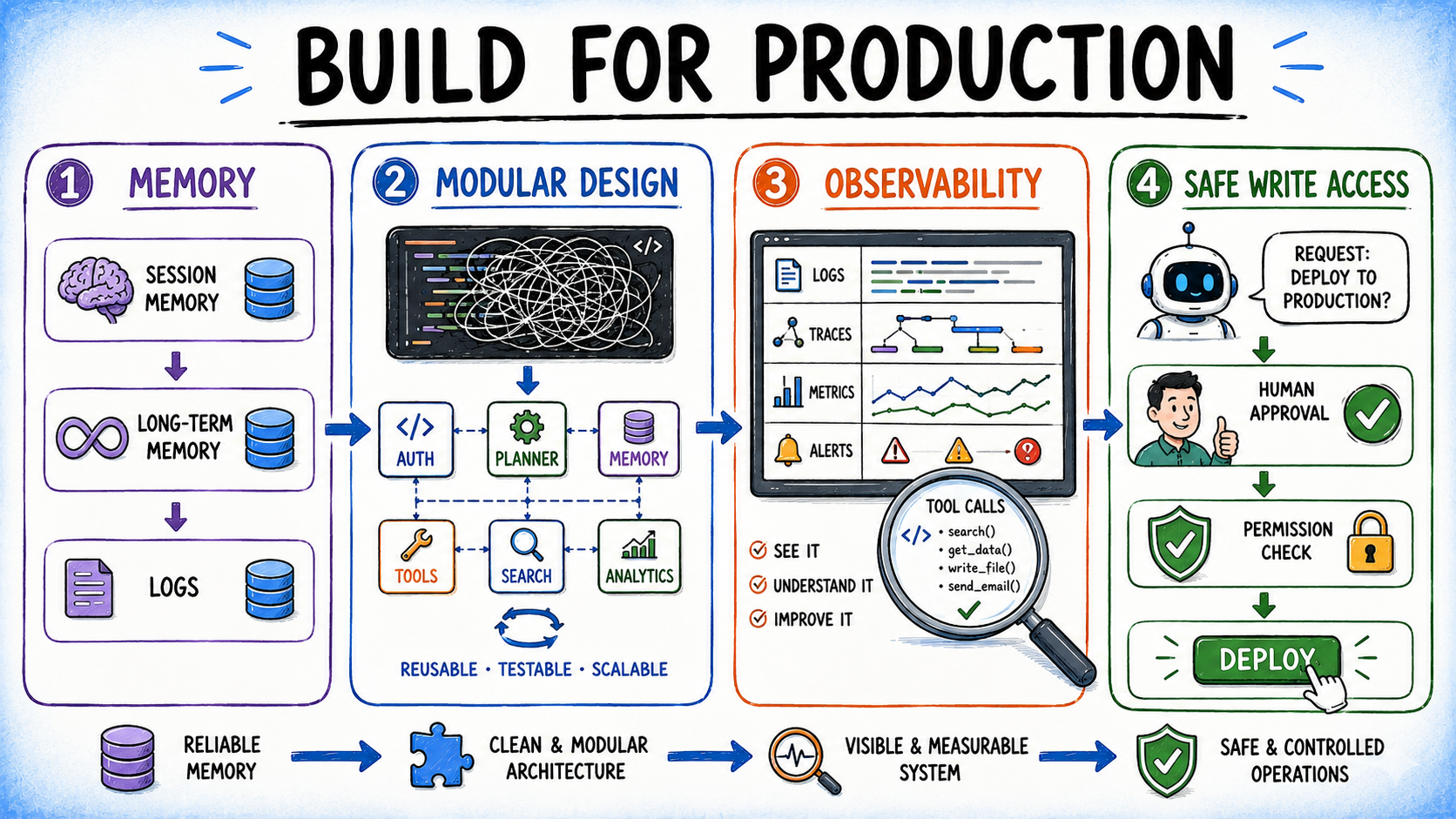
- The Fix: Implement a layered memory system. Use short-term memory for the current execution thread, working memory for intermediate tool results, and long-term memory (such as a vector database) for historical task data.
Hardcoding vs. Composition
When logic is hardcoded into a monolithic block of code, the system becomes brittle. A simple update to the LLM model or a minor change in a tool’s API can break the entire pipeline.
- The Fix: Adopt a modular, component-based architecture. Prompts should be stored in centralized configurations, and agents should be assembled from discrete, interchangeable units. This allows for rapid iteration without triggering systemic failure.
4. Supporting Data: The Cost of Ignoring Observability
The most critical factor in successful agent deployment is observability. In non-deterministic systems like AI agents, traditional logging is insufficient.
Research indicates that teams lacking "deep observability"—the ability to track the reasoning path, the specific parameters of tool calls, and the flow of context—take 80% longer to resolve production incidents than teams with built-in instrumentation. When an agent fails in a multi-step sequence, the developer must be able to "replay" the agent’s reasoning to identify exactly which step deviated from the intended path.
Key Metrics to Monitor:
- Token Efficiency: Monitoring for unnecessary bloat in context windows.
- Tool Call Success Rate: Tracking the reliability of individual tool interactions.
- Step-Count Distribution: Identifying agents that are "looping" or failing to reach a conclusion within an expected number of cycles.
5. Official Perspectives on Risk Mitigation
Industry leaders, including Anthropic and IBM, have emphasized the need for strict governance, particularly regarding "write access." A common mistake is allowing an agent to execute write operations (e.g., modifying a database or sending a message) without human intervention.
The "Human-in-the-Loop" Principle:
High-stakes operations should never be fully automated until the agent has proven reliability through rigorous testing. For production systems, it is recommended to implement a "confirmation gate" where the agent presents a proposed action and waits for a human signature before execution.
6. Implications for Future Development: The "Evaluate-First" Mindset
Perhaps the most damaging anti-pattern is deploying to production before building a comprehensive evaluation suite. Testing against "happy-path" scenarios—the inputs the developer expects—provides a false sense of security.
Adversarial Testing
To build a resilient agent, developers must intentionally try to break it. This includes:
- Adversarial inputs: Testing with ambiguous or intentionally misleading data.
- Edge-case stress testing: Observing how the agent handles truncated tool responses or network timeouts.
- Context Drift Simulation: Testing how the agent performs when its context window becomes saturated, causing "context rot."
Summary: A Blueprint for Success
The transition from "AI experiment" to "AI agent" is not about adding more intelligence; it is about adding more structure. The most effective agents are those that are narrowly scoped, highly observable, and modularly designed.
| Anti-pattern | The Path Forward |
|---|---|
| Multi-Agent Prematurity | Validate the task with a single, highly specialized agent first. |
| Monolithic Logic | Move toward component-based, configuration-driven architecture. |
| Ungoverned Write Access | Enforce strict permission boundaries and human-in-the-loop gates. |
| Context Rot | Implement aggressive context-window management and summarization. |
| No Observability | Treat distributed tracing as a core infrastructure requirement, not an add-on. |
By prioritizing these architectural foundations, organizations can move beyond the common pitfalls and build agentic systems that are not only powerful but also predictable, scalable, and secure. The era of the "God-Agent" is over; the era of the well-engineered, specialized agent has arrived.