The Silent Failure: Mastering LLM Evaluation in an Era of "Confident" Hallucinations
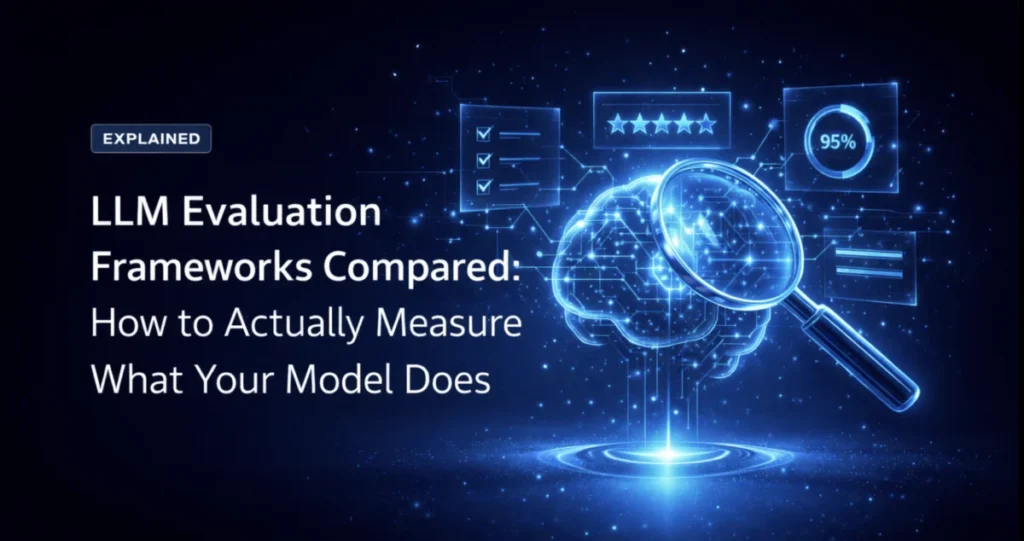
In the current landscape of generative AI development, the most dangerous bugs are not the ones that crash your application—they are the ones that output incorrect information with unwavering confidence. Unlike traditional software development, where a syntax error triggers an immediate stack trace, Large Language Model (LLM) applications fail silently. A prompt tweak or a minor change in the underlying model can lead to plausible but entirely fabricated outputs that slip past manual quality assurance.
As of 2026, the industry has largely converged on three primary open-source frameworks to address this systemic risk: RAGAS, DeepEval, and Promptfoo. While these tools have become the standard for assessing LLM performance, they are not interchangeable "black boxes." They serve distinct functional roles. Furthermore, the reliance on the "LLM-as-a-judge" paradigm—a mechanism central to all three—introduces measurable, documented biases that engineers must proactively architect around rather than blindly trust.
The Anatomy of LLM Failure: Why Traditional Testing Isn’t Enough
The default failure mode for an LLM feature is insidious. You ship a feature after performing a few "spot checks" and verifying that the outputs look reasonable. Three weeks later, a change in a system prompt or an updated model version silently introduces a hallucination or a drop in reasoning quality. Because the output remains syntactically correct and tonally consistent, users—and often developers—fail to notice the degradation until the damage is done.
Traditional software testing relies on deterministic assertions. In LLM applications, however, the input space is infinite and the output space is non-deterministic. This necessitates a shift toward probabilistic evaluation. In 2026, mature GenAI engineering teams have moved beyond manual review, opting instead for a layered approach: using automated evaluation frameworks for CI/CD "gates" and production-monitoring platforms for ongoing drift detection and human-in-the-loop review.
Defining the Evaluation Landscape
Before selecting a framework, it is vital to distinguish between the three distinct tiers of LLM evaluation, as conflating them is the most common reason for failed testing strategies:
- Component-Level Evaluation: This focuses on individual parts of a pipeline, such as the retrieval quality of a vector database or the classification accuracy of a small, task-specific model.
- End-to-End Pipeline Evaluation: This tests the entire user journey—from the user’s query to the final, synthesized response. This is where most developers spend their time, and it is the primary focus of frameworks like RAGAS and DeepEval.
- Human-in-the-Loop & Production Monitoring: This involves ongoing oversight of production logs to catch "drift"—where the model’s performance degrades over time due to shifts in user behavior or data distribution.
Most teams asking "which framework should I use?" are actually looking for solutions for the second category, often needing to pair it with the third for long-term reliability.
Framework Deep-Dive: RAGAS vs. DeepEval vs. Promptfoo
Understanding these tools requires looking past their surface-level similarities and focusing on their "workflow fit."
RAGAS: The Specialist for Retrieval-Augmented Generation
RAGAS (Retrieval Augmented Generation Assessment) is the academic heavyweight of the trio. It is built specifically to score the two most critical components of a RAG pipeline: retrieval (how well did we find the right context?) and generation (how well did we synthesize that context?).
- Best for: Projects where the accuracy of sourced information is paramount.
- Key Advantage: It provides metrics like "Faithfulness" and "Context Precision," which are grounded in research, providing a scientific basis for your quality scores.
DeepEval: The CI/CD Gatekeeper
DeepEval is designed to feel like native unit testing for AI. It integrates seamlessly into pytest, allowing developers to define quality thresholds that, if unmet, trigger a failed build.
- Best for: Teams that want to treat LLM outputs as a first-class software dependency that can break a production deployment.
- Key Advantage: It supports over 14 metrics, including bias, toxicity, and custom rubrics (G-Eval), which allow developers to write natural language requirements for the model to follow.
Promptfoo: The Red-Teaming Powerhouse
Promptfoo stands out by prioritizing comparative analysis and massive-scale test cases. It is an ideal tool for benchmarking different models against one another or running thousands of adversarial "red-teaming" prompts to check for security vulnerabilities.
- Best for: Model selection, prompt optimization, and security auditing.
- Key Advantage: Its CLI-first, YAML-based configuration makes it exceptionally fast for running large-scale batch comparisons without writing extensive Python code.
The "LLM-as-a-Judge" Bias: A Critical Reality Check
The core mechanism behind almost every modern evaluation framework is the "LLM-as-a-judge" approach. This is the practice of using a high-performance model (like GPT-4o or Claude 3.5) to grade the output of a smaller, cheaper, or specialized model.
While research suggests that these judges align with human evaluators approximately 80% of the time, this is an aggregate figure. It does not guarantee accuracy on your specific domain. Furthermore, LLM judges are prone to several well-documented, systematic biases:
- Position Bias: The judge tends to favor the first or last response in a list, regardless of quality.
- Self-Preference Bias: The judge prefers responses that mirror its own stylistic patterns or vocabulary.
- Verbosity Bias: The judge mistakenly equates longer, more complex responses with higher quality, even if they contain unnecessary fluff.
Mitigating Bias: The Audit Habit
Engineers cannot simply trust the score provided by an LLM judge. The most effective way to validate an evaluation pipeline is to implement a "Position-Bias Audit." This involves taking a set of test pairs and running the evaluation twice: once in the original order, and once with the responses swapped.
If the judge gives different scores based on the position of the response, your pipeline is fundamentally flawed. A 5–15% flip rate is common in production environments; anything higher warrants immediate investigation. The solution is straightforward but requires additional compute: average the scores across both orderings, or, better yet, use a judge model from a different family than the one being evaluated (e.g., use a Claude model to evaluate a GPT-based system) to break the self-preference loop.
Strategic Implementation: How to Build Your Stack
Experienced AI engineering teams rarely rely on a single tool. The most robust architectures involve a two-pronged strategy:
- The "Guard" (CI/CD): Use a framework like DeepEval or Promptfoo to enforce quality gates during development. If a change in the prompt causes the "Policy Accuracy" score to drop below 0.7, the merge request is automatically blocked. This is the frontline of defense against regression.
- The "Monitor" (Production): Once deployed, use platforms like LangSmith or Braintrust to log real-world interactions. This allows you to perform ongoing "offline evaluation" on actual production data, ensuring that the metrics you established during development hold up when faced with real-world user queries.
Conclusion: Designing for Trust
The evaluation of LLM applications is as much about process as it is about tooling. No framework can replace the necessity of a rigorous testing culture. RAGAS, DeepEval, and Promptfoo provide the mechanics of measurement, but the responsibility of interpretation rests with the developer.
To build reliable AI, you must move beyond the "looks good to me" stage of development. You must treat your evaluation metrics as living code, subject to the same scrutiny as the application logic itself. By designing for the inherent biases of LLM judges and enforcing strict quality gates in your CI/CD pipeline, you transform your AI application from a unpredictable "black box" into a robust, measurable, and reliable software product. The goal isn’t to reach a perfect score; it’s to reach a state where you understand exactly when and why your model fails.