The Architecture of AI: Navigating the LLM Stack in 2026
The rapid maturation of Large Language Model (LLM) applications has brought developers to a critical, often costly, crossroads. When a prototype moves beyond a simple client.chat.completions.create() call, architects must decide how to manage the growing complexity of memory, data retrieval, and agentic reasoning. Today, the choice between LangChain, LlamaIndex, and raw SDK implementations is no longer just a technical preference—it is a strategic decision that impacts production stability, long-term maintenance costs, and total budget.
With global expenditure on LLM APIs doubling to over $8.4 billion between 2025 and 2026, the stakes are higher than ever. Choosing the wrong framework doesn’t just cause friction during development; it manifests as "abstraction debt," where thousands of dollars in unnecessary token spend are burned by inefficient framework wrappers, and debugging sessions are stretched by deep, opaque stack traces.
The Landscape: Defining the Layers of Abstraction
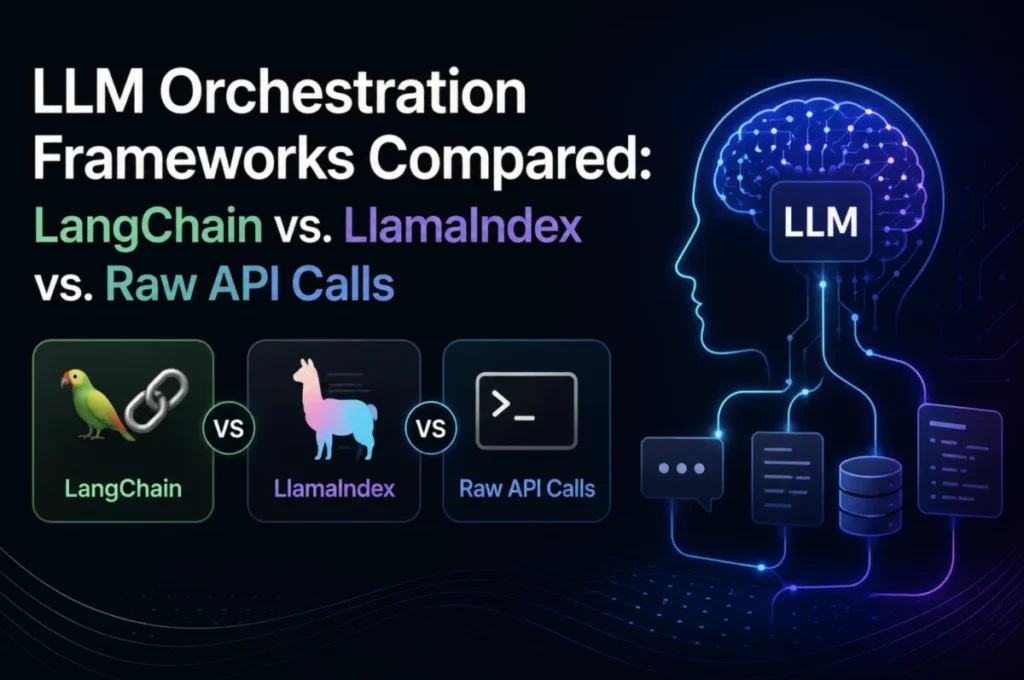
To make an informed choice, one must first look past the marketing narratives of each tool. These three options are not direct competitors; they operate at different layers of the application stack.
- LangChain (The Orchestrator): A comprehensive toolkit designed to chain together complex, multi-step workflows. It is the Swiss Army knife for agentic behavior and conditional logic.
- LlamaIndex (The Retriever): A specialized framework built specifically to bridge the gap between LLMs and external data. It treats data ingestion, indexing, and retrieval as first-class citizens.
- Raw API Calls (The Minimalist): The practice of interacting directly with providers like OpenAI or Anthropic. This approach prioritizes transparency, latency, and full control over the execution loop.
In a modern production environment, these are not mutually exclusive. Many sophisticated teams now utilize a "hybrid stack," using raw SDKs for high-throughput simple tasks, LlamaIndex for RAG (Retrieval-Augmented Generation) pipelines, and LangGraph for complex, stateful agentic workflows.
Chronology of the Framework Wars
The evolution of these tools has followed a distinct arc. In 2023, the industry was in a "framework fever," where adopting LangChain was the default for any LLM project. However, the period between late 2024 and mid-2025 saw a shift toward "minimalism."
As providers like OpenAI improved their native SDKs—incorporating native tool calling, structured outputs, and improved streaming—developers began to realize that the "framework tax" (the overhead in latency and code complexity) was becoming unsustainable for simple tasks. By October 2025, LangChain reached v1.0, signaling a long-awaited commitment to API stability after a tumultuous period of breaking changes. Simultaneously, LlamaIndex solidified its dominance in the retrieval sector, and the emergence of the OpenAI Agents SDK offered a streamlined, low-overhead alternative for developers who didn’t want the weight of a full orchestration framework.
Supporting Data: The Cost of Abstraction
The trade-offs between these approaches are quantifiable. Independent benchmarks from mid-2026 highlight the "hidden costs" of choosing a heavier abstraction layer.
Latency and Overhead
- Raw API Calls: Introduce zero framework overhead. For latency-sensitive voice agents or real-time customer support, this is the gold standard.
- LangChain/LangGraph: Add roughly 10ms to 14ms of overhead per step. While negligible in a single-turn chat, this compounds significantly in high-throughput pipelines processing thousands of requests per minute.
- LlamaIndex: Operates at a lighter ~6ms overhead, optimized for rapid retrieval from document stores.
Token Efficiency
Framework abstractions often require extra "system" tokens to manage state and instructions. Studies show that LlamaIndex uses approximately 1.6K tokens per query, while LangChain can reach 2.4K for equivalent RAG pipelines. Over a production run of millions of requests, this 33% difference in token usage represents a massive delta in operational budget.
Debugging Complexity
One of the most persistent complaints regarding full-stack orchestration is the "stack trace depth." When a LangChain agent fails, the error often resides 15 to 40 frames deep within the internal framework code. Conversely, raw SDK implementations generally yield simple, 2–5 frame stack traces, allowing developers to identify the root cause in seconds rather than hours.
Official Perspectives and Industry Trends
Industry leaders are increasingly advocating for "just-in-time" adoption of frameworks. The prevailing wisdom from the 2026 engineering summits suggests that developers should resist the urge to "over-architect" their systems at the prototype phase.
"The best framework is the one you add only when your problem becomes harder than the code required to solve it," notes a lead engineer at a major AI infrastructure firm. "If you are just building a RAG bot, you don’t need a heavy agentic framework. If you are building an autonomous research assistant, you need the persistence that LangGraph provides. Don’t pay for what you don’t use."
Implications for Production Systems
The decision to adopt a framework should be governed by your project’s primary "pain point."
When to use Raw API Calls
If your application consists of simple, predictable requests—such as sentiment analysis, data extraction, or classification—avoid frameworks entirely. The raw SDK is easier to maintain, easier to debug, and offers the highest possible performance.
When to use LlamaIndex
If your core challenge is "How do I make my model answer accurately from my private, messy documents?", LlamaIndex is the clear winner. Its hierarchical chunking, metadata filtering, and automatic query optimization are difficult to build from scratch and outperform general-purpose frameworks in retrieval quality.
When to use LangChain/LangGraph
If your application requires stateful, multi-turn agents that need to pause, store their state in a database, and resume hours later, LangGraph is the standard. Its ability to manage complex state transitions using a graph-based structure is a critical feature that becomes necessary as your agents evolve from simple responders to autonomous workers.
Conclusion: The Path Forward
The modern LLM stack is not a monolith. The most resilient production systems built in 2026 are modular. They use the Raw SDK as the foundation for efficiency, LlamaIndex as the engine for knowledge retrieval, and LangGraph for the complex, stateful reasoning required at the top of the stack.
By resisting the urge to lock your entire application into a single, monolithic framework, you ensure that your architecture remains flexible. Start with the minimal option that meets your current needs. When you encounter a specific, recurring problem—such as complex document retrieval or agent persistence—that is the moment to introduce the specialized framework designed to solve it. In the fast-moving world of generative AI, the ability to pivot and prune your dependencies is the ultimate competitive advantage.