Hyderabad Rises in Solidarity: Activists Demand Accountability in Education Amidst Wangchuk Crisis
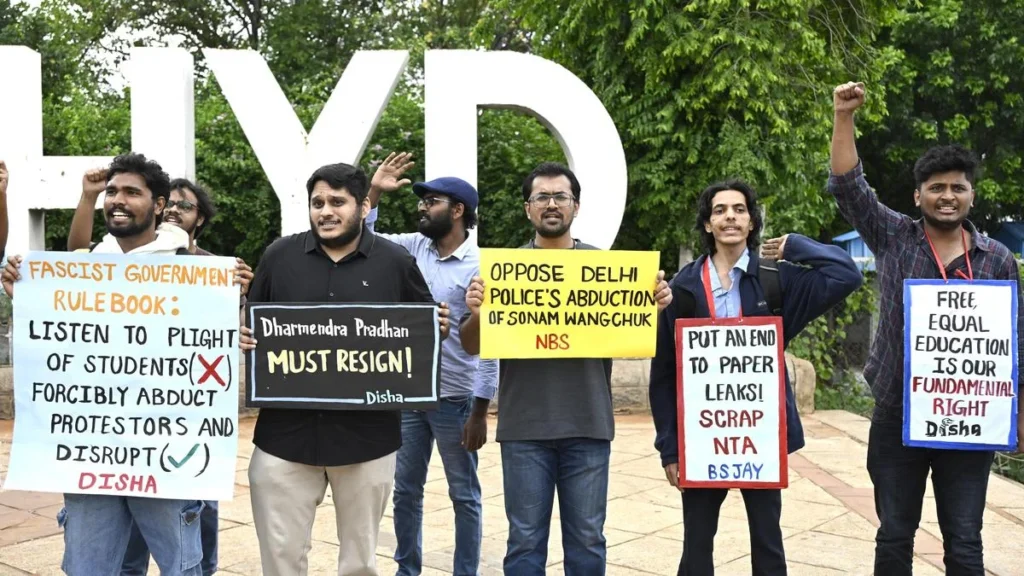
HYDERABAD – On Saturday, the iconic Necklace Road in Hyderabad became a focal point of civil unrest as students, activists, and youth organizations gathered to voice their deepening anxieties regarding the integrity of India’s national education framework. The demonstration, organized by the Disha Students’ Organisation, served as a powerful backdrop for a candlelight vigil at the B.R. Ambedkar statue on Secretariat Road, held in solidarity with renowned environmentalist and educationist Sonam Wangchuk.
The protest, which drew hundreds of participants, was not merely a gesture of support for Wangchuk, who has been forcibly hospitalized following a protracted indefinite hunger strike, but a searing indictment of the Union government’s handling of national-level entrance examinations, specifically the NEET (National Eligibility cum Entrance Test) and CUET (Common University Entrance Test).
The Catalyst: Sonam Wangchuk’s Fight for Accountability
Sonam Wangchuk, a Magsaysay Award-winning engineer and reformer, has long been a voice for the voiceless in Ladakh and beyond. His recent indefinite hunger strike was intended to compel the Union Education Ministry to address systemic rot within India’s higher education assessment bodies. Wangchuk’s protest focused on the lack of transparency, the recurring technical failures, and the administrative apathy that has plagued national examinations, leaving millions of students in a state of academic limbo.
His forcible hospitalization, as characterized by protesters in Hyderabad, was viewed as a strategic maneuver by the state to silence dissent. For the activists gathered at Secretariat Road, the government’s refusal to engage with Wangchuk—despite his 21-day fast—signifies a hardening of the state’s stance against democratic, non-violent protest.
"The government’s response to a Gandhian method of protest is to use force," said SFI State president S. Rajinikanth during his address to the gathering. "When a visionary like Sonam Wangchuk is forced into a hospital bed for demanding simple accountability, it sends a chilling message to the youth of this country: that your future is not a priority, and your questions are an inconvenience."
Chronology of a Crisis: From NEET Irregularities to Public Outrage
The current wave of student agitation did not emerge in a vacuum. It is the culmination of months of mounting frustration across the Indian subcontinent.
- Early 2026: Reports of systemic paper leaks and logistical failures in regional recruitment exams began to surface, setting the stage for widespread distrust.
- May 2026: Following the administration of the NEET and CUET, a torrent of complaints emerged regarding score discrepancies, "grace marks" awarded without clear criteria, and severe technical glitches at examination centers.
- June 2026: As student protests erupted in New Delhi and other major hubs, Sonam Wangchuk announced his hunger strike to demand a structural overhaul of the National Testing Agency (NTA).
- July 2026: Wangchuk’s health deteriorated significantly during his 21-day fast. The subsequent intervention by authorities to hospitalize him sparked a nationwide outcry, leading to the mobilization in Hyderabad on July 18.
The Core Grievances: NEET, CUET, and the Erosion of Trust
The demonstrators in Hyderabad articulated a list of grievances that resonate with students across the nation. The central accusation is that the NTA, the body responsible for these high-stakes exams, has failed in its primary duty: ensuring a level playing field for every candidate.
The NEET Controversy
The NEET examination, which determines admission to medical colleges across India, has become a flashpoint for accusations of corruption. Protesters highlighted that irregularities in the testing process do not just impact grades; they determine the career paths of hundreds of thousands of aspirants who spend years preparing. The perception that the system is "rigged" or "incompetent" has led to a mental health crisis among students, many of whom feel that their merit is being overshadowed by administrative failure.
The CUET Bottleneck
The Common University Entrance Test, intended to standardize admissions across central universities, has faced criticism for its reliance on digital infrastructure that often fails, and for curricula that critics argue prioritize rote learning over critical thinking. Activists at the rally argued that the centralization of these exams has stripped states of their autonomy and burdened students with a high-stress, low-reliability system.

Demands for Reform: The Call for Political Accountability
The rally, which featured speakers from diverse political backgrounds including the DYFI (Democratic Youth Federation of India) and AIDWA (All India Democratic Women’s Association), concluded with a clear set of demands directed at the Union Education Ministry.
- Resignation of Leadership: The primary demand was the immediate resignation or removal of Union Education Minister Dharmendra Pradhan. The organizers argued that the repeated failures of the NTA and the lack of a constructive response to the student agitation constitute a "dereliction of duty."
- Structural Decentralization: Speakers, including DYFI leader Anaganti Venkatesh, emphasized that the current "one-size-fits-all" model is structurally unsound. They advocated for a shift toward more decentralized, state-led testing mechanisms that allow for better monitoring and local accountability.
- Transparency and Audit: The organizations demanded a comprehensive, independent judicial audit of all recent entrance examinations. This would include a transparent disclosure of how grace marks were calculated, the protocols for handling server failures, and the security measures in place to prevent paper leaks.
- Open Dialogue: Above all, the protesters called for the government to stop treating student movements as "law and order" problems and start treating them as stakeholders in the nation’s education policy.
The Broader Implications: A Democracy at a Crossroads
The events in Hyderabad reflect a larger, more existential debate about the relationship between the Indian state and its youth. With India boasting one of the largest youth populations in the world, the education system is the engine of the nation’s future. When that engine stalls, the consequences for the economy and social stability are profound.
The "Democratic Deficit"
AIDWA leader R. Aruna Jyoti noted that the struggle for education reform is inextricably linked to the struggle for democratic space. "When the government refuses to dialogue with those who are fasting for a better education system, they are signaling a move away from participatory democracy," she stated. The implication is that if the government continues to ignore these concerns, the cycle of protests will likely escalate into more disruptive forms of civil disobedience.
The Psychological Toll
Beyond the political and administrative fallout, there is a mounting psychological cost. The anxiety surrounding entrance exams has become a defining feature of the Indian student experience. By failing to provide a transparent and efficient system, the Ministry of Education is contributing to an environment of chronic stress and disillusionment. The protest on Necklace Road was, in many ways, a therapeutic release for students who feel that their hard work is being undermined by a system that refuses to take responsibility for its errors.
Looking Ahead: The Path Forward
As of late July 2026, the Union Education Ministry has remained largely silent on the specific demands for the Minister’s resignation, maintaining that they are working to "streamline" the testing process. However, the intensity of the protests in Hyderabad and across the country suggests that "streamlining" may no longer be enough to appease a disillusioned student body.
The movement led by activists like Sonam Wangchuk has moved beyond local grievances. It has become a nationwide symbol of the demand for systemic reform. For the government, the path forward requires a difficult choice: continue to defend the status quo and risk further alienation of the youth, or initiate a radical, transparent overhaul of the examination system that prioritizes student welfare over administrative convenience.
In Hyderabad, the message was clear: the students are watching, they are organizing, and they are no longer willing to accept the status quo as a substitute for excellence. The candlelight vigil at the Ambedkar statue served as both a memorial for the current state of education and a beacon for the change that these activists believe is inevitable.
As the sun set over the city, the flickering candles against the backdrop of the B.R. Ambedkar statue served as a poignant reminder of the constitutional values of equality and justice that these protesters claim are being eroded. Whether the government chooses to listen, or continues to treat these legitimate grievances as mere noise, remains the defining question for the remainder of the academic year.