The Scaling Wall: Why Agentic AI Systems Falter and How to Architect for Tool Efficiency
In the rapidly evolving landscape of Large Language Model (LLM) applications, the "agent" has become the gold standard for automation. An agent is more than a chatbot; it is a system capable of executing actions—searching the web, querying databases, managing calendars, or manipulating files—to achieve a goal. When you first build an agent with five tools, it often performs flawlessly. It is responsive, accurate, and seems almost sentient.
However, the "three-month trap" is a documented phenomenon in AI engineering. Once that same agent grows to encompass 40 or 50 tools, its performance often craters. It begins to call the wrong tools, hallucinates parameters from unrelated schemas, or stalls entirely, waiting for execution on a task that should never have been initiated.
The underlying model hasn’t changed, but the environment has. This article explores why tool selection breaks at scale and outlines six essential architectural techniques to maintain high-performance agentic behavior without requiring increasingly expensive, bloated models.
The Anatomy of Failure: Why Tool Catalogs Break Agents
To understand why agents fail as they scale, one must look at how LLMs interact with "tool definitions." In most standard implementations, every tool—its name, description, and parameter schema—is injected into the model’s context window on every single turn.
The Cost of Context Bloat
When an agent holds 50+ tools, these definitions can consume 5% to 7% of the model’s total context window before the user has even finished their sentence. This is not merely an efficiency problem; it is a cognitive bottleneck.
The "Lost in the Middle" Phenomenon
Research into LLM attention mechanisms has consistently shown that models recall information at the start and end of a context window with high fidelity, while information buried in the middle is frequently subject to "noise." As you stack dozens of near-identical function signatures, the correct tool often drifts into this "dead zone." The model isn’t necessarily failing to reason; it is failing to attend to the correct signal amidst a sea of irrelevant metadata.
The Hallucination of Parameters
Perhaps the most damaging failure mode is "tool hallucination." When an LLM is presented with too many similar-sounding tools, its probabilistic nature takes over. It may invent non-existent function names or, more dangerously, attempt to call a legitimate tool while populating its arguments with schema data pulled from a completely different, unrelated tool. In a production environment, this leads to catastrophic failures—such as writing file contents into a CRM field or passing Slack credentials to a search API.
Chronology of an Agentic Breakdown
- The Demo Phase (0–10 tools): The agent operates with high precision. The model has enough "headroom" to accurately parse tool descriptions.
- The Growth Phase (10–20 tools): Minor degradation begins. Accuracy in tool selection starts to slip, and latency increases as token counts for tool definitions rise.
- The Complexity Threshold (20+ tools): The "Lost in the Middle" effect becomes dominant. Users begin reporting "stalling" behaviors and incorrect tool calls.
- The Systemic Failure (50+ tools): The agent frequently hallucinates parameters or misidentifies the tool intent. Production reliability drops below acceptable thresholds for enterprise use.
Six Techniques for Scalable Tool Management
The solution to these issues is not a bigger context window; it is "intelligent curation." By controlling what the model sees before it makes a decision, you restore its ability to reason effectively.
1. Gating: The "Conversational Filter"
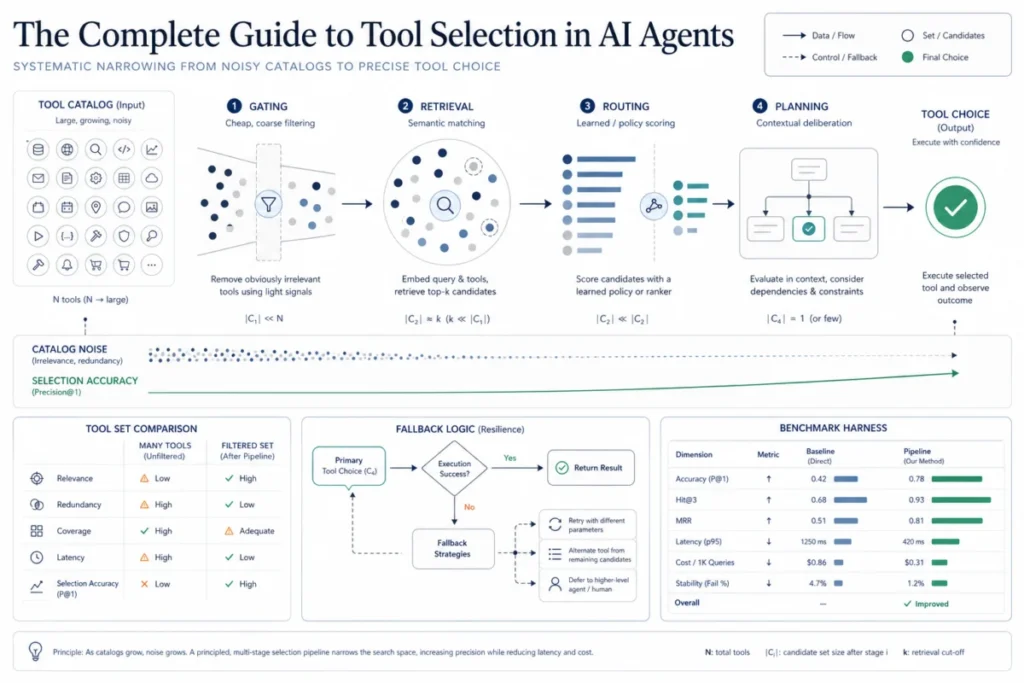
Not every user prompt requires an action. A significant portion of agentic interaction is conversational (e.g., "Thanks," "What do you mean?", "Hello"). If your agent runs a full tool-retrieval pipeline for a simple "Thank you," you are wasting compute and increasing latency.
The Solution: Implement a "gate"—a lightweight classifier or regex-based filter—that determines if a tool is required at all. If the query is purely conversational, the agent skips the expensive retrieval phase entirely. This simple step can reduce unnecessary compute cycles by 20% to 30%.
2. Retrieval-Based Tool Selection (RAG-MCP)
Rather than providing the model with the entire "phone book" of tools, treat your tool catalog as a database. Using semantic search, you can embed your tool descriptions and retrieve only the top-K most relevant tools for the current query.
The RAG-MCP paper (May 2025) provides the benchmark for this approach: by retrieving only the top-relevant tools, the authors observed a triple-fold increase in tool selection accuracy—from 13.62% to 43.13%—while simultaneously cutting prompt tokens by more than half.
3. Semantic Routing
Routing is the structural cousin of retrieval. If your tools cluster into specific domains (e.g., "Data Analytics," "Communication," "Scheduling"), you can use a semantic router to determine the category of the user’s request. Once the category is identified, the agent only loads the relevant "toolbox" into the context window, drastically reducing the search space for the LLM.
4. Planner-Based Selection
For complex, multi-step tasks, the "God Agent" pattern—where one agent tries to do everything—is a recipe for disaster. Instead, implement a planner. The planner breaks a user’s request into a series of logical sub-tasks. Each sub-task is then assigned a specific "capability" tag, and only the tools associated with that capability are provided to the agent for that specific step. This ensures that the agent’s focus remains laser-sharp throughout the entire workflow.
5. Fallback Logic: Designing for Graceful Degradation
What happens when the system is unsure? Most developers rely on "greedy" selection, where the model is forced to pick the "best" tool even when confidence is low. This leads to errors.
The Strategy: Implement a three-tier fallback.
- Tier 1: High-confidence match (direct execution).
- Tier 2: Low-confidence match (reformulate the query or re-embed).
- Tier 3: No confident match (explicitly ask the user for clarification).
Admitting ignorance is always more professional and safer than a hallucinated, incorrect action.
6. Benchmarking
You cannot optimize what you do not measure. Establish a labeled benchmark set of (query, correct tool) pairs. Run your pipeline against this set regularly. By comparing your filtered, optimized pipeline against a naive "full-catalog" baseline, you can quantitatively track the impact of your architectural changes on accuracy, token cost, and latency.
Official Perspectives and Industry Implications
Leading AI research labs and infrastructure providers are increasingly acknowledging that the "context-is-all-you-need" approach is hitting a wall. OpenAI’s documentation notes a hard limit of 128 tools per agent, but as the data shows, the practical limit for consistent, high-accuracy performance is significantly lower—often around 15 to 20.
Industry experts argue that the shift toward "Modular Agentic Systems" is the next frontier. By decoupling the tool catalog from the reasoning engine, organizations can build agents that are not only more accurate but also more maintainable. As companies move from experimental prototypes to mission-critical production systems, the ability to audit why a specific tool was chosen—or why a request was escalated—will become a mandatory requirement for compliance and safety.
Conclusion: The Path Forward
The transition from a "demo" agent to a "production" agent requires a fundamental shift in how we handle information. It is time to move away from dumping every possible function into the model’s context window.
By layering gating, retrieval, routing, planning, and robust fallback logic, you effectively simulate a human expert who knows exactly where to look for information rather than trying to memorize an entire library. These techniques do not require more powerful hardware or larger models; they require a more disciplined approach to system architecture.
As the agentic ecosystem continues to mature, the winners will not necessarily be those who have the biggest context windows, but those who have the smartest filters. Stop asking your model to read the entire phone book; teach it to look up the number instead.