Bridging the Gap: Integrating Local LLMs into Machine Learning Pipelines with Scikit-Ollama
In the rapidly evolving landscape of artificial intelligence, the reliance on commercial cloud-based Large Language Model (LLM) APIs has become a double-edged sword. While models like GPT-4 or Claude offer unparalleled reasoning capabilities, they introduce significant hurdles: recurring subscription costs, latency issues caused by network traffic, and, perhaps most critically, the privacy concerns associated with sending sensitive data to third-party servers.
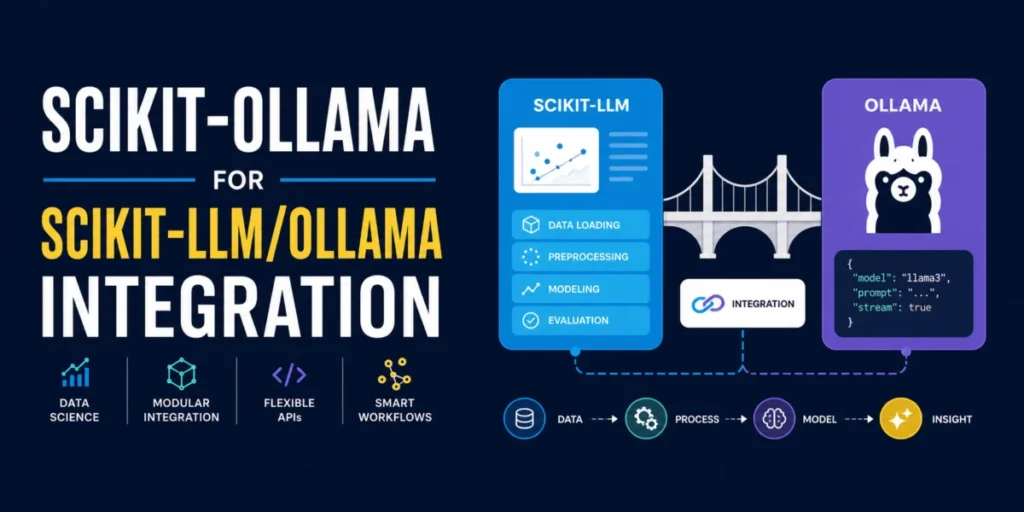
Enter scikit-ollama, a transformative library that bridges the gap between the familiar, developer-friendly scikit-learn ecosystem and the power of locally hosted LLMs powered by Ollama. By enabling zero-shot text classification entirely on local hardware, developers can now maintain the rigorous standards of data privacy and cost-efficiency without sacrificing the intelligence of modern generative AI.
The Shift Toward Localized AI Architectures
For years, the standard workflow for data scientists involved training classical machine learning models using scikit-learn. The syntax is standardized, the pipeline integration is seamless, and the community support is vast. However, the rise of LLMs initially created a silo; to use them, one had to interact with proprietary APIs.
The integration of LLMs into traditional workflows is no longer merely a theoretical experiment; it is a practical necessity. By leveraging scikit-ollama—a library heavily inspired by the architecture of scikit-llm—developers can now invoke local models as if they were standard estimators. This integration allows for the deployment of sophisticated zero-shot classifiers on hardware ranging from high-end workstations to standard laptops, effectively removing the "black box" nature of cloud-based inference.
Chronology of Development: From Cloud-Native to Local-First
The development trajectory of this technology highlights a broader industry pivot:
- The API Dominance Phase: Initially, AI integration was synonymous with RESTful API calls. Data was transmitted over the internet, processed by remote clusters, and returned to the client. This introduced significant compliance risks for industries like finance and healthcare.
- The Rise of Local Inference: Tools like Ollama emerged to simplify the deployment of open-weight models (like Llama 3 or Mistral) on consumer-grade hardware. This democratized access but lacked a standardized API for developers accustomed to the
fit()andpredict()patterns of Python’s machine learning libraries. - The Synthesis: Libraries like
scikit-ollamaarrived to harmonize these two worlds. By wrapping Ollama’s inference engine in a class that adheres to thescikit-learnEstimator API, the developer experience was finally unified.
Technical Implementation: A Practical Walkthrough
To begin utilizing local LLMs in your machine learning stack, you must ensure your environment is configured correctly. Because scikit-ollama relies on modern Python features, it is strictly compatible with Python 3.9 or higher.
Step 1: Environment Preparation
After establishing a virtual environment, installation is performed via the Python Package Index:
pip install scikit-ollamaStep 2: Loading Data and Defining Objectives
We utilize the datasets module from the skllm package to demonstrate sentiment analysis. This dataset acts as a proxy for real-world text classification, where the objective is to categorize movie reviews into "positive," "negative," or "neutral" buckets.
from skllm.datasets import get_classification_dataset

# Load the movie review dataset
X, y = get_classification_dataset()
print(f"Sample review: X[0] nLabel: y[0]")
Step 3: Integrating the Local Estimator
The magic happens within the ZeroShotOllamaClassifier. Unlike traditional models that require training on thousands of samples to learn patterns, this classifier uses the inherent linguistic capabilities of a model like Llama 3 to infer sentiment based on a prompt.
from skollama.models.ollama.classification.zero_shot import ZeroShotOllamaClassifier

# Initialize the classifier pointing to your local Ollama instance
clf = ZeroShotOllamaClassifier(model="llama3:latest")
Step 4: The "Fit" and "Predict" Ritual
In this paradigm, the fit() method does not update weights or optimize a loss function in the traditional sense. Instead, it registers the candidate labels. This is a form of "in-context learning" where the model is instructed on the taxonomy it must follow.
# Providing the schema for the model
clf.fit(None, ["positive", "negative", "neutral"])

# Perform inference
predictions = clf.predict(X)
Supporting Data: Why Local Inference Wins
The transition to local inference is supported by three primary pillars:
- Latency: By removing the network round-trip to a cloud server, the response time becomes dependent solely on local hardware performance (GPU/CPU/RAM). In high-throughput environments, this difference is measurable in seconds per batch.
- Cost-Efficiency: Cloud providers charge per token. For large datasets or high-frequency applications, these costs become astronomical. Running a local Llama 3 instance costs only the price of electricity and the initial hardware investment.
- Privacy: In an era of strict data governance (GDPR, CCPA), the ability to process sensitive text without egressing it to a third-party server is a strategic advantage. Data never leaves the local machine’s memory, providing an air-gapped security profile.
Implications for Industry Professionals
The implications for data science teams are profound. By abstracting the complexity of prompt engineering behind the scikit-learn interface, the barrier to entry for incorporating LLMs into production pipelines is lowered.
Bridging the Semantic Gap
The ZeroShotOllamaClassifier works by reformulating the user’s request into a constrained text-generation prompt. It forces the LLM to output only the specific class labels defined during the fit() stage. This effectively turns a generative model—which usually provides conversational, unstructured responses—into a deterministic classifier. This is the cornerstone of robust software engineering with AI: ensuring that the output is predictable and machine-readable.
Future Outlook
As hardware acceleration for local LLMs continues to improve (with technologies like Apple Silicon’s Neural Engine and NVIDIA’s TensorRT-LLM), the gap between the performance of cloud-hosted models and local models will continue to shrink. We are entering an era where "on-device AI" is not just for mobile phones, but for high-performance backend systems.
Conclusion
The integration of scikit-ollama into your professional workflow represents a maturing of the AI industry. We are moving away from the "API-first" gold rush and toward a more sustainable, private, and developer-centric approach. By mastering these tools, data scientists can maintain the standard of excellence defined by scikit-learn while leveraging the cutting-edge reasoning capabilities of local LLMs.
Whether you are building a sentiment analysis tool, a content moderation filter, or a complex document classifier, the ability to run these processes entirely on your own infrastructure is no longer a luxury—it is a competitive necessity. As the ecosystem matures, expect further refinements in model quantization and optimization, making the promise of local, private, and high-performance AI a reality for every developer.