The New Digital Imperative: How AudioEye is Bridging the Accessibility Gap in an AI-Driven Web
In the early days of the internet, digital accessibility was an afterthought—a peripheral concern relegated to the margins of web development. Today, it has become a central pillar of corporate responsibility, legal compliance, and commercial strategy. As the digital landscape expands, the challenge of ensuring that the 1.3 billion people globally living with disabilities can navigate the web has become a defining mission for platforms like AudioEye.
With over 127,000 organizations currently relying on its services, AudioEye has emerged as a leader in the movement to make the internet a truly inclusive space. By merging the speed of artificial intelligence with the nuance of human expertise, the company is redefining what it means to be “digitally accessible” in an era where the web is increasingly the primary gateway to essential services, commerce, and information.
The Core Mission: Accessibility as the Default
At its heart, AudioEye operates on a foundational belief: accessibility should not be a legal hurdle or an emergency scramble; it should be the default state of the web.
“Our vision is bigger than just fixing bugs,” says Mike Barton, VP at AudioEye. “We are working toward a digital world where accessibility is woven into the fabric of the internet. That is the bar we hold ourselves to, and it is why we keep investing in better detection, faster fixes, and stronger legal protection for our customers.”
This mission addresses a critical reality: the digital divide is widening. While the internet offers unprecedented opportunities, those without the ability to navigate it—whether due to visual, motor, or cognitive impairments—are effectively barred from the modern economy. AudioEye’s platform aims to remove these barriers, ensuring that whether a user relies on a screen reader or keyboard navigation, their experience is seamless and equitable.
A Chronology of Evolution: From Niche to Necessity
The journey of digital accessibility over the past two decades has been transformative. When AudioEye was founded, the industry was largely defined by indifference. Accessibility was a checkbox exercise, if it was considered at all.
The Shift in Stakes
The evolution of the sector has been driven by three primary forces:
- Legal Escalation: Accessibility-related lawsuits in the United States have doubled since 2020. The legal environment is no longer localized; international regulations, such as the European Accessibility Act (EAA), have created a global standard that companies can no longer ignore.
- Technological Acceleration: AI has fundamentally altered how websites are constructed. While this has allowed for rapid development, it has also introduced new layers of complexity that, if left unmanaged, create new barriers for users.
- The Business Case: Companies have moved past the “charity” mindset. They now recognize that accessibility is a competitive advantage. With $18 trillion in global spending power held by the disability community, excluding this demographic is no longer just a moral failure—it is a significant revenue loss.
Through this evolution, AudioEye has refined its hybrid approach. While early iterations relied on manual audits, the modern iteration of the platform leverages AI to handle the sheer volume of the modern web, while reserving human expertise for the complex, nuanced barriers that software cannot yet fully comprehend.
Supporting Data: The Cost of Inaccessibility
The numbers behind the push for accessibility are staggering. For businesses, the "side issue" of accessibility is now a direct threat to the bottom line.
- Market Power: People with disabilities represent an estimated $18 trillion in global annual disposable income.
- The Bounce Rate Reality: Research indicates that 70% of people with disabilities will abandon a website if it presents accessibility barriers.
- Customer Loyalty: For many, shopping is restricted to known-accessible sites. Once a brand fails a user, they rarely get a second chance.
- Litigation Trends: E-commerce remains the primary target for accessibility-related litigation, with 78% of all lawsuits in this space focusing on online retailers.
AudioEye’s platform addresses these metrics by acting as a "conversion lever." By resolving issues before they impact the user, businesses see higher conversion rates and reduced bounce rates, effectively capturing a market segment that their competitors are inadvertently excluding.
The Hybrid Model: Why AI Needs a Human Heart
One of the most persistent debates in the tech world is the reliance on automated accessibility tools. AudioEye differentiates itself by rejecting the idea that AI is a "silver bullet."
The Role of Automation
Automation is essential for scaling. AudioEye’s platform, which deploys via a single line of JavaScript, scans sites against Web Content Accessibility Guidelines (WCAG) in real-time. It handles high-volume tasks such as:
- Adding missing alt text to images.
- Fixing broken form labels.
- Correcting complex heading structures across thousands of pages.
The Role of Human Expertise
However, software cannot understand intent. It cannot determine if a complex carousel accurately conveys its message to a screen reader user. This is where AudioEye’s certified accessibility experts—many of whom have lived experience with disabilities—step in.
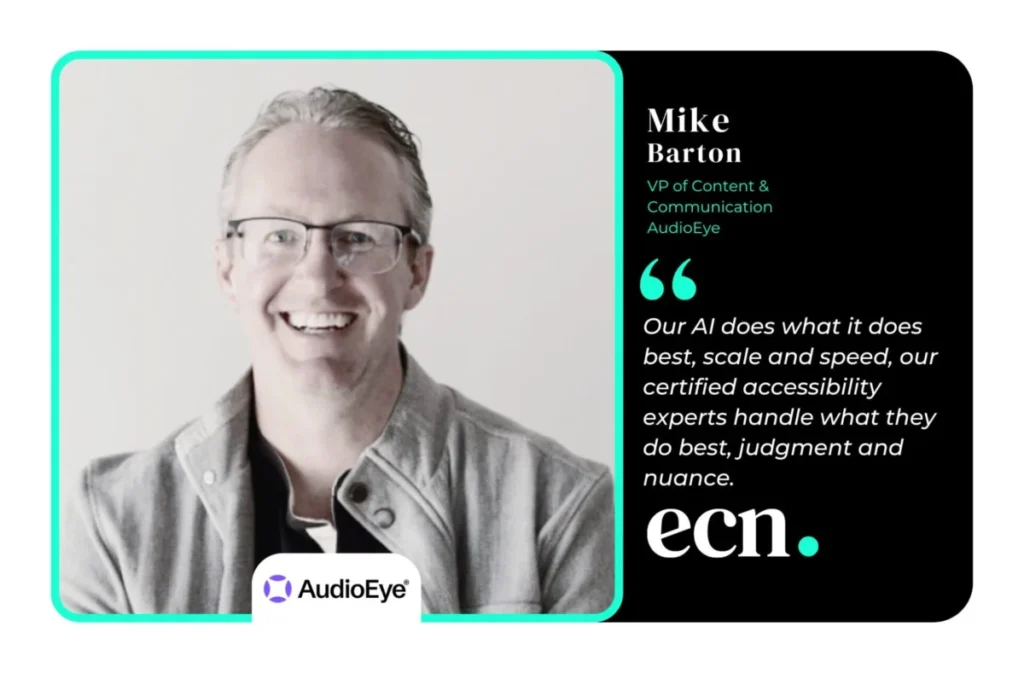
“Software finds the patterns; experts find what hides between them,” Barton explains. “That combination is why our legal protection rates are significantly higher than automated-only solutions. We use AI for speed and humans for judgment.”
This dual-layered approach results in approximately 97% of issues being resolved before a developer ever needs to touch the source code, creating an efficient workflow for enterprise teams.
Legal and Regulatory Implications
For many organizations, the primary motivator for pursuing accessibility is the threat of litigation. The legal landscape is becoming increasingly hostile toward inaccessible digital environments.
AudioEye positions itself not just as a software vendor, but as a legal partner. When a claim or demand letter arrives, the company provides expert validation and "debunk reports" to support the client’s legal counsel. This proactive stance has resulted in documented courtroom dismissals and a legal guarantee that distinguishes the platform from simple "accessibility widgets" that offer little to no protection in a court of law.
Looking Ahead: The Future of the Accessible Web
The future of accessibility is inextricably linked to the future of AI. As we move into the next decade, two trends are dominating the conversation at AudioEye.
1. The Global Regulatory Expansion
With the European Accessibility Act now in full force, the map of compliance has expanded. Organizations that previously only focused on US ADA compliance are now finding themselves subject to international standards. AudioEye is scaling its infrastructure to help global brands navigate this fragmented but increasingly rigorous regulatory environment.
2. The Rise of AI-Driven Discovery
Perhaps the most intriguing development is the role of AI agents in web discovery. These agents "read" a site’s accessibility tree to understand and index content. If a site is inaccessible, it is effectively invisible to these emerging AI search tools.
“Accessibility and AI discovery are going to be the same conversation in a few years,” says Barton. “If your site isn’t accessible, you are invisible to the next generation of discovery channels.”
A Commitment to Inclusivity
As the digital and physical worlds continue to blur, the mandate remains clear: the internet must work for everyone. For AudioEye, the next few years will be defined by closing the gap between the speed of AI-generated content and the fundamental need for human-centric design.
By continuing to innovate in detection, remediation, and legal defense, AudioEye is ensuring that the future of the web is not a gated community, but an open, accessible landscape for all. As businesses continue to face the pressures of a digital-first world, the decision to invest in accessibility is shifting from a burden to a strategic necessity—one that, when executed correctly, fosters growth, builds brand loyalty, and ensures that no customer is left behind.