The Evolution of AI: Bridging the Gap Between Predictive Models and Agentic Reasoning
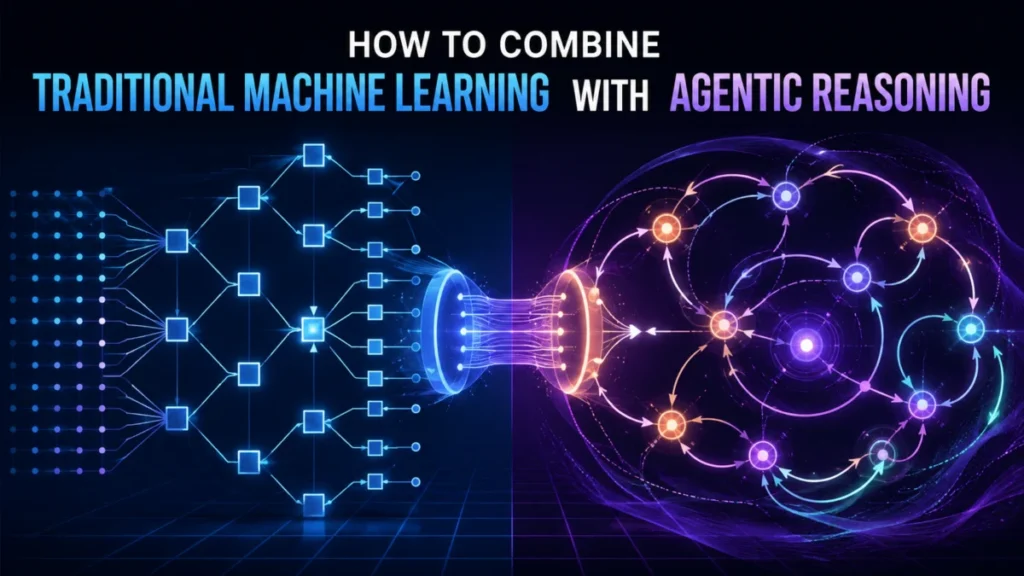
In the rapidly evolving landscape of artificial intelligence, we are witnessing a fundamental shift in how systems are architected. For years, the industry has been obsessed with the "model"—the singular, monolithic neural network designed to ingest data and spit out a prediction. While these models have achieved remarkable success, they remain inherently limited.
We are now entering the era of the "Agentic System." By combining the precision of traditional machine learning (ML) with the cognitive flexibility of agentic reasoning, developers are creating AI systems that don’t just offer probabilities—they solve problems. This article explores the limitations of current ML paradigms, the transformative potential of agentic reasoning, and the blueprint for building hybrid systems that represent the next frontier of enterprise automation.
1. The Architecture of Certainty: Traditional Machine Learning
To understand why agentic systems are necessary, we must first acknowledge the bedrock of modern AI: traditional supervised machine learning.
The Input-Output Paradigm
At its core, a traditional machine learning model is a function. You provide an input—a high-dimensional vector representing a transaction, an image, or a sequence of text—and the model performs a series of mathematical transformations to produce an output.
- Pattern Recognition Excellence: Models like XGBoost, Random Forests, or specialized deep neural networks are peerless when it comes to identifying patterns in structured data.
- Speed and Scale: Once a model is trained and deployed, it can process millions of inferences per second. This is the engine behind credit scoring, fraud detection, and recommendation engines.
- Deterministic Reliability: Because these models are static, their behavior is predictable. They do not "hallucinate" in the way large language models (LLMs) might; they follow the learned weights established during their training phase.
However, this strength is also a prison. These models lack an internal state; they are "stateless" entities. They cannot remember what happened five seconds ago, nor can they decide that the input they’ve been given is insufficient to make a high-confidence decision.
2. The Bottleneck: Where Predictive Power Stalls
As businesses push AI into more complex domains, the "input-output" model begins to show significant cracks. The failure points typically manifest in three distinct categories:
The Multi-Step Deficiency
Real-world workflows are rarely single-step. Consider a diagnostic AI in a hospital. A traditional model can look at an X-ray and predict the probability of pneumonia. But a clinician does more than that: they look at the patient’s history, cross-reference it with lab results, check for medication allergies, and then draft a treatment plan. A static ML model can contribute to one step of this chain, but it cannot navigate the entire workflow.
The Contextual Void
Static models operate on the assumption that all necessary context is provided in the initial input. In reality, complex tasks are investigative. An IT security agent investigating a breach must pivot based on findings. If a firewall log shows an anomaly, the agent must then inspect server logs, check user access rights, and verify current system updates. A model that cannot pause, search, and iterate is fundamentally unable to handle dynamic environments.
The "Action Gap"
Finally, there is the disconnect between prediction and execution. A predictive model can tell you that a supply chain disruption is imminent, but it cannot reroute a shipping vessel. It produces a probability, but the world requires an intervention. Bridging this gap—the "last mile" of AI—is where most projects fail, as they require custom-built "glue code" that is often brittle and difficult to maintain.
3. The Emergence of Agentic Reasoning
The shift toward "Agentic AI" involves moving from a system that calculates to a system that reasons.
What is an Agent?
An agent is an autonomous system capable of perceiving its environment, setting goals, decomposing those goals into sub-tasks, and executing them through tool-use. The "reasoning engine" at the heart of this is typically an LLM (Large Language Model), which serves as the controller, while the "tools" are the specific ML models, APIs, or databases that the agent invokes.
The Four Pillars of Agentic Capability
- Planning: Agents use frameworks like Chain-of-Thought (CoT) to break down abstract user requests into actionable sequences.
- Tool-Use (Function Calling): Agents can be equipped with "toolboxes." They don’t need to know how to calculate a complex regression; they simply need to know which API to call to have an ML model do it for them.
- Iterative Adaptation: If an agent attempts to retrieve data from a database and fails, it doesn’t crash. It interprets the error, modifies its query, and tries again. This self-correcting feedback loop is the hallmark of agentic systems.
- Agency: Agents act upon the world. They can send emails, update CRM entries, or trigger cloud infrastructure changes, effectively closing the action gap.
4. Supporting Data: The Hybrid Advantage
Industry data increasingly suggests that hybrid architectures outperform monolithic ones. In a 2024 benchmarking study of enterprise AI workflows, systems that used a "Controller Agent" to orchestrate smaller, specialized ML models showed a 40% improvement in accuracy for multi-step tasks compared to using a single, massive foundation model alone.
The reason is simple: Specialization. A large model might be a "jack of all trades," but it is often less accurate at specific tasks than a small, hyper-tuned model. By delegating tasks—using a BERT-based model for sentiment, a XGBoost model for fraud, and an LLM for reasoning—the system achieves both depth and breadth.
5. Strategic Implications: How the Two Work Together
The future of enterprise AI lies in the Orchestration Layer.
The "Orchestrator" Pattern
In this paradigm, the Agent acts as the Chief Executive Officer (CEO), and the traditional ML models act as the specialized staff.
- The CEO (Agent): Sets the strategy, interprets the goal, and makes high-level decisions.
- The Staff (ML Models): Execute specific, high-precision tasks on command.
This architecture solves the biggest issue in AI development: Maintenance. When a specific component needs an update—for example, the fraud model needs retraining due to new attack vectors—it can be swapped out without needing to rebuild the entire agentic framework.
6. Real-World Illustration: The Insurance Claims Workflow
To see this in action, look at the insurance industry.
- The Traditional Approach: An automated system flags a claim as "High Risk." It triggers an email to a human adjuster. The adjuster then spends 30 minutes manually checking records, calling providers, and reading the policy document.
- The Agentic Approach: An agent receives the claim. It identifies that the claim is "High Risk." It then:
- Queries the internal database for the claimant’s last three years of history.
- Uses an ML model to perform a "consistency check" between the provider’s current invoice and historical billing patterns.
- Reads the PDF of the policy to verify coverage limits.
- Drafts a summary report for the human adjuster, highlighting exactly why the claim was flagged and providing the supporting data.
The result is not just a faster process; it is a higher-quality outcome. The human is no longer a data-gatherer; they are a decision-maker.
7. Conclusion: The New AI Paradigm
We are moving away from the era of "AI as a prediction tool" toward the era of "AI as a digital employee." This transition does not discard the investments made in traditional machine learning; rather, it elevates them.
By wrapping our specialized, highly-accurate models in agentic reasoning layers, we transform static predictions into dynamic, goal-oriented actions. For organizations, this means the ability to automate not just tasks, but entire processes. The future belongs to those who stop viewing AI as a "black box" that outputs numbers, and start building systems that can plan, reason, and execute on our behalf.
The threshold has been crossed. The challenge for the next decade is no longer just how well our models can predict, but how effectively our agents can act.