RAG vs. Fine-Tuning: The Definitive Guide to LLM Domain Adaptation in 2026
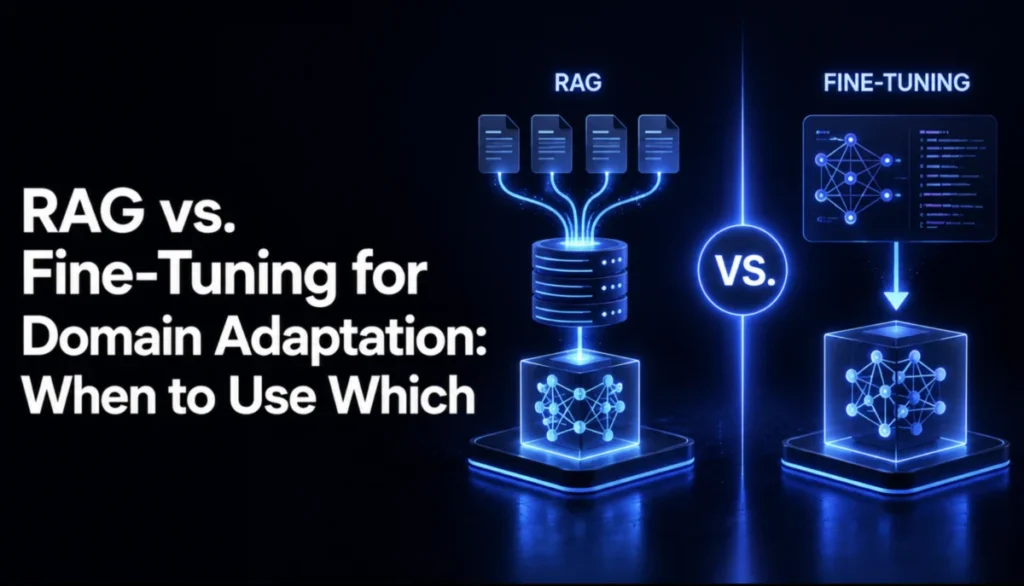
In the rapidly evolving landscape of enterprise artificial intelligence, the debate between Retrieval-Augmented Generation (RAG) and fine-tuning has reached a fever pitch. Often framed as a binary choice—an "either/or" decision that pits one methodology against the other—the reality of modern, high-performance production systems is far more nuanced. As of 2026, industry data suggests that approximately 60% of sophisticated LLM deployments utilize both techniques in tandem. This convergence is not a result of indecision, but rather a realization that these two methodologies solve fundamentally different problems.
For architects, engineers, and CTOs, the challenge lies in understanding the mechanical distinctions between these approaches and determining when to deploy each. This article provides a comprehensive technical breakdown of how to navigate the "RAG vs. Fine-Tuning" divide, supported by working code examples and a strategic decision framework.
The Mechanical Divide: Understanding the Difference
To move beyond the common misconceptions surrounding LLM customization, one must first understand the mechanical reality of how these models function.
Retrieval-Augmented Generation (RAG)
RAG is fundamentally an information injection technique. Crucially, it does not modify the model’s internal weights. Instead, it alters the "context window"—the immediate workspace the model uses to generate a response. When a user submits a query, a retrieval mechanism searches a curated knowledge base, extracts the most relevant documents, and presents them to the model alongside the original prompt.
In this paradigm, the model acts as a highly capable engine that processes provided briefing documents to form an answer. It is the gold standard for dynamic data environments where information is large, subject to frequent updates, or requires strict traceability.
Fine-Tuning
Conversely, fine-tuning is a behavioral modification technique. It involves adjusting the model’s underlying weights by training it on specific input-output datasets until the desired behavior becomes part of the model’s core "reflexes."
Modern approaches, such as Low-Rank Adaptation (LoRA) and QLoRA, have revolutionized this process. Instead of retraining the entire model—a costly and time-consuming endeavor—engineers now train small "adapters." These adapters often represent less than 1% of the base model’s total parameters, allowing for high-performance tuning at a fraction of the cost and time, often requiring only a few hours of compute.
Chronology of Adoption: The Shift to Hybrid Systems
The evolution of these technologies has mirrored the maturation of the AI industry.
- 2023: The Era of Prompt Engineering. Organizations initially relied on complex prompting to force models into compliance.
- 2024: The Rise of RAG. As hallucinations became a critical barrier to entry for enterprise, RAG emerged as the standard for grounding models in factual, company-specific data.
- 2025: The Refinement of Fine-Tuning. With the widespread adoption of parameter-efficient fine-tuning (PEFT) methods like QLoRA, fine-tuning became accessible to mid-sized engineering teams.
- 2026: The Hybrid Standard. The current state of the art recognizes that RAG excels at factual recall, while fine-tuning excels at tone, formatting, and strict structural output. Modern pipelines now chain these together to achieve optimal results.
Supporting Data: Why Factual Knowledge Isn’t "Trained"
One of the most persistent myths in the AI space is that fine-tuning a model on a large corpus of technical documentation will result in the model "learning" those facts. Research consistently indicates otherwise.
Fine-tuning is a tool for style, structure, and pattern recognition, not for factual database construction. When a model is fine-tuned on a vast set of medical literature, it may adopt the tone and vocabulary of a physician, but its ability to recall specific, granular facts from that training data remains statistically unreliable. Conversely, RAG-based systems—which pull live, verified documents—maintain high fidelity to the source, making them significantly safer for tasks requiring high precision.
Case Study 1: Implementing RAG for Engineering Runbooks
Consider an internal engineering team struggling to manage incident runbooks. These documents are updated weekly, and accuracy is paramount.
The Technical Implementation
A RAG pipeline involves three distinct steps:
- Chunking: Breaking down long documents into manageable, semantically meaningful pieces.
- Indexing: Using a vectorizer (like TF-IDF or a neural embedding model) to map these chunks into a searchable space.
- Generation: Using a "System Prompt" to strictly constrain the model to only utilize the retrieved context and provide citations.
Code Excerpt: The Retrieval Chain
# snippet of retrieval.py
def chunk_document(doc, max_sentences=2):
    sentences = re.split(r"(?<=[.!?])s+", doc["text"])
    chunks = []
    # ... logic to group sentences ...
    return chunks

# The Generation step
SYSTEM_PROMPT = """You are an internal engineering assistant.
Answer only using the provided source excerpts.
Cite the source document ID for every claim in square brackets."""
This architecture ensures that when a developer asks, "How do I failover the database?", the model cites the exact runbook, allowing for auditability and verification at 2:00 AM.
Case Study 2: Fine-Tuning for Structured Output
Contrast the RAG scenario with a financial services firm needing to classify customer complaints into a proprietary, rigid taxonomy (e.g., BILLING_DISPUTE, CARD_FRAUD_SUSPECTED).
The Behavioral Requirement
The challenge here is not information retrieval; it is compliance. The model must output a specific JSON structure every time, regardless of the user’s phrasing. While a system prompt can encourage this, it lacks the consistency required for high-volume automated ticketing systems.
Fine-tuning allows the model to "internalize" the classification schema. By training on a high-quality, validated dataset of examples, the model learns the exact structure and categorization logic required, significantly reducing the frequency of formatting errors that would otherwise break downstream processing.
Implications: The Strategic Decision Framework
To determine which path—or combination of paths—your organization should take, follow this logic:
1. Does the information change frequently?
- Yes: RAG is mandatory. You cannot re-train or fine-tune a model every time a database schema or policy changes.
- No: Proceed to the next question.
2. Is auditability and source citation a hard requirement?
- Yes: RAG is mandatory. Fine-tuned models cannot "point" to the specific training sample that informed an answer.
- No: Proceed to the next question.
3. Does the model consistently fail to follow output format or tone requirements?
- Yes: Fine-tuning is likely necessary. If prompt engineering and RAG context-stuffing consistently fail to enforce your JSON structure or brand voice, you have a behavioral issue that only weight modification can fix.
4. Is the project a "knowledge" problem or a "behavior" problem?
- Knowledge: RAG.
- Behavior: Fine-Tuning.
- Both: Hybrid.
Conclusion: The Path Forward
The most successful production systems treat the "RAG vs. Fine-Tuning" debate as a false dichotomy. For the vast majority of enterprise applications, the optimal path is to start with RAG. It provides immediate value, is easier to debug, and requires no model training.
Once your retrieval system is stable, observe the model’s behavior. If you find yourself struggling with consistent output formatting, professional tone, or adherence to a strict classification schema—and these problems persist despite your best efforts at prompt engineering—that is the signal to introduce a fine-tuned adapter.
By separating the knowledge base from the behavioral interface, organizations can build systems that are not only highly accurate but also robust, maintainable, and scalable. In the professional domain, the most sophisticated AI systems are those that acknowledge the distinct roles these two technologies play and use them in concert to solve the complex problems of the modern enterprise.