Navigating the AI Frontier: Academic Panic, IP Dilemmas, and India’s Evolving Tech Landscape
Main Facts
The intersection of artificial intelligence and academic research has reached a volatile flashpoint. Last month, OpenAI’s Codex model purportedly solved the complex Navier-Stokes equations—a mathematical century-old puzzle carrying a coveted $1 million prize—in a matter of days. However, this scientific milestone was overshadowed by profound anxiety. Prominent mathematician Tristan Buckmaster raised alarms that his unpublished research drafts might have inadvertently fed the model, igniting a global debate over intellectual property, ownership, and academic priority in the era of generative AI.
The incident highlights a chilling reality for researchers: feeding confidential academic work or unfiled patents into large language models (LLMs) can erode career-defining credit and proprietary rights. While OpenAI denied using specific user inputs for that output, the episode exposed severe vulnerabilities in how sensitive data is handled within frontier AI systems.
Simultaneously, the Indian academic and startup ecosystem is navigating this uncharted territory. Institutions are shifting from casual adoption to formal policy frameworks. While many researchers routinely employ AI for basic literature reviews, they are increasingly hesitant to upload complete solutions or patentable methodologies. Instead, academic bodies are establishing secure, localized alternatives—such as running smaller, open-weight models on campus servers—to prevent data leakage to proprietary frontier models.
Beyond academia, India’s tech and startup economy continues to experience robust shifts. From the semiconductor sector—where early-stage startups like circuitEvolve are leveraging AI to revolutionize analogue chip design—to shifting venture capital dynamics that saw AI and cleantech outpace traditional sectors like fintech in Q3 2026, the country is rapidly adapting its policy and innovation playbooks to harness AI while safeguarding domestic intellectual property.
Chronology of the OpenAI Dispute and Academic Fallout
The Convergence of AI and Advanced Mathematics
The friction between advanced mathematics and artificial intelligence has been building for years, but last month’s events marked a watershed moment. OpenAI deployed its Codex model to tackle the Navier-Stokes equations, a set of nonlinear partial differential equations describing the motion of viscous fluid substances. Long considered one of the holy grails of classical physics and mathematics, the equations carry a $1 million bounty for a complete, smooth solution.

The Buckmaster Saga Unfolds
Within days of deployment, OpenAI announced that the model had successfully solved a key mathematical proof relating to the equations in just four days. The speed of the breakthrough sent shockwaves through the global mathematics community.
Shortly after, mathematician Tristan Buckmaster voiced deep concerns. Buckmaster feared that his own unpublished drafts, uploaded or processed within digital research environments, might have been ingested by the model, serving as the foundational training data or context window input that enabled the rapid breakthrough.
Denials and Institutional Panic
OpenAI quickly defended its processes, issuing statements denying that user inputs from Buckmaster’s specific interactions were used to train or shape the final output. Nevertheless, the damage to scientific trust was done. The episode laid bare a systemic vulnerability: academic researchers collaborating or testing hypotheses within AI ecosystems lack absolute guarantees that their proprietary, unpublished intellectual labor remains confidential. The fear of losing first-mover advantage and academic priority sparked widespread panic across global university labs.
Supporting Data and Market Intelligence
India’s Venture Capital Shift: Q3 2026 Insights
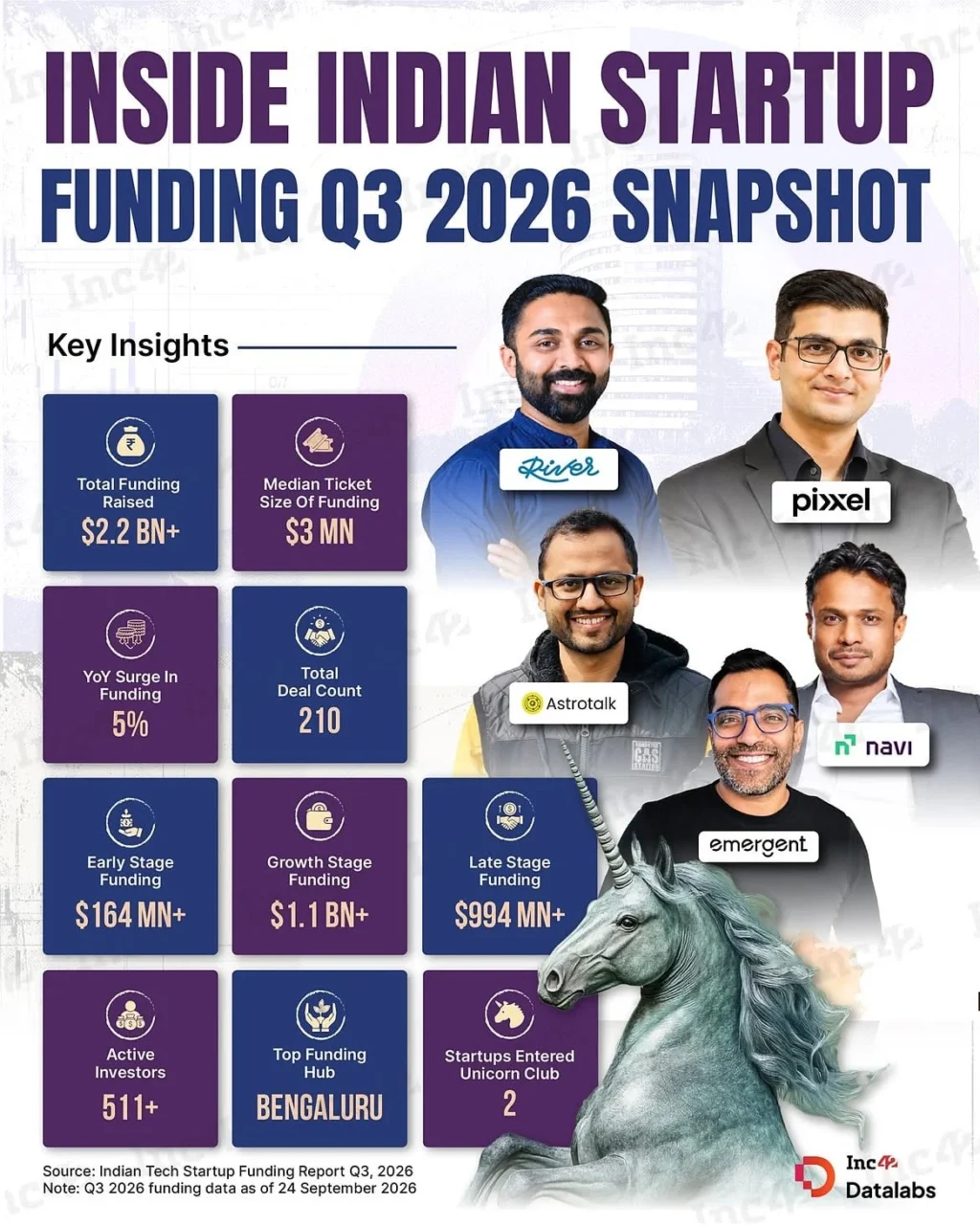
The broader macroeconomic and startup climate reflects a shifting appetite toward deep tech and sustainable innovation. According to recent market data, Indian startups collectively raised upwards of $2.2 billion across 210 deals in Q3 2026, marking a 5% year-on-year increase.
Crucially, the composition of this funding signaled a structural evolution in the Indian startup ecosystem:

- AI and Cleantech Surge: Artificial intelligence and cleantech emerged as the most-funded sectors during the quarter, notably overtaking traditional investor favorites such as fintech and e-commerce.
- Semiconductor Momentum: India’s homegrown semiconductor market is on a steep upward trajectory, projected to burgeon into a $200 billion market opportunity by 2035. This has catalyzed deep-tech startups addressing systemic bottlenecks in hardware development.
Spotlight on DeepTech: circuitEvolve
As the semiconductor wave builds, early-stage innovators are creating specialized tools to capture market share. Founded in 2026, deep-tech startup circuitEvolve is tackling one of the most notoriously sluggish segments of hardware manufacturing: analogue chip design.
Traditional analogue design relies heavily on thousands of simulation runs and manual parameter adjustments, making the process painfully slow, expensive, and difficult to scale. circuitEvolve has introduced an in-house AI layer designed to integrate seamlessly with existing electronic design automation (EDA) software.
- The OPTIM Stack: The startup’s flagship product, OPTIM, operates as a closed-loop system. It simulates circuit parameters, evaluates candidates, and verifies results against target performance constraints. It iterates continuously until the design converges.
- Validation: Claiming compatibility across process-design kits (PDKs) and device libraries, circuitEvolve has successfully validated OPTIM across more than 1,000 devices, positioning itself as a vital co-pilot for analogue chip engineers.
Official Responses and Regulatory Perspectives
The Policy Gap in India
While academic panic mounts, regulatory frameworks are struggling to keep pace. India currently lacks a standalone, comprehensive law governing the use of artificial intelligence in scientific research.
Policy initiatives, such as the Department for Promotion of Industry and Internal Trade’s (DPIIT) proposed 2025 framework, lean heavily toward financial compensation and monetization rights. Legal experts and intellectual property (IP) attorneys have criticized this approach as fundamentally misaligned with scientific research. While revenue sharing suits creators like musicians or digital artists, the primary harm suffered by scientists is the irretrievable loss of academic credit, priority, and professional reputation.
Without explicit legislative protections, Indian scientists who input draft manuscripts, experimental data, or unfiled patents into commercial AI servers face severe risks of proprietary rights erosion.

Institutional Self-Policing and Guidelines
Recognizing the legislative lag, Indian academic and research institutions are moving from passive observation to active institutional policy:
- Restricted Use Cases: Many universities now restrict researchers to using AI strictly for literature reviews, explicitly forbidding the upload of complete solutions, proprietary algorithms, or patentable methodologies.
- Campus Infrastructure: Leading institutes are deploying smaller, open-weight models on local campus servers. This allows researchers to leverage LLM capabilities without exposing sensitive, frontier data to third-party cloud servers where user data control is compromised.
- Responsible AI Charters: Colleges across the country are drafting internal guidelines to mandate secure handling and encryption of unpublished research papers.
Implications for the Future of Research and Industry
The Scientist’s Dilemma: How to Use AI Safely
As generative AI embeds itself deeper into everyday workflows, the scientific community faces a paradox: researchers cannot afford to ignore the productivity gains of AI co-pilots, but they cannot afford to let their guard down regarding data security.
Intellectual property attorneys and technology experts recommend a rigorous compliance protocol for researchers navigating this transition:
- File Provisional Patents First: Scientists must file provisional patents or secure digital time-stamps before feeding any novel methodology or invention into an AI interface.
- Use Enterprise APIs with Non-Training Clauses: Researchers should exclusively utilize API endpoints backed by legally binding, guaranteed non-training clauses that explicitly bar providers from using input data to train future models.
- Maintain Offline Notebooks: Traditional, dated physical or cryptographically secure offline notebooks remain essential for establishing clear timelines of invention in the event of an intellectual property dispute.
Conclusion: A Critical Crossroads
The OpenAI dispute involving Tristan Buckmaster and the Navier-Stokes equations is not an isolated incident; it is a preview of the systemic tensions defining the AI era. As Indian academia formulates ethical guidelines and startups like circuitEvolve redefine what is possible in deep tech, the overarching lesson remains clear. Innovation cannot outpace protection. Until robust legal frameworks catch up with technological realities, researchers, institutions, and tech entrepreneurs must practice vigilant self-policing to ensure that the pursuit of artificial intelligence does not cost them the very credit that defines their life’s work.