Beyond the Hype: Architecting Intelligence in the Age of AI Agents vs. Workflows
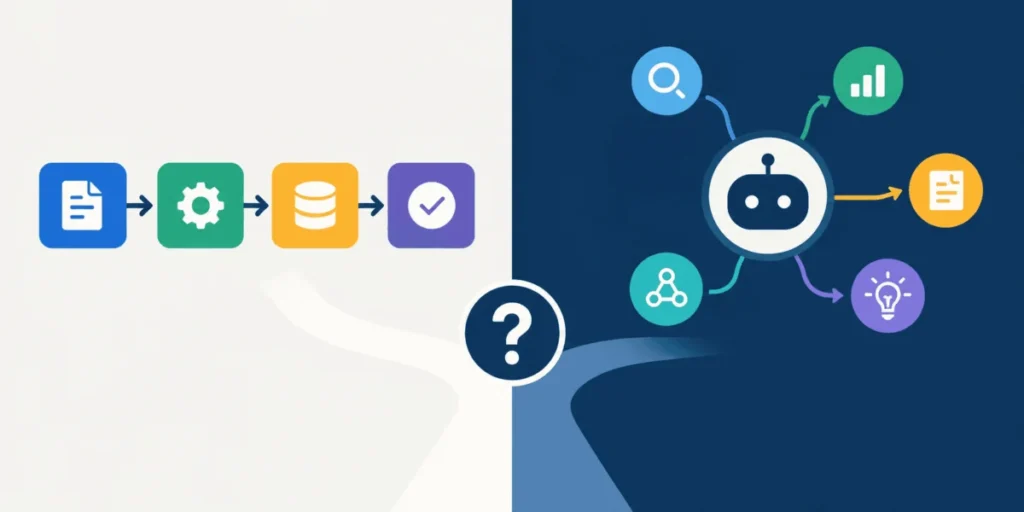
In the rapidly evolving landscape of artificial intelligence, "Agent" has arguably become the most overused term in the industry. Today, a simple chatbot with a few API integrations is labeled an "agent," as is a rigid document-processing pipeline or a basic scheduled automation. This linguistic inflation has led to a widespread architectural crisis: engineers and product managers are increasingly deploying complex, autonomous systems to solve problems that could be handled with significantly more stability and lower cost by traditional deterministic workflows.
Before writing a single line of code, it is imperative to distinguish between these two paradigms. Understanding the fundamental difference between an AI workflow and an AI agent is not just a technical necessity—it is a strategic requirement for building scalable, maintainable, and cost-effective software.
The Core Distinction: Determinism vs. Emergence
To move past the hype, one must define these terms by their control flow.
Defining the Workflow
A workflow (often referred to as a pipeline or chain) is a system where the control flow is established at design time. The developer acts as the architect of the logic, defining the sequence of operations, the branching conditions, and the exit criteria before the system ever executes.
Even when a workflow integrates a Large Language Model (LLM) to perform specific tasks—such as summarizing a document or classifying an email—it remains a workflow. The LLM acts as a component within a predetermined, predictable path. The developer knows exactly what comes before and after the LLM call.
Defining the Agent
An agent represents a paradigm shift where the control flow is handed over to the model at runtime. The agent is provided with a high-level goal and a set of "tools" (APIs, calculators, database queries). The LLM then decides—based on its internal reasoning—which tool to invoke, in what sequence, and whether to continue or terminate the task.
The defining characteristic of an agent is its ability to handle ambiguity through iterative cycles: observation, thought, and action. Unlike a workflow, which follows a map, an agent is navigating via compass and local terrain.
Chronology of an Architectural Decision
The evolution of AI development has moved from static prompting to sophisticated orchestration. Understanding how we arrived here helps in deciding which path to take.
- The Era of Single Prompting (2022): Developers treated LLMs as black-box completion engines. If the output was wrong, the prompt was adjusted.
- The Rise of Chains (2023): Developers realized that single prompts were insufficient for complex tasks. Frameworks like LangChain introduced the concept of chaining—linking multiple LLM calls together in a sequential manner.
- The Agentic Explosion (2024–Present): With the introduction of ReAct (Reasoning and Acting) patterns, the industry pivoted toward autonomous agents. While powerful, this shift led to the "agent-everything" trap, where developers began treating simple tasks as complex agentic problems.
Supporting Data: Why Complexity is a Liability
The assumption that "Workflow = Simple" and "Agent = Sophisticated" is a dangerous misconception. In reality, complexity is a multiplier of technical debt.
The Cost of Autonomy
Agents are inherently more expensive to operate. Because they rely on iterative "Chain of Thought" reasoning, an agentic task often consumes significantly more tokens than a workflow. For instance, a task that requires a simple classification could be done in one LLM call. An agent, however, might engage in five "thought-action-observation" loops, increasing the cost by 500% and latency by orders of magnitude.
Reliability and Predictability
In enterprise environments, auditability is paramount. If a system makes a decision—such as denying a loan or flagging a fraudulent transaction—the organization must be able to trace the decision-making logic. In a workflow, the path is documented and deterministic. In an agentic system, the path is often "emergent," meaning it may vary based on the specific prompt and the state of the tools at the time of execution. This non-determinism is a significant risk for regulated industries.
The Practical Test: The Whiteboard Metric
Before architecting any AI-driven feature, apply the "Whiteboard Test."
The Question: Can you draw a complete, functional flowchart of the task before the LLM ever runs?
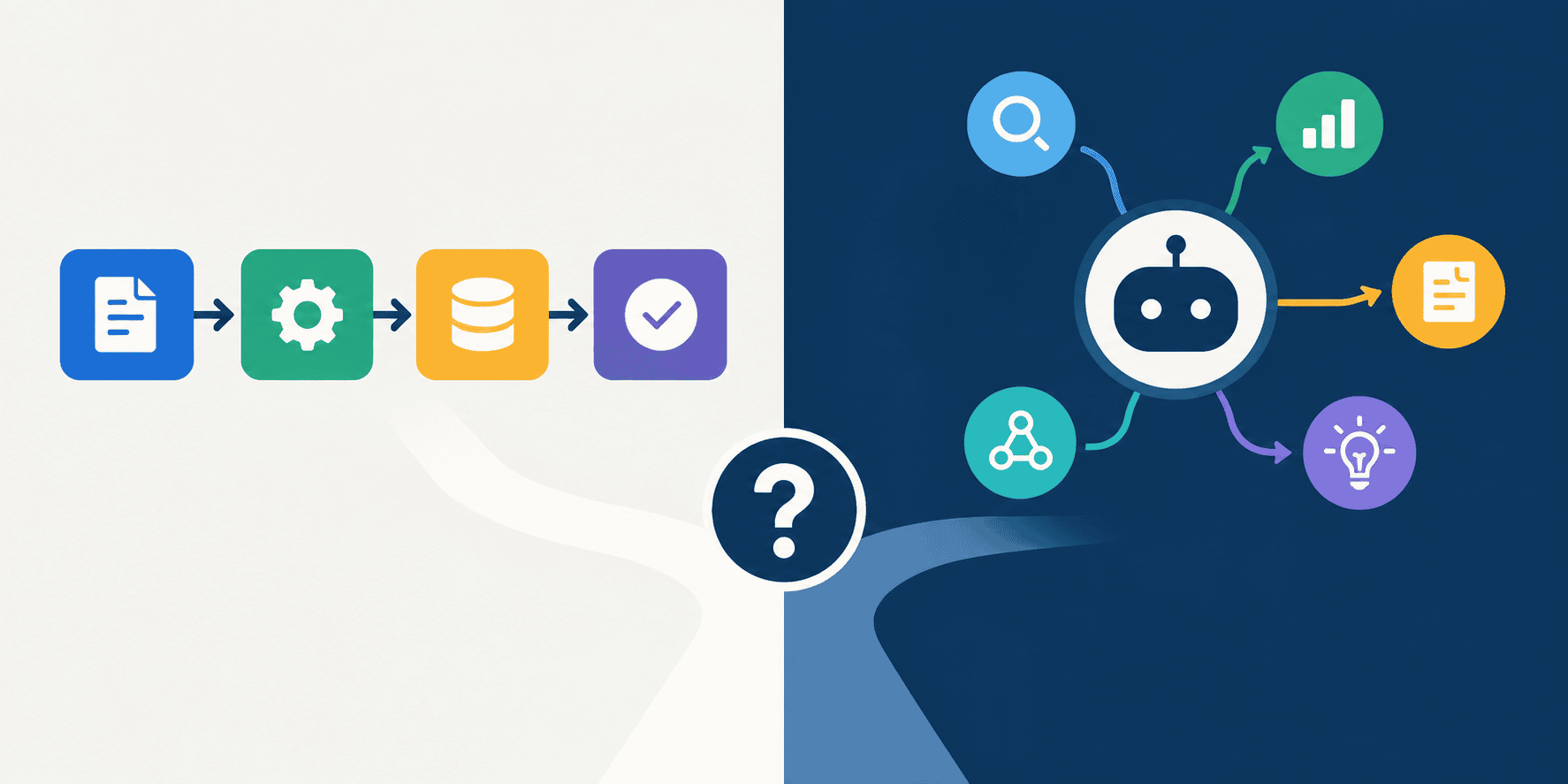
If you can map out the steps, branches, and decision points on a whiteboard, you have a workflow. You do not need an agent. The "extra flexibility" of an agent is often a liability rather than an asset. Agents excel when the state space is so vast or unpredictable that no human could reasonably map all possible outcomes. If the problem space is constrained, a workflow with LLM-based decision nodes is almost always the superior engineering choice.
A Comprehensive Checklist for Builders
Before moving from concept to code, evaluate your use case against the following criteria:
1. Can you define the steps beforehand?
If you are extracting data from a contract, your steps are linear: Read document, extract fields, validate schema, store in DB. This is a classic workflow. The LLM is just a tool in the pipeline.
2. Is the input variability manageable?
If the inputs are routine (e.g., customer support tickets), a fixed decision tree with LLM classification is more maintainable than a "general-purpose" agent that might hallucinate a path for a simple inquiry.
3. Are you sensitive to volume and latency?
High-volume applications require predictable performance. Agents, by design, introduce "reasoning latency" that can degrade the user experience. If your application needs to respond in under a second, an agent is rarely the right choice.
4. Is compliance a requirement?
Audit logs are easy to maintain in a workflow. When you need to explain why an AI made a decision to a regulator, a hard-coded workflow is your best defense.
5. Have you exhausted the "Workflow + LLM" pattern?
Before jumping to autonomous agents, attempt to solve the problem by creating a rigid workflow where the LLM is only called to perform specific, isolated judgments (e.g., "Is this text a complaint? Yes/No"). This hybrid approach often provides 90% of the benefit of an agent with 10% of the complexity.
Strategic Implications: Building for Sustainability
The "Agent" hype cycle is a symptom of a broader trend: the desire for "magic" solutions. However, the most successful AI products in the market today are not those that use the most autonomous agents; they are those that use the right amount of AI to solve specific, well-defined problems.
The Future of Hybrid Architectures
The industry is beginning to converge on Hybrid Systems. These systems use workflows for the "plumbing"—handling data, API calls, and logic—and reserve agents for the "intelligence"—the specific, bounded tasks that require reasoning.
For instance, an e-commerce platform might use a deterministic workflow to process an order (cart check, payment, shipping). It might then deploy an agent only for the "Customer Advocacy" module, where the agent is allowed to search internal policies and interact with the user to resolve a complex, non-standard dispute.
Conclusion: Start Constrained
The best advice for developers is to build like an engineer, not a dreamer. Start with the most constrained, deterministic workflow possible. Measure the points where that workflow fails or becomes too brittle. Only then, once you have identified the specific "bottleneck" where logic cannot be easily hard-coded, should you consider injecting an agentic component.
By prioritizing workflows over agents, you are not just saving on token costs and latency—you are building systems that are robust, debuggable, and ready for the rigors of production. Remember: If you can draw the flowchart, start with a workflow. If the path must be discovered in real-time, consider an agent.