The Architecture of Intelligence: Navigating the RAG vs. Fine-Tuning Divide
In the rapidly evolving landscape of 2026, the question of how to best adapt Large Language Models (LLMs) to specific enterprise domains has moved from a niche research interest to a mission-critical boardroom discussion. The prevailing debate—often framed as a binary choice between Retrieval-Augmented Generation (RAG) and fine-tuning—is increasingly viewed by industry experts as a false dichotomy.
Recent analysis of production LLM deployments indicates that approximately 60% of sophisticated systems now utilize a hybrid approach. This shift is not a result of indecision; rather, it reflects a growing maturity in understanding that RAG and fine-tuning address fundamentally different technical requirements. To build a robust production system, architects must move beyond the "either/or" mentality and embrace a framework that treats these methods as complementary components of a unified intelligence strategy.
The Mechanical Divide: How They Work
To understand when to employ these techniques, one must first deconstruct the mechanics of how LLMs process information and behavior.
The Mechanics of RAG: Knowledge as a Service
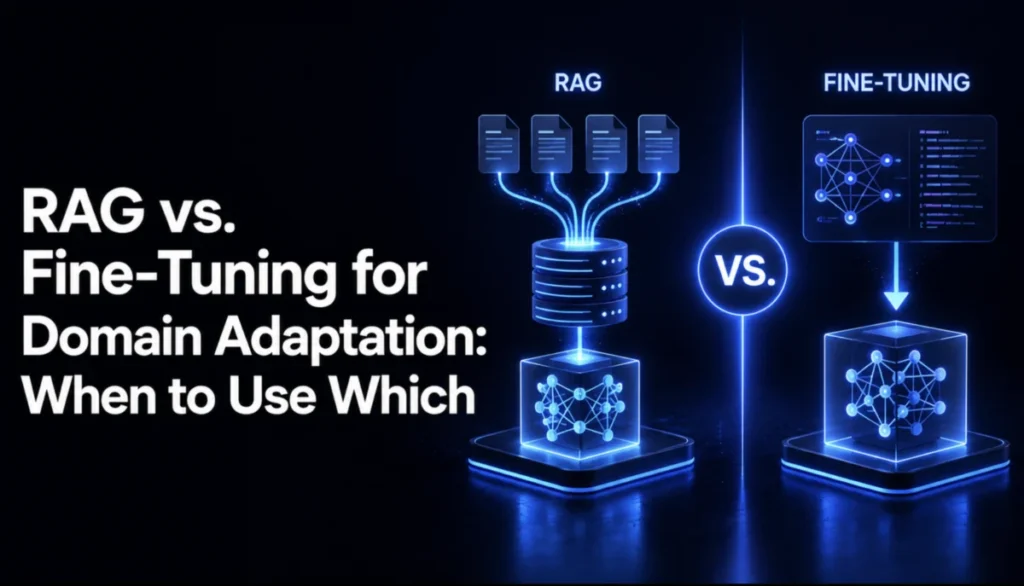
Retrieval-augmented generation functions as an external library for the model. Crucially, RAG does not modify the underlying model weights. Instead, it operates during the inference phase. When a user submits a query, the system performs a search across a proprietary knowledge base, retrieves the most pertinent documents, and "injects" them into the model’s context window.
The LLM then acts as a reasoning engine, synthesizing the provided context to answer the user. This makes RAG the gold standard for dynamic data environments—where information is large-scale, frequently updated, or requires verifiable citations for regulatory or debugging purposes.
The Mechanics of Fine-Tuning: Shaping Model Behavior
Fine-tuning represents a structural alteration to the model itself. By training the model on specific input-output pairs, developers adjust the neural weights to bake in a desired pattern, tone, or output structure.
Modern approaches, such as Low-Rank Adaptation (LoRA) and its quantized variants (QLoRA), have democratized this process. By training only a small adapter—often accounting for less than 1% of the model’s total parameters—organizations can achieve specialized behavior for a fraction of the cost and time of traditional full-model retraining. However, it is essential to emphasize that fine-tuning is a tool for behavioral consistency, not a reliable mechanism for knowledge injection.
Chronology of the Debate: From "Full Retraining" to "Hybrid Adapters"
The trajectory of this technology has moved rapidly:
- 2023: Early adopters attempted to force-feed models knowledge via full fine-tuning, leading to "hallucination-prone" models that were expensive to maintain and difficult to update.
- 2024: The industry pivoted toward RAG as the primary solution, recognizing that large-scale knowledge retrieval was more efficient and accurate than weight-based memorization.
- 2025: As production systems matured, developers encountered "behavioral drift"—models that could find the right information but failed to format it consistently or maintain the required corporate tone.
- 2026 (Present): The current consensus emphasizes a layered architecture. RAG provides the grounding (factual content), while fine-tuning provides the scaffolding (formatting, taxonomy, and stylistic guardrails).
Supporting Data: Why Factual Recall Fails in Fine-Tuning
A critical, frequently misunderstood point in the AI community is the limitation of fine-tuning for factual storage. Empirical testing consistently shows that models fine-tuned on dense, specialized literature (such as medical or legal corpora) do not "learn" the facts in a way that allows for reliable retrieval.
When queried, these models are prone to "confabulation"—a phenomenon where the model reconstructs a plausible-sounding fact from its internal statistical associations rather than accessing the literal source material. In contrast, RAG systems allow for explicit tracing. When a system provides an answer backed by a citation (e.g., [Source: Runbook-ID-001]), it transforms the LLM from a "black box" into an auditable assistant. This auditability is not just a feature; in sectors like finance or healthcare, it is a non-negotiable requirement.
Real-World Implementation: Case Studies
Case Study 1: The Incident Response RAG System
An engineering team tasked with managing incident runbooks requires a system that reflects daily changes in infrastructure.
- The Approach: The team implements a TF-IDF or vector-based retrieval index that chunks technical documentation by sentence boundaries to preserve context.
- The Result: By using a system prompt that mandates answering only from retrieved sources, the system achieves 99% accuracy in citing runbook procedures. Because the documents are modular, updating the "knowledge" is as simple as updating a text file—no training required.
Case Study 2: The Financial Taxonomy Fine-Tuning System
A financial services firm needs to categorize millions of customer complaints into a rigid, internal taxonomy (e.g., BILLING_DISPUTE, CARD_FRAUD_SUSPECTED).
- The Approach: System prompts alone proved insufficient to prevent the model from deviating from the strict JSON output format required by the ticketing backend. The team utilized LoRA to train an adapter on a small, curated set of 500 perfectly labeled examples.
- The Result: The model internalizes the required JSON schema and output logic. The "behavior" is now inherent, reducing latency and error rates across millions of transactions, while factual knowledge about the customer remains separate and handled via database lookups.
Implications for Production Systems
The decision to implement one or both of these technologies carries significant operational implications.
Infrastructure Requirements
RAG necessitates a robust data pipeline: document ingestion, chunking, embedding, and a vector database. It requires high-speed connectivity to data stores and efficient retrieval algorithms. Fine-tuning, conversely, demands GPU compute power during the training phase, but the resulting inference is often faster and more predictable because the "logic" is baked into the model’s weights.
The "Cost of Truth"
In a RAG-based system, the "cost of truth" is the latency of the retrieval call and the token usage of the context window. In a fine-tuned system, the cost is the upfront training and the technical debt of maintaining an adapter that may need to be retrained if the output taxonomy changes.
A Concrete Decision Framework
To determine the path forward for your organization, follow this diagnostic:
- Does the information change frequently?
- Yes: Use RAG. (Updating weights is too slow/expensive).
- Is the output format or tone strictly governed by internal standards?
- Yes: Use Fine-Tuning. (Prompting is too brittle for consistent structure).
- Is the accuracy of the answer verifiable against a source?
- Yes: Use RAG. (Fine-tuned models hallucinate facts).
- Is the system failing to follow instructions despite clear prompting?
- Yes: Use Fine-Tuning. (The model needs a behavioral shift).
Conclusion: The Path Toward Hybridization
The most successful AI deployments of 2026 are not built on one technique, but on the intelligent combination of both. RAG serves as the foundation for truth and freshness, while fine-tuning provides the specialized behavior and consistency required for professional-grade software interfaces.
Start with RAG. It is the fastest path to a functional, auditable prototype. Only once you have established a reliable knowledge pipeline should you consider fine-tuning to refine the model’s behavioral traits. By separating the what (the knowledge) from the how (the behavior), organizations can build systems that are not only accurate but also scalable, maintainable, and, most importantly, trustworthy.