The Fission Frontier: How Nuclear Reactors on the Moon Spark a New Geopolitical Space Race
By Global Science & Geopolitics Correspondent
As humanity stands on the precipice of establishing a permanent foothold on another celestial body, the race to the lunar south pole has transcended simple exploration. It has evolved into a high-stakes technological and geopolitical competition. At the center of this new space race is a formidable power source: nuclear fission.
Space agencies across the globe are aggressively developing microreactors to sustain long-term lunar operations. However, this push for atomic energy is driven as much by the harsh realities of lunar physics as it is by a frantic land grab for the most valuable, resource-rich real estate on the Moon.
Main Facts: The Nuclear Power Play on the Moon
The United States, Russia, and China are locked in a parallel pursuit to industrialize the lunar surface. By the end of this decade, NASA aims to install a 20-kilowatt (kW) nuclear fission reactor near the Moon’s south pole by 2030—a power output roughly equivalent to the energy needs of a few households on Earth. Meanwhile, Russia is collaborating with China on a planned nuclear reactor for the International Lunar Research Station (ILRS), designed to produce approximately 10 kW.
While these energy yields may sound modest compared to terrestrial power plants, their deployment is groundbreaking. Unlike solar panels, which are rendered useless during the punishing two-week lunar night, nuclear reactors provide continuous, uninterrupted power regardless of sunlight.
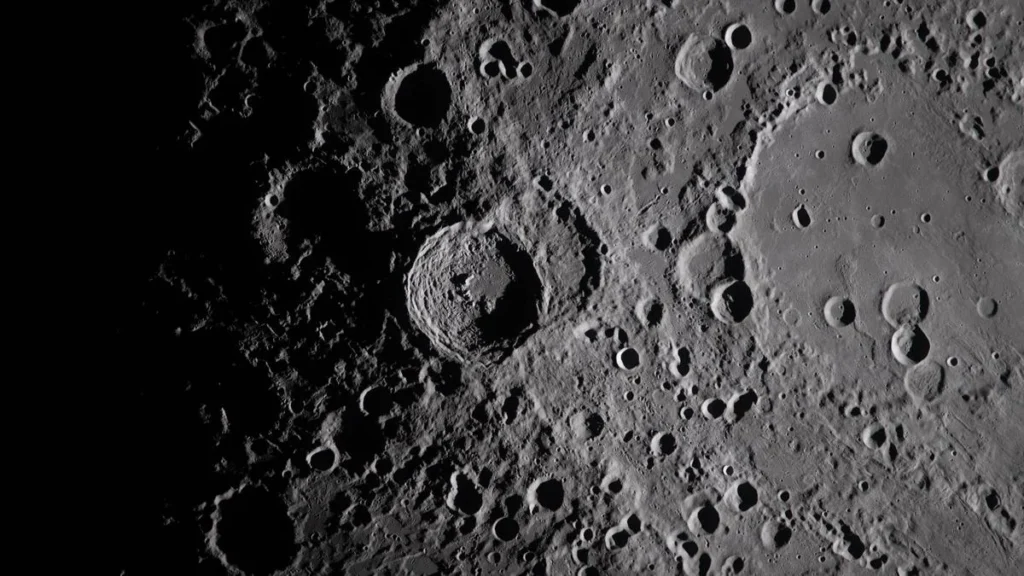
This independence from solar cycles is vital for humanity’s next giant leap. Both U.S. and Chinese factions are concentrating their activities near the lunar south pole—a region characterized by high peaks of eternal or near-eternal light flanking permanently shadowed craters where temperatures plunge below a frigid -200°C.
These deep, ultra-cold craters preserve vast deposits of water ice. This ice is the ultimate lunar Swiss Army knife: it can be melted and purified to quench astronauts’ thirst and electrolyzed to manufacture hydrogen and oxygen. Together, these elements serve as high-performance rocket propellants, turning the Moon into a literal gas station for deep-space exploration.
However, extracting and processing these resources at an industrial scale requires immense amounts of energy. According to a 2000 NASA assessment by scientists Julie Kleinhenz and Aaron Paz, producing just 10 metric tons of oxygen via electrolysis requires roughly 68 kW of power. Consequently, the initial 20 kW reactors are merely stepping stones toward an eventual grid of small reactors designed to power full-scale lunar mining and manufacturing operations.
Chronology: From Sci-Fi Concepts to 2030 Deadlines
The journey toward lunar nuclear power spans decades of theoretical physics, shifting political mandates, and accelerating engineering timelines:
- 1960s–1970s (The Cold War Genesis): Both the Soviet Union and the United States briefly experimented with space-based nuclear reactors (such as the Soviet SNAP-10A and U.S. SNAP-10A/RIM-FS systems), but the technology was largely shelved due to high costs, political treaties restricting orbital weapons, and safety concerns.
- 2020 (The Resource Awakening): NASA formally re-evaluates the power requirements for in-situ resource utilization (ISRU). Studies by researchers like Kleinhenz and Paz underscore that solar power alone cannot scale to meet the energy demands of heavy industrial processing, cementing the need for fission surface power.
- 2022–2023 (The Artemis Acceleration): NASA and the Department of Energy select commercial contractors to design a 40-kilowatt-class fission surface power reactor, with a targeted demonstration on the lunar surface by the end of the decade. Simultaneously, China and Russia formalize their joint roadmap for the International Lunar Research Station (ILRS), explicitly integrating nuclear power sources into their timeline for the 2030s.
- Late 2023–2024 (Geopolitical Friction): NASA leadership publicly warns that China is engaged in a terrestrial land grab under the guise of scientific research, heightening urgency within Western space agencies to secure optimal lunar sites.
- 2030 (The Current Target): NASA’s planned deployment window for its first operational lunar fission reactor, setting the stage for permanent human habitation and industrial-scale resource extraction.
Supporting Data: The Physics and Logistics of Lunar Fission
Deploying a nuclear reactor on the Moon involves staggering engineering hurdles and strict mathematical parameters. Space agencies must balance the high energy density of fission against the prohibitive costs and hazards of space logistics:
- 20 Kilowatts: The baseline power output of NASA’s planned lunar reactor, sufficient to power a small terrestrial cluster of homes or support a modest crewed outpost.
- 68 Kilowatts: The estimated power required to produce just 10 tonnes of liquid oxygen through the electrolysis of lunar water ice, highlighting the massive energy deficit solar arrays face.
- -200°C: The extreme cryogenic temperatures found within the permanently shadowed craters of the lunar south pole, where water ice is preserved.
- 1 Kilometer: The recommended safety distance advised by NASA-commissioned research for situating a nuclear reactor away from human habitation zones, drastically limiting the footprint of ideal base locations.
- Unirradiated Core: The mandatory state in which reactor fuel must be launched from Earth to prevent catastrophic radiological hazards during atmospheric ascent, meaning activation and criticality must be achieved entirely on the lunar surface.
Furthermore, the logistical chain is immense. Engineers must design systems capable of launching massive shielding components or leveraging in-situ materials (like lunar regolith) to block radiation. Once operating, the reactor core must reject massive amounts of waste heat into the vacuum of space, requiring sprawling radiator arrays that must be meticulously engineered to resist abrasive, electrostatically charged moondust.
Official Responses: International Law, Safety Zones, and Geopolitics
The most volatile dimension of lunar nuclear power is not technological—it is legal and geopolitical. The rush to secure the best sites on the Moon has created a regulatory gray area fraught with tension.
Under the landmark Outer Space Treaty of 1967, international law explicitly forbids any nation from appropriating celestial bodies through national sovereignty, occupation, or any other means. No flag planted in the lunar dust can claim ownership of sovereign territory.
However, a modern legal framework has complicated this consensus. The Artemis Accords—a U.S.-led framework signed by dozens of partner nations—introduces the concept of temporary "safety zones." These zones are legally justified as practical measures to prevent harmful interference between competing operations.
Critics and geopolitical rivals, however, view these safety zones as a legal loophole. As space law experts point out, a nation does not need to stake a territorial claim to dominate a region; it can simply place a nuclear reactor, a landing pad, or a mining facility at a strategic choke point and invoke international safety regulations to restrict access to surrounding terrain.
Because the lunar south pole features a very limited number of ideal locations—sites combining high solar exposure, flat landing terrain, and access to ice-filled craters—the stakes are exceptionally high.
NASA Administrator Bill Nelson has repeatedly voiced concerns over China’s lunar ambitions, stating publicly that the U.S. is locked in a direct race with Beijing to secure the scientifically and economically vital "best parts" of the Moon.
Conversely, Chinese space officials and international legal scholars maintain that China’s ILRS program operates transparently under multilateral scientific cooperation, accusing the West of weaponizing space exploration narratives to protect geopolitical dominance. Meanwhile, European nations and the United Kingdom are quietly advancing their own microreactor studies, desperate to avoid being left out of the infrastructure network that will define the lunar economy.
Implications: The Dangers of a Premature Nuclear Rush
While nuclear power is indisputably necessary for a mature, self-sustaining lunar economy, the current trajectory carries profound systemic risks.
At present, no spacefaring nation possesses a mature lunar economy. There are no thriving space-based manufacturing sectors, no massive commercial consumer bases, and no active propellant refineries operating at scale. Yet, governments are feeling immense, politically driven pressure to install nuclear reactors first—simply to beat their geopolitical rivals to the punch.
This "rush-to-install" mentality introduces severe hazards:
- Contamination Risks: If a nuclear reactor suffers a mechanical or structural failure during deployment or operation on the Moon, it risks permanently contaminating the very few habitable and resource-rich locations astronauts desperately need to access. Unlike Earth, the Moon has no atmosphere or biosphere to buffer radiological accidents, and the lack of weathering means radioactive fallout could persist indefinitely.
- Militarization of Lunar Infrastructure: By weaponizing safety zones around nuclear installations, superpowers could effectively cordon off critical access routes to water ice and sunlight, turning scientific bases into de facto military checkpoints.
- Escalation on Earth: Competition over scarce lunar real estate risks translating into terrestrial diplomatic friction, straining international cooperation frameworks at a time when space governance is more fragile than ever.
Conclusion
The dawn of lunar nuclear power represents an extraordinary triumph of human ingenuity. Fission reactors will undoubtedly illuminate the dark craters of the south pole, melt the ancient ice, and fuel the rockets that carry humanity deeper into the cosmos.
Yet, as the United States, China, and their respective allies race to emplace the first atoms of fission energy on the lunar surface, the true test will not be whether the reactors work. The test will be whether humanity can manage the geopolitical terrestrial baggage it carries into the stars, ensuring that the Moon remains a domain for peaceful scientific discovery rather than a theater for terrestrial conflict.